
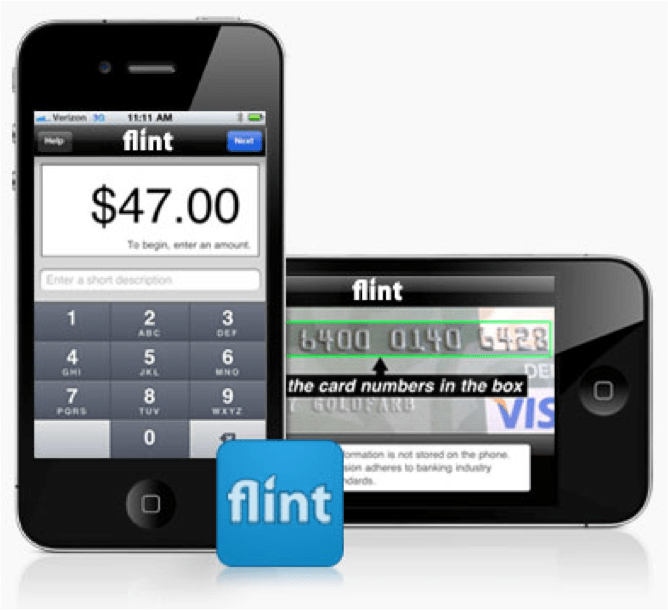
Flint, a small business-focused mobile payment app that does away with dongles and NFC and instead uses the camera on a phone to “scan” a card’s numbers, has come out of beta. The iOS 6/ iPhone 5-compatible app is now available to download in the U.S. App Store.
In development for the last 18 months, Flint first launched as an invite-only service in May 2012, at the same time that it announced $3 million in funding from True Ventures and Storm Ventures.
Like Square, PayPal’s here, Sail from Verifone and others, Flint is targeting merchants that, traditionally, have been considered too small to accept card payments, because they do not have a high enough volume of transactions to justify the processing fees and card-reading equipment. Flint says that there are some 17 million businesses in the U.S. alone that fit this profile.
Unlike Square, here and Sail, Flint doesn’t rely on any hardware to do the job, other than what is on the mobile phone itself. That means that future-looking solutions like NFC — the basis for payment solutions from the likes of Isis — are also not necessary for Flint to work today. After a card’s vital numbers are scanned and digitized — the numbers are sent to Flint without being stored on the device — the payment is then authenticated with a zip code and on-screen signature.
In its beta phase, Flint says that it’s already been picking up some decent momentum. It’s had about one thousand merchants from all 50 states sign up to use the service, including photographers, therapists, consultants, fitness trainers, IT professionals and tradespeople. Flint is not yet releasing total merchant numbers or transaction volumes on the app. But Greg Goldfarb, co-founder and CEO of Flint Mobile, says that average transaction size was higher than expected, at “well over $100.”
“We feel this reflects the user base being professional service types, consultants, etc. instead of the typical retail merchant (coffee shops, etc.) that Square is in,” he added.
“Flint’s mission is to empower everyday small business users who are out and about and who are underserved by other solutions,” said Goldfarb in a statement. “We’ve worked very closely with our beta users to develop a compelling app and are excited to make it available to a broader audience.”
Apart from not requiring a dongle to work, Flint is hoping to compete against more established mobile payment startups by offering some other advantages. For starters, its commission structure charges 1.95% plus $0.20. Credit card users pay 2.95% plus $0.20. By comparison, Square charges 2.75 percent per swipe. (Manually-entered cards cost 3.5 percent plus $0.15 with Square.) Merchants can activate the service through the app itself, rather than needing to register online.
It’s also offering some services around the transactions themselves. These include social marketing — customers can share business reviews and recommendations on Facebook after making a payment; those can also get posted to a business’ Facebook page. Flint also lets businesses customize receipts, create loyalty offers, program a range of pricing options/menus and include sales tax and tipping. And finally, Flint also offers a kind of online “dashboard” of sorts, where merchants can get an overview of all transaction activity, although there doesn’t seem to be much in the way of analytics around those transactions yet.
For now, the app is iOS-only, but like its competitors, it’s likely that Flint will be rolling out for other platforms soon, and potentially could even work on non-smart devices, given that most feature phones are also equipped with cameras. Goldfarb says that Android is next up with an app coming out in early 2013.
And given that the solution is software-based, you could also see a time when Flint might also consider how it can create an API to embed its service directly into business’ own apps. Indeed, this is something that Flint is already considering. “We are indeed in discussions with a number of potential integration partners,” says Goldfarb. “From an overarching point of view we built the platform with potential to embed or white label the solution for partners.”






















Comment