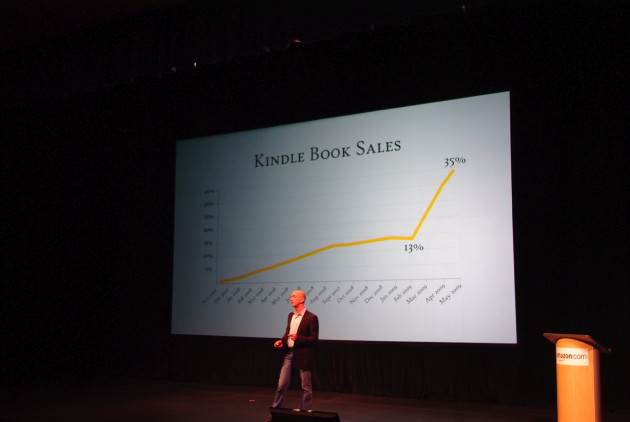
The most startling thing Jeff Bezos said today at Amazon’s launch of the Kindle DX, it’s large-format Kindle optimized for textbooks and newspapers, was this statistic: For books that are available on the Kindle, sales are already 35 percent of the same books in print, up from 13 percent just a few months ago. In other words, if a paper book sells 10,000 copies on Amazon, it will sell an additional 3,500 digital copies on the Kindle. Let me repeat that, digital books via the Kindle are selling at 35 percent the level of physical books 18 months after launch.
That is an amazing ramp up. The Kindle now has 275,000 titles, most of them are the “head” titles that most likely make up the bulk of Amazon’s total book sales. So how much of Amazon’s book sales are now digital? I tried to ask a few Amazon execs here at the press conference, but they won’t say. It is no doubt a huge number. Amazon sells $2.7 billion worth of “media” every quarter, which includes books, music, and movies. Books is still one of its largest categories, if not the largest. Let’s say Amazon sells $1 billion worth of books every quarter. And its top 275,000 titles represent 80 percent of sales. Kindle book sales alone would amount to $280 million ($1.1 billion a year), and that would not include the cost of the device. See correction below.
I am making these numbers up, but even if you change it to 50 percent, Kindle book sales would be trending at $175 million a quarter ($700 million a year). The Kindle might turn out to be Amazon’s biggest growth business yet.
Correction: After I posted this, I tried to verify the numbers once again. The 35 percent refers to the number of titles or units sold, not revenues, and is indeed additive. So let’s take the example above again. If 10,000 copies of a book are sold in physical form, and another 3,500 in digital form that is a total of 13,500 copies sold. The Kindle portion selling at 35 percent the rate of physical titles, but represents 26 percent of the total. (Showing it as a percentage of print books rather than as a percentage of the total sales makes for a better slide).
So let’s take this new number, 26 percent, and apply it to my assumptions above. At 80 percent of sales, instead of $280 million a quarter, it would be $208 million (26% of $800M). At 50 percent, it would be $130 million (26% of $500M).
But there is one more step. You also have to take into account the fact that Kindle books are cheaper than paper books, at least for new titles. A new title on the Kindle sells for $9.99, compared to $24.99 for a hardcover book. You have to factor in paperback books also, which tend to cost about $10 for more recent titles. So there is some discount. For the sake of argument, let’s say it averages to about a 50 percent discount. That would cut the revenue numbers down in half again to $104 million and $65 million, respectively. On an annualized basis, that comes to somewhere between $520 million and $260 million in Kindle book revenues (again, this does not include device revenues).
The numbers change based on what assumptions you plug in, but as a point of comparison, Citi analyst Mark Mahaney is estimating Kindle book sales of only $189 million this year, going to $612 million in 2010 (with total Kindle-related sales of $1.2 billion in 2010, if you add in device sales). At the very least, it looks like Amazon is well on track to meet Mahaney’s estimates, and may be ahead of them already.





That isn’t an amazing statistic. The 35% is for Amazon sales. Since the only place you can buy a e-book for the Kindle is through Amazon, and I assume people buy books in print at places other than Amazon, the statistic isn’t that meaningful.
It’s pretty impressive to me.
Actually you can get Kindle books at a lot of places, Baeen books has a very large FREE library of Kindle format books and other publishers are putting older titles up for free also.
They should call it rentals, because you’re not buying anything and it’s DRMed.
Amazon should scan all out of date books and sell them on the Kindle and actually make money and give percentage to copyright owners vs. just steal it like google does.
this is incredible – we live in truly”exponential” times… the kindle may be the most amazing device released in the last 10 years… i am ready to back that up btw
> the kindle may be the most amazing device
> released in the last 10 years
hahahaha. I needed a good laugh.
The kindle is a freaking dorky piece of junk. But all the Amazon stockholders (sure, you aren’t one, right?) or Amazon astroturfers are out in force trying to push this POS on us.
I agree that Kindle will significantly help authors sell more books (with instant delivery), but some authors don’t have their books out on Kindle (hint, hint Dan Schawbel, author of Me 2.0 – Build a Powerful Brand to Achieve Career Success)
Some authors don’t have their books on the Kindle because either they or the publishers don’t want to, it’s not an Amazon decision. If I can convert documents to a format that the Kindle can read on my computer (via mobi) or by emailing it to Amazon, I don’t imagine it’s that hard for any author to do the same.
“For books that are available on the Kindle, sales are already 35 percent of the same books in print. In other words, if a paper book sells 10,000 copies on Amazon, it will sell an additional 3,500 digital copies on the Kindle.”
Is that what it means, or does it mean if 10,000 books are sold, 6,500 are in paper format and 3,500 are in Kindle format? Are Kindle sales 35% of total sales, or just 25% as you stated?
I had the same question. I think it is the former ie 3500 + 6500 = 10000 rather than 10,000 + 3500.
Percentages like these are usually reported as percentage of total.
It is closer to 25%. Updating the post to make it clearer.
I am a Kindle skeptic but that is actually an impressive stat.
When you factor in the margin on these books vs their print counterparts, this is amazing news for book publishers.
Sorry – I need a little more clarification…..Are these “Extra” sales i.e. if they sold N copies of Book X in Dec 2007 are they still selling N but 25% are Kindle or are they selling N+25%?
Something seems amiss. If the number stated in the article were actual financials, then Amazon should be heavily subsidizing Kindle sales. Looking at the hardware and pricing IMHO that is not the case (unless the eInk screens are super expensive).
Something seems amiss about how happy Aamazon is always purporting to be re: Kindle. They never give definitive number re: unit sales. It is only “…greatly exceeding out most optimistic projections.” Well if you optimistically projected 1K unit and sold 10K, that’d be huge win **relative to forecast**.
Apple has never shied away from providing clear and specific numbers re: iPhone. In fact, at time zero, Jobs even provided a forecast of how many units they expected to sell in the upcoming year (given some confusion about what “a year” meant). Since then, nothing but transparency about unit volumes, app volumes, iTunes sales, etc.
Memo to all. Without transparency, higher risks must be assigned. Amazon may be redefining the book market with Kindle, but I am going to discount that statement heavily unit real unit volumes are provided.
The implications of this device are well beyond the issue of price. Education publishing is a massive business. With this move, Amazon can have an impact on the business and profitability of the main players in the market: Pearson, McGraw Hill and others and to a smaller extent of the newspaper industry. Eventually, many titles will be available only online with clear cost savings on production, storage and distribution. And Amazon is now position to be the gatekeeper of that space.
This is potentially bigger than iTunes.
The price of the device will be subsidized and then will reduce over time anyway.
Way to go Amazon!
I see the kindle as having a huge impact on the future of our print media, especially with the larger screen design. And this news link http://www.newsy.com/videos/will_new_kindle_dx_change_reading/ says that Amazon made a deal with textbook companies that would give them access to 60% of the textbook market. Now the question starts to become, what will people prefer more?
There may not be a choice. As somebody mentioned above, and I agree with, a lot of college text books will not be available printed soon. As it is, the prints runs are very small, at some point it will not be economical to make even smaller runs as more and more people use devices like the Kindle.
you guys have no idea of how the college text market works.
given the increasing pressure that faculty/profs are starting to see regarding costs of textbooks, there’s no way a prof would ever look at a book that’s only on the kindle.
this isn’t to say that the faculty wouldn’t look at an ‘ebook’, simply that the kindle can’t just be the only method of viewing… the committee/prof that makes the decision would demand that any book they wanted to use, be able to be seen/viewed in multiple formats, electronic (for kindle/pc/etc…) or to even be printed out at the local kinko’s!!
-peace
University of Phoenix is already all digital with regards to textbooks. You pay a set fee and all books and library is available on your computer. No hard copy textbooks. I also just bought a Kindle more for reading while traveling instead of lugging books around or buying books at the airport bookstore when I finish my books I brought.
This is just the beginning stage of this type of product.
One other consideration beyond the revenue is the potential cost structure advantage. I’d be curious to compare the cost structure of supporting e-distribution of the books via Kindle (servers, people, Sprint) verses the physical warehousing (people, space, racks, etc., etc.). Granted there is the fee they are paying to Sprint, but I am sure they got a deal given the carrier’s current condition…
When will the Kindle get cracked? Is it possible?
Bear in mind that Amazon also offers a print on demand service, for those people who like their books the old fashioned way.
Their overall cost structure is revolutionary for this business, and if, as is expected, the cost and speed of print on demand drops, it’ll be even more disruptive.
What Amazon is doing is nothing short of cornering the whole book publishing industry. If they figure out how to partner with Google, it’s all over.
and again…
all the kindle/amazon could ever be would be another distribution channel.. given anti-trust issues, amazom could never ‘force’ the college textbook publishers into a ‘offer they can’t refuse’!
however, amazon could in theory look to become an actual publisher of textbooks.. which would then allow them complete control over the ability to set the price for the text/book/content on their device…
amazon doesn’t need to force anybody to do anything.
all they need to do is offer the combination of distribution that they can get with digital/kindle and analog/book. Combine that with Amazon’s natural access to high quality content, and that’s a winning combination.
The only thing Amazon needs to “enforce” is that books intended for distribution on Kindle, follow Amazon’s publishing standards, in order to work correctly in Kindle itself. From there, it’s a small step to paper.
You hit the point that Amazon will become a publisher itself. Amazon’s new model offers authors the ability to bypass traditional publishers, and can entice them with the prospect of higher royalties (but no advances) and better promotion than traditional publishers offer in general.
And with print on demand and electronic distribution, Amazon offers customers a level of service, that print publishers can’t match, without the hassle of print runs and inventory.
And with that in place, there’s still nothing to stop Amazon from doing print runs when there’s a major book promotion, along the lines of a new J.K Rowling book. btw, with that kind of book, I would not be surprised to see Amazon do the kind of distribution deal that AC/DC and Genesis recently did with Walmart and their cd’s/dvd’s.
I also expect to see Amazon partnering/merging with one of the traditional bricks & mortar bookstores, such as Barnes & Noble, with them becoming some kind of outlet shopping for Amazon.
Finally, I’d point out that while people mention anti-trust all the time, I can’t recall a successful and significant prosecution in recent years.
Furthermore, in the case of Amazon, whatever they do, it’s going to be very easy for them to show that both authors and customers will benefit strongly, and that argument is going to be very powerful against the traditional publishers, and make it very likely for them to win any prosecution.
Interesting assumptions about the Kindle book sales! Sorry if I am missing out on something in the article and the comments, but I didn´t see thoughts about profit (aot revenue) contribution from the Kindle books. Are the margins for Amazon higher or lower, anyone?
And in my last comments, I meant of course: Are the margins higher or lower for Kindle books than paperbacks?
And in my last comment, I meant of course: Are the margins higher or lower for Kindle books than paperbacks?
quick, let’s bail out the publishers!
sadly until authors I care about – William Gibson, Iain M Banks and the like – come to the Kindle it’s just an over-priced toy.
Amazon never shares data – we still don’t know how many Kindle readers have been sold. The 35% of sales is VERY suspect, and has got to be the result of some interesting math. If very slow velocity books sells 1 kindle copy (maybe the dead tree version isn’t even available??) for 100% of sales and Gorky Park sells .00001% in the kindle edition can’t we “average” that and say that represents “50% of sales of the same books?” Not a hater – just questioning the reality of this. Will any publisher step forward to comment?
Just exchanged email with Amazon PR. They say you have interpreted the stat incorrectly — Kindle sales are not 35% ON TOP of physical sales, they are 35% of TOTAL unit sales. It is not 26% of the total, it is 35% of the total.
Check with their PR again.
This makes the number even more amazing.
The % on the graph jumps suddenly in March. Wait, didn’t Kindle 2 release at the end of February? Wasn’t the Kindle out of stock for several months, accumulating backorders? Wouldn’t most new Kindle users, after sinking $350 into the device, buy at least a dozen or so books right off the bat so they’re not walking around with one book on their Kindle? The big question on the percentage is the time period on which it is calculated. If it only includes the most recent 1-2 months of sales then it would make sense that the spike in the graph is from a surge of sales from new Kindle users. If we could see the graph later this year (which I’m sure we won’t), it would drop back down to something closer to 15%.
Amaon is spinning a fairy tale. Take a closer look at the pricing on the vast majority of Kindle titles: books aren’t selling for $9.99, they are selling for fifty cents, ten cents, a penny…many are even free. I suspect that Kindle owners are downloading all the free classics available on Amazon, in the same way that early iTunes users loaded up all their existing CD files–you tend to aggregate all the free and already paid-for stuff on your new gadget right away. But they aren’t actually BUYING dozens of books.
Why else would Bezos and Amazon keep all the real data secret? If the true facts supported the kind of Kindle adoption that Bezos is claiming, don’t you think Amazon would be sharing those facts? Instead all we get are ridiculously inflated and unverified growth claims.