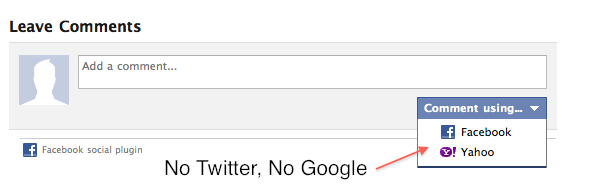
 Given that it’s an identity that 600 million people around the world already use, the push by Facebook into the publisher comment space is undoubtedly going to be a very, very strong one. And the fact that Yahoo is on board with the launch magnifies that strength. But it could have been even stronger.
Facebook originally planned to use Twitter and Google logins for the commenting system as well. But both were scrapped in the final hours leading up to launch for unspecified reasons, according to people familiar with the matter. Actually, to those who have watched the space over the past several months, it’s pretty clear why the options vanished: all the players involved just plain don’t like each other.
Okay, maybe that’s a little extreme. A better way to say it is that the sides don’t want one another using their rival’s social graph to bolster their own social products. We saw this last year when Twitter tried to launch a new Facebook friend import tool, and Facebook blocked it within minutes. Had Facebook tried to launch Twitter login for Facebook Comments using Twitter’s public APIs, you can bet the favor would have been returned just as swiftly.
And then there’s Facebook and Google. Yeah — same deal, but worse. And it’s been going on for years, actually. And it keeps going.
From a user perspective, this is all too bad. Having the option to login with all of these under one system would be great. Of course, from the perspective of startups like Disqus, this social graph war is undoubtedly welcome since they’re a neutral third-party that is free to utilize all the services.
For their part in this battle, Facebook only has this to say:
This is an update to a Comments product that’s been widely used since February 2009. As part of the update, we’ve added Yahoo! as a third party login, and hope to add additional providers in the future.
Google declined to comment. Twitter has not yet responded to our request for comment.
Update: Here’s Twitter’s comment:
We are not participating in Facebook’s new system for leaving comments on web sites. We will continue to have conversations with Facebook about ways in which we can work together.