Jason Kincaid currently works as a writer at TechCrunch.
He grew up in Danville, California and later relocated to UCLA in Los Angeles, California, where he studied biology with a minor in ‘Society and Genetics’.
You can reach him at jkincaidtc@gmail.com (he has other addresses too, so don’t worry if you have a different one). → Learn More
The TechCrunch Disrupt Startup Battlefield is approaching its dramatic conclusion, and the 7 finalists remaining are making their closing arguments in front of a panel of all-star Silicon Valley judges. Here are their questions and the startups’ answers, along with links to our past coverage of each company.
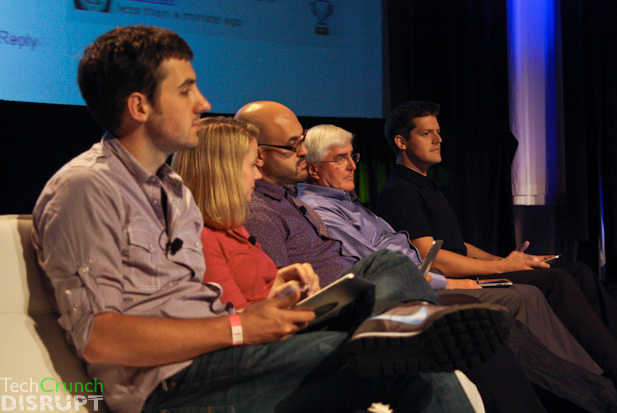
Judges: Kevin Rose Marissa Mayer Jason Goldman Ron Conway Roelof Botha

Badgeville
Read Our Past Coverage: Badgeville Wants To Layer Social Gaming (And Yes, Badges) Across The Entire Web
Team of five, raised $250k, profitable.
KR: I love it. Foursquare for the web.
MM: I also like it. I think the analytics piece is powerful. You have to integrate it on your site (i.e. it isn’t already everywhere).
JG: You allow custom rewards.. One thing that’ interesting about foursquare is that you have to be careful with how you set up rewards.
A: It is how you implement it. We’re finding that in implementations we are coaching customers about best practices.
RC: Impressive when your rev is double your capital and you’re a startup. Who are competitors?
A: Lots of consumers plays looking to adapt this to websites, non-whitelabel, not aligned with medium/large publishers… Our vision isn’t about gamification, it’s about influencing behavior and outcomes… There’s not just market with medium/large pubs. Can also go through medium and long tail with API products.
RB: I think this is a yes. Key themes: mobile, social. Don’t think website owners would do this on their own. So I think this company is off to a great start.
Okay, and we wanna make sure everyone has enough time to present, so that everybody can call the people in from who are already out there?
If I can have my Paul Carr, can you please come out here? Paul and the judges. All right. Are you ready for the final battlefield? We were just having a microphone issue backstage.
Do you have the list? We should I have the list I've got everything.
Let's announce the.
Well, before we do Eric. I mean, I don't know if this is gonna work. This is Mike's insistence. I just wanna know the general insist it may or may not work.
There's a website that's been built during, this is amazing, it might disruptive companies get start and websites get built during the conference. And there is a sight that's been built called dancingerick.com It's Erick with a K. So, I don't know if we can get it on the screen, but if not you can put it on your laptops but maybe we can get it. If not, you will have to.
I guess I'll just have to look for it
You can you could re-enact it now, if that would.
I could, but there's so many that I think that were waiting.
Okay, but before the end of this s ession, we will have DancingErick.com . I think t hat's, that's more than enough for DancingErick.com
More than enough, I think.
A huge round of applause for Erick Schonfeld. More than enough dancing Erik for that one there.
Please, please Erick, don't hurt them. All right. Let's
Knock it off. I don't know if we'll follow that, but let us try. Let's welcome our, let's welcome our panel of judges to the, to the stage.
Many of them will be permitted. Welcome to stage please, Roelof Botha from Seqouia , Ron Conway from SV Angel, Jason Goldman from Twitter, Marissa Mayer from Google and our last minute addition Kevin Rose from Digg. All right.
That's good.
It's good. W e all have seats. Not comfortable. now, so, the way we did this was we put together or the judges both from yesterday. There was more discussion afterwards.
We have our finalist which hopefully we've seen the least of. We can put them all into the Disrupt cup, mix them up, and pick out at randomly order ID picture again just to make it completely fair.
So that's my way of saying. If I announced them in the wrong order, it's not my fault. Lets start with, I believe Badgeville. A round of applause for Badgeville. Thanks, bro. Just a timer check, it says 5 minutes. I think it suppose to say 6.
It is supposed to say 6 minutes. Can we get the timer to say 6 minutes. Okay.
All right. So, my name is Chris, this is Wedge behind me. We're here to welcome you to Badgeville.
Let's get started.
What is Badgeville? We're a loyalty and rewards platform for web publishers to drive engagement. Why did we start this company? It's because everybody online is thinking about how can we retain our users and drive new audience growth.
And we've already seen that there's proven techniques from social gaming that drive behavior in the right ways and allow those services to create highly engaging experiences and we wanna offer that to everybody on the web.
And finally, w e participate in our loyalty programs everyday in our real world but we're not rewarded for our attention and our loyalty is on our favorite websites. W e're here to fix those problems.
So, how do we do that for publishers? We have a highly flexible platform where publishers can define any kind of behavior that they wanna drive with their audience and deliver any kind of reward against that behavior. We use all of the techniques from game mechanics. Things like, points, trophies, levels, accomplishments achievements but we also can reward them with tangible rewards. What do you find when you actually move your loyalty strategy to an online one is that your users are just clamoring to engage with you in a way where they get rewarded with reputation, status and recognition. And we have a platform to basically helps you do that. Why is this so important? It's because it's not about page use anymore it's about engagement. Understanding your users, understanding your audience. What behaviors are they doing ? Who are you're top users, and what is the real health of your community? Think about this publishers already set those conversion goals in their legacy systems for analytics but those conversion goals are trapped in those systems. We think you should share your goals with your audience and make them transparent so that you can actually win and achieve your objectives.
Let me show you a demo of our product. Here we are on a site, that's installed Dadsville. By the way, we automatically innovate with your existing user community, your users don't have to do anything new.
L ets go ahead and perform a behavior on this site that this particular publisher values. I've just left comment here. As soon as I do that, By the way this is a live demo on a production site.
As soon as I do that. I unlock an achievement that gives me real time feedback for having done so. For some reason the message isn't showing What else can I see on the site? I can see who the top fans are right now in this community.
I can even connect with those users and find out more information about where they are in social media and other ways to connect with them. I can see real time achievements happening across the site. Who's unlocking achievements and what other things that I can do the site to actually engage in those why.
I can click on my profile and see all of the points, levels, achievements that I've unlocked. By the way, all of the content and business logic for this is entirely set by the publisher. I can even share achievements with my friends and promote those into Facebook and Twitter. Finally one thing we're really excited about is I can even import my social graph directly into this site from Facebook and Twitter, and see how I stack up on this site with my friends. And if my friends are on this site, I can invite them to participate with me.
Let me show you how easy this is to setup as a publisher.
I log in to our dashboard. I go into settings. I can create new behaviors, define points and levels and upload my badges and rewards. In this case, we see this publisher set these behaviors as their key objectives. Let me go ahead and take a look at one of those objectives. Here I see all of the different rewards that have been uploaded here. We've made it really for marketing managers, community managers, anybody to set this goals and start delivering rewards very easily to their audience. Here I set the triggers and the values for what unlocks these achievements. I can also go into an analytic's area, and start to understand who's doing behaviors on my site, which behaviors are working, what are the friction points in my community that's preventing users from engaging more deeply. and there is a lot of stuff here that we don't have time to go through. Back to the sides. Back to the sides.
All right so, one thing that's really important to understand, is that we've built this to support any kind of site content sites, media sites, communities, shopping sites and created a system that's high ly flexible for any type of behavior and any type of reward. We can deliver this with Turnkey Widgets or with our Flexible API . It works with your web and your mobile strategies and we have a whole set of motivators that we can leverage.
We've actually identified about 40 different motivators that we wanna build into our system. We actually think the product's about 10% complete right now. Lots of opportunity. We started selling this product 90 days ago . We've already signed 10 customers.
Across those 10 customers we're trying talking about powering engagement for over 400 million monthly paid fees and we already booked over half a million dollars this quarter. We expect to do over a million this year in 2010. Here are some of our clients. By the way, we launched our website on Monday and we already received over 300 sales inquirie . S o we think the opportunity is huge. There's over 250 million websites out there. Facebook installed on over a millions sites, creating a social layer where identity is now available to publishers.
The next step is to start the drive behavior through loyalty and rewards and one last thing I just want to quickly cover, which we didn't share on Monday which I think is important here is we've done all of these with a team of 5 people. We've raised only 250K, which I think acutally makes us the most capital efficient company that you're gonna see here today. We've already booked over half a million dollars with some amazing clients which I think validates our product in market fit. We're already profitable today, and you know I think we're solving a real problem.
For the entrepreneurs in the room, I think this goes to show that if you find the right market with a good product, you work hard, then you too can actually make it to the final stage here at TechCrunch Disrupt. Thank you for your time. So, I'll go in order. I'll start Kevin. Comments, questions for BadsVille. I love it. I mean, I think that it makes sense. It's Fourquare for the web and I think that a lot of these rewards, you know I was thinking, how this could be applied to even traditional media companies, you know, you put something like this in the New York Times and after they come back and visit ten times or tweet some of the articles or Digg somebody's stories, you give them a free 6 months subscription of the Print Magazine or whatever it may be. So you know, It's pretty awesome.
Thank you, thank you.
It's a great start. Congrats on everything you build with such a small team and I love the product. Thank you.
Marissa.
Oh, I think I also really like it I think that the social gaming aspect of it is great. I also think that the analytic's piece is really thoughtful because I do agree with you were far beyond page are using. We need to look in a lot of more detailed metrics really understand what's on sites.
I guess I have a few questions. I think that one of my questions revolves around. Seems like this is a per site approach, so you integrate the game into your the particular site.
It's a little bit different than Four script for the web, because apps everywhere you go on the web, is that right? That's correct. I would say it's actually more Foursquare for your website, but aligned with publisher objectives with their behaviors and the rules they what wanna set . So.
So, I mean I think one thing is about is there a way to expand beyond just as a single website application.
So is a game that people can play all across the web. Exciting there will be a bigger players like these when others will be motivated to move in to that space is pretty to be naturally.
I think the other piece is it would be really good to see example applications. Not maybe their customers or much for you perceived that are some, some great games. There's some really good examples so people can really understand what kinds of behaviors or what kinds of games might be go with it. I think like versus point about the...that it's...y our answer about it's Foursquare for websites is something you should think about in just in terms of what's your answer to if it's really successful and the browsers decide that they're just gonna build this... they're just gonna build this themselves, right. So, that is with the user, it's with the user web, or the user goes, or where the website go at. Another thing that I thought was interesting is that you allow the goals to be... you allow the goals to be modified and one of the things, I think, that's interesting about... one of the things that's interesting about Foursquare is that you know, you have to be careful with the rewards that you set up because if you set the wrong words, if you put the wrong score board up, y ou actually encourage, you know, perverse incentives. It's like if one of the badges was created the most comments or one of the badges was first in a thread, like that actually is somewhat detrimental. That's actually somewhat to what a blogsite with website publisher might actually want to have happened.
And it may not be obvious. That's the effect that they have but, like, I think, one of the things that, like, you know, and probably Kevin knows this better than anyone here, that you have to be really careful about is, when you put up a number, people are immediately gonna start gaming that number and, you know, and we put up a reward, people are immediately gonna start like, thinking, "Okay, what's the thing I do to get the most of that." And I wonder if like, you know, I don't know if you have any thoughts about.
I can respond right?
Yup.
So I mean, I think, those are all great points so I think it is how you implement it and I think what we've tried to build an abstract out is a way to have any kind of business logic that allows a publisher to achieve it's objectives with this kind of rewards framework. What we're finding actually is the implementations that we're doing right now. coaching our customers around best practices around how to do this. We actually have a really strong team from the advisors from Zynga, Playdom and I think we've given a lot of thought around the right ways to drag my behavior.
But, I think this is like a new brand new category, right? Like moving gaming types of incentives and rewards to non-gaming activities. I think it's like a brand new frontier. I think we're gonna learn a lot as we go through that. That doesn't mean that, you know, publisher shouldn't explore it, try things, make mistakes and then learn from that and I think, you know, we wanna help them really understand what's the best way to maximize engagement through these techniques. I think although we signed 10 customers already, we actually talked to probably about 100 organizations over the summer that kinda see, you know, where does this fit on their priority scale and what we're seeing is that, it's highly relevant to what they're all thinking about right now. They're highly receptive to it. They're not gonna implement like a generic one size fits all set of rewards. They need to align it exactly with their business objectives, that might be rewarding people for doing premium subscriptions or might be for sharing articles or actually completing reading articles or buying different combinations of products within the store.
Yeah. And so it's really about creating a very flexible system that aligns with that and that doesn't mean it's gonna be something that you implement within 24 hours but it is something that if we help them, they' ll be able to implement it within a matter of weeks, let's say.
Yeah.
We bring in Ron. Pretty impressive when your revenues are double you're paid in capital in your startup.
Thank you, Ron.
I'm curious, who else is in this space? Who's your competitor?
So, I'll try to give you a direct answer. I think there's a lot of different consumer place that are trying to kind of look at how they could adapt this to websites across the web, you know, non white label, not aligned with like medium and large publishers. I also see that there is a couple of companies that are actually quite well funded . Bunchball is one company that is like a gamification platform where you can build actually very rich gaming experiences on websites, as well as a couple of other players whether, maybe doing a pure API play, to add gamification types of experiences to websites and mobile and things like that. Where we see a difference I think is for us is number 1, I think our vision is not about gamification . Actually, I think I mention it probably once in the entire presentation today.
Our vision is about loyalty and rewards and influencing behavior and outcomes. And I think this is really an analytics play, and the next generation in analytics play at that.
This is about not just writing down behavior of what users are doing now on your site or even in aggregate. It's about changing outcomes on your site, and using a platform like ours to do that.
We just happen to use game techniques in order to help move that along.
I wonder about how many times you said the word gamification, I don't think it's gonna become a word. Okay. So, first thing congratulations, including the rest of the panel on what you've accomplished with a little paid in capital. The key question I have is around the ability to sustain a competitive edge in those market.
I think the analytics of business obviously is a huge business and impacts of many different websites. But if you look at the successful outcomes, there weren't many great companies built in the box of analytics. Analytics often being provided for free by people by Google or in the case of AdMob they bundled it for free. And, how are you thinking about maintaining an edge of competition and not having a race to zero in what you charge for a service like this?
Yeah. I think, so I think that analytics market actually is quite interesting. I mean, Omniture built this very large business with 3,000 customers and that's 3,000 out of the million that we talked about that are implementing Facebook social plug-ins. But I also see that there is not just the market with medium and large publishers. That could actually be a very interesting business, but the fact that we can also go after the medium tail than the long tail with maybe some of these API products to make it very easy to implement and almost self served. The price points that we are seeing even with the leads that we started talking to since Monday and even at the trade show here where even at like a thousand dollar per month price point in a self serve basis, that there is like a lot of interest some customers to explore that.
So, I actually think that a ny serious web strategy in the next 18 months is going to leveraging achievements, loyalty and rewards as a core strategy to driving engagement. I mean I don't think that's a questionable statement.
And now, it's a question of which, which capabilit y are you gonna use to do that? Are you gonna build it yourself, and I actually think this is actually a really complicated stuff to build, having work on this for the last 6 or 7 months and then there is probably a hand full of players than can try to service at market.
I think we're actually we take a very valued oriented approach. A solution or in a approach of around, loyalty, and rewards, and I think that the customers that we signed probably are pretty good evidence that, you know, with a very young company, we do have the right vision and the ability to execute against that, that is giving them confidence to actually sign up these customers. Okay, we got about a minute left. So there's a pretty big cash price and lots of other things at stake. So this is the time to give them a whole time if you have any follow up points and the panel really loves this or really hates it.
Now is the time to speak up. Silence. You're completely down to middle of the road to this.
Let's get a gut sense, would this be a yes or a no to you? I think it's a yes. I mean, the thing about the key things that a lot of people are focused around right now are mobile and social.
And I don't think that every website owners can innovate and build all this social features and agree with you. Just difficult, it's not the core focus Things that they need for a separate company to build that social engagement capability for other publishers and so I think that marker opportunity is real and this company is off to a great start. Okay, well then. That's pretty much out of time. A round of applause then for Badgeville. So yeah I didn't explain properly because I'm pretty bad at my job
Pinger
Read our past coverage: Pinger Now Turns Your iPod Touch Into A Free Cell Phone
MM: Monetization?
A: We already do ads for text. For voice you can buy or earn minutes. Earn though Offers.
JG: What was inflection point? Domestic only? Per minute cost?
A: Handing out real phone numbers. For now. About 2 cents a minute.
RB: Thing is scary is competition.
A: For carriers, we’re bringing devices/iPad etc for first time into network. Adding new traffic to networks. Skype costs money to get a phone number. Google Voice is different problem for different market. GV uses your minutes.
KR: You’re profitable and growing like crazy, why here?
A: Michael asked us. We don’t need the money but we need PR.
A: We’re banned in some schools which is a great sign.
RC: If you get them when they’re 18, how do you keep them when they switch to an actual cellphone.
A: Keep people using great products by giving them a great product.
JG: On calling plan. Download apps to get minutes value exchange is a little wonky. There are only so many apps. You’re creating maintenance problem where they download and have to remove.
A: We also let you buy it. Can use iTunes account. GameCrush

Read our past coverage here: GameCrush Lets Guys Pay Money To Play Online Games With Women (Seriously)
RC: Metrics so far? Enough women to meet demand?
A: 12% conversation rate for people registering to play. Yes. Got 6000 over last 3 months during private beta.
MM: I disagree with observations around gaming. I think having a unique title is big. I think you need more compelling games. I wonder about real-time nature especially if you are missing realtime and addictive nature.
A: We noticed that players are building relationships with PlayDates. We want to expand to have more engaging games. Could also put platform on other platforms.
KR: 60 cents a minute sounds high.
A: We launched at a dollar a min, we discounted it. That seemed to be price point they were satisfied with.
A: We have ‘the edge’ which is more edgy but we are not an adult site.
JG: You talked about sports bar metaphor. Games might not be pickup mode.
A: If I go to sports bar I don’t expect to see women I’m going to talk to about sports… This mimics mecanics of bar.
RB: Innovation is interesting. Video used to sit on the side. Realtime video hasn’t been integrated the way you’re doing it. I think Chatroulette was one of first.. this is an extremely interesting innovation. My question, do you do anything more as a social engagement service of which gaming is only one arena.
A: End of the way we’re about enhancing interactive experience, but it could be around watching pilots, cooking.

Opzi
See our past coverage: Opzi: A Quora For The Enterprise
RC is an investor
RB: Converting users to paying customers.
A: Looking at what Yammer has done. Going to create a product, from then on want team leaders at a company to adopt it and spread it virally.
KR: Why can’t Quora do this?
A: Quora is aiming to extract knowledge and make it public, they’re a consumer play, don’t think it falls in what they’re thinking of. Companies will go in diff. directions after Q&A.
MM: I think integration points are interesting. A lot of info gets created in a company as a byproduct of something else. Need to provide great enterprise search.
JG: I think Google, Salesforce are you bigger threat than Quora. They already have these touchpoints, this in place with the businesses.
RB: Don’t think you need the most comprehensive search, just need to connect people who know where to find the answer with the question asker.

DataSift
See our past coverage here: Tweetmeme Founder’s Datasift Helps You Find A Needle In A Tweetstack
RC: Business model?
A: 50% of rev comes from data sales. Cloud based, we charge you for complexity involved and how long we run it for.
KR: I think of Yahoo Pipes where it’s fun, but how do you get a lot of people do use this?
A: iPad app able to visualize news with magazine style.

CloudFlare
See our past coverage: CloudFlare Wants To Be A CDN For The Masses (And Takes Five Minutes To Set Up)
Since stepping off stage at Disrupt, getting 2.1 website signups per minute.
MM: Market need is very real. Hard problem. Future roadmap?
A: Goal is to protect the entire Internet.
When a visitor comes to a site on the CF network, get the best possible experience.
JG: You built five data centers with fudning?
A: Not from foundation up. We raised 2 million from some amazing partners.
RC: Soluto won the last Disrupt… was so good but can you explain the IP behind it. Prove that it works.
A: I would encourage people to look at users.
JG: Pricepoint?
A: Have freemium. Enhanced features for money. SSL. Also, sort of like OpenDNS model where users have given us permission to monetize certain number of pages, like error pages. We’re not messing with your content, we’re unintrusive. If infected computer comes to your site can tell them about it.
KR: Curious as to if you had a medium/high vol site can you handle it. What happens if you fall over.
A: We’ve done some high traffic site. SXSW Panelpicker. Can hit a big button and route traffic direct to backend. If DNS goes down can go to other large DNS providers.
RB: We’re an investor in OpenDNS. Question is around customer acquisition and distribution.
A: We think going forward opp for channel program. On Monday announced partnership with HostGator. They’ve built CloudFlare into their control panel.
KR: Technical team?
A: We started Project Honeypot six years ago. Been tracking online fraud. Started out with Email. Have someone who was on original Ops team at Yahoo. We’re hiring.
A: We think there’s an opportunity to work with hosting providers, rather than charging them, to work with them to build out or infrastructure.
RC: What’s data center cost?
A: Fixed cost. Minimum data center is three machines. Can’t say actual cost.

Qwiki
Past coverage: Qwiki Just May Be The Future Of Information Consumption. And It’s Here Now
RC: Biggest application?
A: Qwiki is a platform.
KR: Beautiful, elegant. But is it just reading from Wikipedia?
A: Wikipedia is a source but there’s much more. Many other sources for media, videos, structured data.
MM: I think it’s really polished, visually beautiful. Well packaged. Watching information is a sweet spot. How interactive?
A: You do put more time into a video, but you recall better.
JG: People react to personal assistant metaphor. But seems like different usecase than information retrieval.
A: We are worst audience for this text, because we spend our days going through a lot of text. But everyone else gives what they want plus what they use.
JG: Think about which usecases you can own. I think you can own having your iPhone waking you up and waking you up like HAL.
RC: I don’t know if I’d use it I’d have to think about it. Barry Diller would try to buy this for CityGrid. Lot of text and video on the web, am I right in thinking that the audio is what makes this the most unique. I think this is Flipboard-ish.
A: We draw from a lot of sources, the presentation is the difference. Different use case from Flipboard.
RB: What you’ve hit on is “site, sound and motion” captures our imaginations. Question is, what’s the cost of processing?
A: All programmatically created on the fly. If it’s a reference we can cache. Depends on use case for caching.
How do you monetize?
A: If we get a large footprint we can build a sophisticated advertising engine. Right now we’re on product. But with consumer’s undivided attention, there’s a lot you can do.