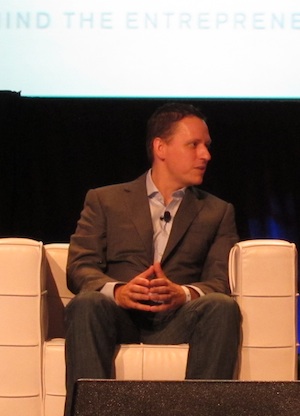
Thiel is starting a new initiative that will offer grants of up to $100,000 for kids to drop out of school. Yes, you read that right. Though that’s not how Thiel puts it. Instead, he calls it “stopping out of school.”
The basic gist is that he will fund up to 20 kids under the age of 20 who apply for this grant. His hope, obviously, isn’t to ruin their lives, but instead to find the best minds thinking about big things early in life. This is where true disruption comes from, Thiel believes.
And it also solves another problem that many young people face today: crippling debt. Because going to college is so much more expensive than it was even when Thiel was in school, he notes that a lot of kids come out of school having to worry about debt rather than just focusing on doing great things. Thiel hopes to change that.
He’ll be accepting applications for this grant through the end of the year for enrollment in 2011.
in contrarian but is and always and he almost always says something just shocking in every conversation I have, so hopefully he won't disappoint before lunch.
So, Peter thanks for being here.
Thanks for having me Sarah.
So, to start out, y ou been spending splitting your time between New York and Silicon Valley.
There's been a lot of talk that the start ups in New York have really been becoming more competitive with Silicon Valley.
I've been traveling all over the world and seeing what I think are really competitive start ups in emerging market, curious to get your sense of whether or not Silicon Valley is really still the home where all great entrepreneurs come or if you know there really is a change we're seeing g eographically.
Well I think Silicon Valley is still the center for a lot of technology innovation certainly in the US and I still think in much of the world, but I think one of the things that is, is very strange so like a big picture respective is that we have all this buzz and momentum with different companies t hat are coming out of the valley but it seems strangely disconnected with what's going on in the rest of the US or the rest of the developed world, I'm not talking about emerging markets.
And so, in the US we have a massive recession it's near depression, it's just not called depression it's been like incredible stagnation for in a median hourly wages have not gone up since 1973.
We have 37 years of basic stagnation.
And then a Silicon Valley story has been Moore's Law , computers are doubling every 18 months.
You've had computers, you've had the internet a nd so, it's a very strange disconnect were if you go 30 miles outside of Silicon Valley, it's completely, i t's not working at all.
So, I think, I think one of the questions that is being asked about Silicon Valley and that we need to be asking ourselves more is how are we actually doing things that are making the country and the world a better in next few decades.
And there's some strange way in which we have built a lot of technologies that of been invaluable in a lot of ways but they have not been quite enough to move the dial and I think, I think that, I think that outside of computers and the internet things have actually been surprisingly stalled for a while, y ou know if you were looking at the world in you know future history of the world according to Star Trek 1967.
You know we'd have permanent lunar bases by 1990.
Right.
You know, man visit Mars.
I wanna teleport.
A teleport, w ell that was a look further.
I spent 30 hours on planes a month from the teleport.
You know, p lanes have gotten slower.
You know we have super sonic planes 20 years ago we don't have those anymore.
Energy stuff has gotten, has not been solved.
So the arts of all these hard technology problems that have not been solved, and I think we need to be spending a lot more time focusing on a kinds of breakthrough technologies that will take our civilization to the next level rather than on a lot of incremental things that have been working for a while but then I think will work less well in the next decade or two.
So, I think a lot of people in Silicon Valley would say , you know it's not the job of private companies, it's not the job of Intra-Capital it's NBC's t o fund a lot of the basic science that would go into those kind of breakthroughs even if it is a huge market and I think it's kind of a stalemate that we've been in clean tuck market.
Yes, yes, well it is, it is, it is not our job to do basic science and I, I don't think of, you know I don't think of our job is trying to find the next Albert Einstein or something like that we don't really do science but we would like to find the next Howard Hughes or something like that and so we are, I do think there are ways in which technology can be driving it and we made this be in the point we'd what we have to do and so to the extent of a lot of the low hanging fruits has been picked that would suggest that you wanna actually be focusing on these harder kinds of technology, they may take quite a while to build, b ut I think they are extremely valuable as they've gotten in built and we've been involved with the number over the last few years.
So what's the weirdest, wackiest most sci-fi Star Trek deal you've done?
Well, I think probably the most Star Trek like one would be SpaceX which is the [xx] rocket company which you know, it was involved with PayPal early on.
He's been working on SpaceX for something like 7 years now since 2003.
And it's so, it's weirdly the sort of thing not very many people in Silicon Valley were interested in.
It's like you know, why should you invest in a rocket company and they're getting.
Well, it sounds like something like a 5 year old would say.
Like, I want to grow up and build a rocket company like.
Well, it turns out when you look at the business, it's you know, there, there are not very many rocket companies.
It is a technology that's not been developed for a long time.
The economics are not terrible because people generally pay for rockets in advanced.
It's similar to like the Dell computer.
Like $3 billion contract from NASA.
They pay for the contracts in advance of building and so, it's actually a lot better than sort of a lot clean tech type deals.
I think it's just the kind of thing that's not in people's mental framework to be a, to be looking at.
And so, o ne of the ways we've thought about the kinds of technologies look are we should go back 1950's and 1960's and look at sort of the classic science fiction and all the things people said would happen, space, robotics, artificial intelligence, next generation bio-tech and look at and take another look at all those industries and some of them may not happen.
But some of them maybe happening.
So, we've been looking at a lot of AI related stuff which has been out of fashion for 25, 30 years a nd I don't know if we get generalized AI, we get computers they're simply better than humans.
But there's a lot of interesting stuff happening at the margins.
And it's an area no one's been looking at.
So, we were talking backstage about this sort of famous statement that you made, I think back in 2006 or so it was the beginning of the retro scale here comes another comes another bubble video.
Right.
Which said, we're absolutely not another internet bubble.
And everyone thought well that's ridiculous of course we are Facebook got valued up 500 million.
Well, Facebook is valued at a lot more than 500 million now.
Do you think we were in a bubble van and you know by the way now we have a much bigger horizon evaluations for all the big companies and for a lot of smaller companies, are we in so rt of web bubble now?
I don't think that we are at a crazy evaluation point, y ou know Facebook obviously has gone up tremendously in volumes for secondary market if you will buy and sell shares.
I suspect that still, the least over valued or the most under valued of the major internet companies in the world.
Let me clear it, you think Facebook at what is it worth now?
You know something like 30 billion.
A $30 billion space book is still under value.
It's relatively under valued.
So, it be, you know, if you had a choice between Google and Facebook, you should be on Facebook.
But, it's, it's, I do think, I do think this doesn't necessarily mean the start up investing is at a good point.
So, it's quite possible that the internet is at in more mature stage than people realize.
And so, there are a lot of people talk about cellphones and mobile applications and we've been very nervous about investing in these areas because we think so much the value on these things will be captured by the larger existing companies so that, you know, the yelp of cellphones will be yelp.
The Google of cellphones will be Google and so it maybe like the car industry in the 1950's where it became w as much more important culturally and socially than it was on the 1920's, it b ecame a lot bigger.
But the car companies themselves were actually started in 20's even though they grew a lot in the 50's and they transformed the US in the 50's.
If you wanna work in the car industry in 1950 you should join one of the big companies, and if you we're a technology investor in 1950 you should not have funded new car companies and so.
So, you wouldn't fund a Facebook today?
We would be a lot more careful.
I mean we're not categorically a gainst it, we've definitely been doing, you know some internet deals here and there.
We have, you know we meet a lot very talented people, well episodically i nvest, there some spaces where we're still very excited about.
But, but I think the angel to be see thing, early stage to be see thing it feels very crowded.
It's an industry you want to be always be fundamental, and contrarian and, well I think there's a fundamental story of how the internet's gonna grow, it's not as contrarian as it was 3 or 4 years ago.
No, it's interesting that you make the carnalogy .
About 10 years ago, I started seeing that w ith PC companies.
People would say you know, remember back in the early days of cars, there are all these models that condensed down onto a big three.
In the early days of computers, you had Commodore, you had Wang, you had all these big companies.
It condensed down to a handful and growth slowed.
I mean, are we at that point with the internet now?
It's hard to say.
You know, I'm not certain where in 1950 maybe or 1940.
But we are, I think it's important, you know, when people ask what's the future of social networking of the internet, I think we have to ask the question where are we at today and I think we are at a point where it will be a lot harder to make progress through some incremental changes and a lot of like will tend to get captured by bigger companies.
And so that's why we are focusing on in sort of very different breakthrough technology areas that we think are much more likely to actually drive progress in this country in the next decade or two.
You know, you said something really interesting on, an interview I saw you on CNBC several years ago that I always think about.
You said that an investment in Microsoft was not investing in a tech company.
An investment in any of the blue chips that we would consider tech, tech, the big Tech Belwethers.
We're not really investing in to tech, tech, the big Tech Belwethers.
We're not really investing in to technologies cause those companies were intended to see things stay at the status quo not disrupt the markets.
Not investment invasion.
And at the time you said, if you wanna invest in innovation, invest in Google.
Do you think that's still the case or sort of they joined the Microsoft category.
It's a complicated question with Google, question is how much of it is built on the existing search monopoly versus how much is on, on really developing new technologies elsewhere and so I think Google is sort of complicated in between case.
Apple I think is still a largely a pro innovation story, b ut certainly IBM, Microsoft Intel, Dell, Oracle, all these companies are basically that's against innovation and they will do well if you have a world where nothing changes.
Just like the car companies by the 1950's would do great if there was never any competition, if there was no cars coming from Japan or anything like that.
Where in the 1920's the car companies were tech companies.
So, technology is a category it's something that changes.
And you can't just say that the tech companies are the same companies that were called the tech companies 20 years ago and I think it's very important to understand that by definition what is technology?
What is disruptive is something that changes and if it doesn't change.
Right, so what about Facebook?
Are they still a tech company?
I think they are still insanely focused on building the product.
I t's in part driven by Zuckerberg, he's a p roduct visionary, you know probably his many ways resembles Steve Jobs and it's I, I think, I think he will stay, as long as he stays involved in company it would be about I, I think, I think he will stay, as long as he stays involved in company it would be about really building great new products and this is standard graph on Facebook because its changes too often and make all these random changes to the website the people don't understand, but it's because they're trying to actually change things for the better.
Right.
Well, so my understanding is that Zuckerberg is actually an evil genius, that's what I see in movie trailers all around the country.
Well, I would beg to differ, I know, I think everybody who knows him, who's been involved with Facebook tends to disagree with that.
The basic, you know, it's sort of I think the plays of movies is a good portrayal of how Hollywood works is not really a portrayal of of how Silicon Valley works or at least should work.
Silicon Valley is about a positive sum game where you create great companies where all the stakeholders can benefit the founders, investors and our society at large, plus Hollywood really is this incredibly nasty zero sum game, where everyone is just trying to stamp on on everybody else.
So, I think the movie is a very accurate description of the, of Hollywood.
A bit Hollywood and a bit Facebook.
But you know I would say that, I would that, that aside I think one very good th ing about the movie is that to the extent it encourages young Americans to think that they too can start great companies I think that will dominate everything, and we have the Wall Street movie in 1987, in the late 80's which, was much more negative movie on Wall Street than the social network thing is on, on Silicon Valley and that movie encourage people for the next 20 years to go work on Wall Street and so i f this movie just encourages people to try to build great companies in Silicon Valley i t will do far more good than evil.
So, you're actually pretty major part of the early days of Facebook.
How did you get away with being in this movie so little?
Well, I think the movie was.
It's pretty unscathed.
The movie was largely around, is largely centered on the personalities of the people who actually were starting a company.
It's somewhat less interesting as an investor so I think it's, it's really that, I , I've yeah, I'm happy with my part in it.
All right, great.
So, Peter you're one of the only guys that I know that invest at the Angel Level, VC Level and then also at the Hedge Fund Level.
Usually don't see those three disciplines in one investor.
People would say, they're all different kinds of investing, different horizons.
How do you juggle about which do you like more?
Well, I like all of them.
I think it's, it is very helpful to have the big picture in form the details and the details in form the big picture and so I think they've, the two things tend to be connected in a lot of ways.
I think that basically, I think one, one for example, one's from negative p erspective we've had over the last 6, 7 years has been that on the one hand there's an energy crisis.
On the other hand the clean tuck companies for a variety of reasons d on't work, and so that's been sort of very useful perspective and thinking about what not to do and probably the one thing we have not done is any alternate energy investment.
It may change, but certainly that's been, that's been a one hard type area by the way the people try to do.
But I think a lot has been misdirected.
Y ou know, alternate energies, sort of this ambiguous term.
It can mean either more expensive or less expensive energy.
Oil price is worth $3 a barrel in 1973.
But now it's 75 dollars a barrel.
Even if you're just been [xx] it's gone up by something like a factor of 4 i n real tough terms and the challenge for alternative energy is to cerate something that's actually cheaper than oil and to the extent it's something that's ends up being more expensive.
I think it's just not gonna work.
Okay, I just realized much of my panic we only have 2 and a half minutes left and Peter has a rather exciting announcement to make here at Disrupt.
Well, we've been, you know we've been brainstorming a lot on, on what we're gonna, you know, what we can do to try to break the sort of relative stasis we've been in as a society and you know as a BC Fund we've been investing in these breakthrough technology companies.
One of the things that we think is very important is to encourage potentially young entrepreneurs to actually get involved in a science technology and in creating all this great value for the next generation.
So one of the initiatives that we're gonna be starting over the next few weeks is a program for offering grants of up to $100,000 to up to 20 people under age 20 for starting something new.
They're dropping out of school.
Or stopping out of school.
This is every parents worse nightmare.
You're offering kids money to leave school and start a company.
Well it depends on whether the parents are worried about the, a bout this, the debt of students are accumulating and so and I do think, I do thing there are a lot of things people learn in school.
I don't think they learned anything much about entrepreneurship.
A lot of the great companies have started by people who've been, who've been quite young and we think that, we think that actually trying to encourage that is very good.
One of the big problems with the education system i n both, it's undergrad and grad school levels which a lot worse when I went to school 20 years ago is that it just cost so much more and so you end up with people burden with incredible amounts of debts and well, they maybe able to track towards certain safe jobs is actually a lot harder for people to take the risks you need and we think you're gonna have to take a lot of risks to build the next generation of companies.
So the, we're basically are gonna be taking applications through the end of this year for 2011.
The basic thing is you can apply individually or in a team of up to four people.
It is a two year program up to $100,000 and we will, we will encourage people to do something from California to get involve in the, a breakthrough technology, anywhere in the world.
And it's 20 of them you said?
Twenty under 20.
Okay.
Great.
Well, thank you so much for being with us.
Sorry we didn't get a ny questions from the audience, but we'll have you back in the next one, and do more Q and A.
Thanks for having me.
Thanks.
Thanks a lot.
Thank you very much.
Am I the person who finish on time?
Yes.
Okay, so we're gonna break for lunch and unbelievable.