
Over the past several months I’ve moderated or been on a number of panels with many of the top players in the location space. A common theme keeps recurring. When someone brings up rivalries between any of the companies, it is always downplayed in favor of an “everyone wins” message. I’ve been skeptical of that since day one, but as the space has exploded, there have been signs that a lot of companies are winning (as evidenced by both usage and fundraising). But now, as the space matures and larger rivals enter, things are starting to get more testy.
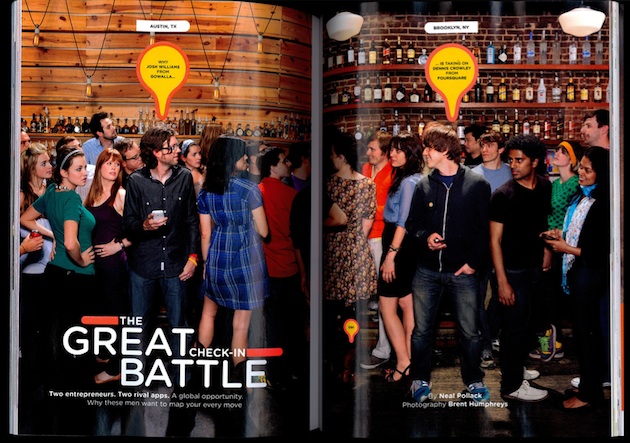
The most obvious rivalry is between Foursquare and Gowalla. Even as the two battled for supremacy at the SXSW conference this year, both sides downplayed the rivalry. But the fact is, there is a rivalry (and they even play it up for next month’s UK edition of Wired magazine — see: pic above). Foursquare and Gowalla don’t talk to one another — in fact, their two leaders, Dennis Crowley and Josh Williams, had never met until a panel I moderated at Where 2.0 after SXSW this year. That’s not to say they hate one another, but they’re also not out there holding location potlucks to discuss how they can work together for the betterment of everyone.
On Monday, another competitor in the space, Loopt, released its latest location app, Loopt Star, which asks users to check-in places to engage with brands. Crowley wasn’t a big fan of this (to say the least), and let it be known on his blog. “Check out Loopt’s foursquare knock-off. Points for checkins and “boss” instead of “mayor,”” he wrote. He continued:
Not to be a hater, but if I was going to create a foursquare knockoff, I’d use game mechanics and create something *totally different* (e.g. the “Points 2.0” stuff we’re cooking up now @ foursquare HQ).
Why would you ever just clone someone else’s work? Learn from it and innovate on top! That’s how we all push this space forward!
Earlier today, Loopt CEO Sam Altman tweeted out that he thought Foursquare was blocking the IP address of his office. Crowley responded on Twitter that it wasn’t intentional as far as he knew. But the block is still in place.
Crowley’s criticism of Loopt Star is very similar to a post he did back in January in response to Yelp entering the check-in space. At the time, Crowley wrote:
Shameless. At least innovate on top of it!:
Most any foursquare user will tell you our leaderboard is flawed. It tracks the wrong metrics; it encourages fake checks & cheating; etc. We’ve been hustling these past few months to build the infrastruture that allow us to tweak the game mechanics on our end (think: Leaderboard 2.0)
Poor guys, you copied the wrong stuff! :)
Of course, nearly 6 months later, we have yet to see this Leaderboard 2.0 stuff that he keeps referring to (Foursquare has undoubtedly been distracted by scaling issues and Yahoo acquisition offers).
As the company generally seen as the frontrunner in this space right now, of course Foursquare is going to have others gunning for it. But they’re hardly the only ones getting testy with rivals. Behind the scenes, a number of these companies seem to have a growing dislike (or at least, distrust) for one another. They may say the right things when they’re on stage or on panels, but it’s a different story when the spotlight is off.
All of this is to be expected. As the location space continues to be validated, each company is out to prove that it’s the one that will be the next big thing — the one people will remember. And as more people are beginning to understand that they can’t use all of these services all the time, some are going to be forced out.
And there’s a larger concern for many of these companies: it’s still far from proven that each can survive as their own businesses. Some are starting to make revenues, but those can quickly dry up if larger networks like Facebook or Google start to copy features and entice brands to sign up with them instead. And plenty of the larger companies out there still view the location startups as features rather than stand-alone products. If that thought starts panning out, many of these locations startups will be fighting to position themselves for quick exits.
Indications right now are that Facebook won’t enter the space in a major way (but will have simple check-ins), and instead will federate other location services’ data. But that will cause tensions too as each location service tries to become the preferred method that Facebook’s nearly 500 million users choose.
The next time you’re at an event and you hear one of these guys say that in the location space “everybody wins,” don’t believe them, because they don’t believe it either. That may have been the case in the early days, but we’re beyond that now. And all of these companies know it and are starting to act like it.
[photo: flickr/dpstyles]