If the huge profusion of mobile handsets, phablets and tablets on display at CES weren’t enough of an indicator, we now have some numbers from Gartner that spell out how the PC industry continues to decline in the face of smaller, cheaper, more portable, and more popular computing devices. Total worldwide PC shipments for Q4 totaled 90.3 million units, a decline of 4.9% over Q4 2011’s 95 million units, according to preliminary figures out today from the analyst group. Other key points: HP has regained its lead over Lenovo, with 14.6 million PCs shipped, giving it a 16.2% share of the market. And Windows 8 has so far had very little impact on things.
Although in the past vendors and analysts have explained PC sales declines as due in part to a softer economy, this time around Gartner is fairly straightforward in linking the drop to the rise of competition from other devices. “The PC industry’s problems point to something beyond a weak economy,” the company writes.
In the past, Gartner and others have described a drive for a “multiscreen world,” where content be consumed anywhere, that would lead to a blended future where people would buy different devices for different purposes. But the analysts now appear to be shifting their basic premise about how consumers and businesses will use tablets in relation to PCs, says Mikako Kitagawa, principal analyst at Gartner.
“Tablets have dramatically changed the device landscape for PCs, not so much by ‘cannibalizing’ PC sales, but by causing PC users to shift consumption to tablets rather than replacing older PCs,” she writes. “Whereas as once we imagined a world in which individual users would have both a PC and a tablet as personal devices, we increasingly suspect that most individuals will shift consumption activity to a personal tablet, and perform creative and administrative tasks on a shared PC. There will be some individuals who retain both, but we believe they will be exception and not the norm.”
PCs, she says, will “age out” as more people buy tablets. In Q4, it looks like devices that are closer to tablets in form factor are feeling more pressure than those that are markedly different: mobile PCs (laptops and netbooks) were down by 11%, while desktop PCs were down by 6%.
But for now there are still PC makers that are growing market share, and others that are not. As you can see from the table below, HP’s leading share of 14.6 million units was actually down 0.5% from its numbers one year ago. Lenovo’s nearly 14 million PCs shipped gave it a 15.5% share of the market, but it was up 8.2% from a year ago. Dell, disastrously, is down by nearly 21%, although it’s still clinging to number-three in the rankings. Acer is also down but ASUS is up.
Update: Dell later saw a surge in its shareprice brought on by speculation that it might get taken private amid its lackluster performance.
Preliminary Worldwide PC Vendor Unit Shipment Estimates for 4Q12 (Units)
| Company | 4Q12 Shipments | 4Q12 Market Share (%) | 4Q11 Shipments | 4Q11 Market Share (%) | 4Q12-4Q11 Growth (%) |
| HP | 14,645,041 | 16.2 | 14,711,280 | 15.5 | -0.5 |
| Lenovo | 13,976,668 | 15.5 | 12,915,766 | 13.6 | 8.2 |
| Dell | 9,206,391 | 10.2 | 11,633,387 | 12.2 | -20.9 |
| Acer Group | 8,622,701 | 9.5 | 9,690,624 | 10.2 | -11.0 |
| ASUS | 6,528,228 | 7.2 | 6,133,042 | 6.5 | 6.4 |
| Others | 37,393,913 | 41.4 | 39,934,184 | 42.0 | -6.4 |
| Total | 90,372,942 | 100.0 | 95,018,284 | 100.0 | -4.9 |
Note: Data includes desk-based PCs and mobile PCs, including mini-notebooks but not media tablets such as the iPad. Data is based on the shipments selling into channels.
Source: Gartner (January 2013)
Windows 8. We have seen indications from others that Windows 8 is not having a massive impact yet, and Gartner is adding its voice to that chorus.
“Windows 8 did not have a significant impact on PC shipments in the fourth quarter,” it states flatly.
It’s explanations are that the devices running the OS were simply not compelling enough — “lackluster” is Gartner’s word — and that, well, Windows 8 has been conceived with touch in mind, and PCs are, by and large, simply not incorporating that well enough yet at this point.
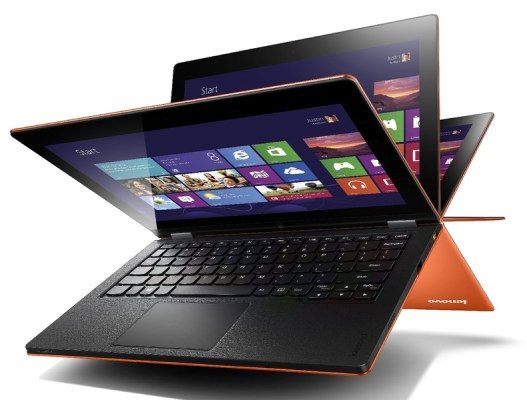
Pointedly, this is an area that Lenovo has been working hard to develop with products like the Yoga, which tries to combine the best of both touchscreen tablet and keyboard/power PC worlds. Products like these also appear to be the most successful of the mobile PCs at the moment:
“All-in-one form factor models from Asus, Lenovo and HP look like a promising platform for the future,” writes Isabelle Durand, principal research analyst at Gartner.
Breaking out regional sales, the U.S. beat the worldwide trend, with declines of 2.1%. Gartner notes that anticipated arrival of Windows 8 helped companies control inventory better, although there was still oversupply because of “rather weak” sell-through. This could mean deep discounts on the horizon.
Again, as with the wider market, the consumer electronics spend during the holidays went “into other products and services,” although businesses may have seen better growth.
Table 2
Preliminary U.S. PC Vendor Unit Shipment Estimates for 4Q12 (Units)
| Company | 4Q12 Shipments | 4Q12 Market Share (%) | 4Q11 Shipments | 4Q11 Market Share (%) | 4Q12-4Q11 Growth (%) |
| HP | 4,657,123 | 26.6 | 4,137,788 | 23.1 | 12.6 |
| Dell | 3,355,152 | 19.2 | 4,020,549 | 22.5 | -16.5 |
| Apple | 2,145,082 | 12.3 | 2,035,082 | 11.4 | 5.4 |
| Lenovo | 1,476,606 | 8.4 | 1,345,975 | 7.5 | 9.7 |
| Acer Group | 1,377,824 | 7.9 | 1,756,838 | 9.8 | -21.6 |
| Others | 4,493,820 | 25.7 | 5,637,726 | 25.6 | -2.0 |
| Total | 17,505,607 | 100.0 | 17,881,424 | 100.0 | -2.1 |
EMEA was a bit more grim. Its decline of 9.6% was nearly twice as big as the worldwide drop for shipments. Gartner says that Western Europe — which is in an economic slump — was the cause, with Central and Eastern Europe, along with the Middle East and Africa, still seeing quarter-on-quarter growth.
Table 3
Preliminary EMEA PC Vendor Unit Shipment Estimates for 4Q12 (Units)
| Company | 4Q12 Shipments | 4Q12 Market Share (%) | 4Q11 Shipments | 4Q11 Market Share (%) | 4Q12-4Q11 Growth (%) |
| HP | 5,346,900 | 19.1 | 5,829,182 | 18.8 | -8.3 |
| Lenovo | 3,087,629 | 11.0 | 2,386,877 | 7.7 | 29.4 |
| Acer Group | 3,015,318 | 10.7 | 3,532,612 | 11.4 | -14.6 |
| ASUS | 2,794,279 | 10.0 | 3,233,350 | 10.4 | -13.6 |
| Dell | 2,351,990 | 8.4 | 3,176,724 | 10.2 | -26.0 |
| Others | 11,458,059 | 40.8 | 12,887,932 | 41.5 | -11.1 |
| Total | 28,054,175 | 100.0 | 31,046,677 | 100.0 | -9.6 |
Asia/Pacific saw the smallest decline of all regions, Gartner says, with shipments down only 1.8% for 29.9 million units, with the story again being one largely of consumers looking to smartphones and tablets rather than PCs, with the price points for the most interesting, higher-end models of PCs still too high for the market.
Full-year sales, Gartner says, are down 3.5% on 2011 to 352.7 million units, and HP managed to stay at the top spot with Lenovo close behind. In the declining game, those hardware makers that continue to push crazy innovations are the ones leaping ahead at the moment. ASUS, which has just under 7% of market share worldwide, saw the biggest increase with growth of over 17%.
Table 4
Preliminary Worldwide PC Vendor Unit Shipment Estimates for 2012 (Units)
| Company | 2012 Shipments | 2012 Market Share (%) | 2011 Shipments | 2011 Market Share (%) | 2012-2011 Growth (%) |
| HP | 56,508,218 | 16.0 | 60,553,740 | 16.6 | -6.7 |
| Lenovo | 52,159,229 | 14.8 | 45,688,493 | 12.5 | 14.2 |
| Dell | 37,611,747 | 10.7 | 42,864,265 | 11.7 | -12.3 |
| Acer Group | 36,661,066 | 10.4 | 39,282,791 | 10.8 | -6.7 |
| ASUS | 24,206,696 | 6.9 | 20,678,302 | 5.7 | 17.1 |
| Others | 145,554,478 | 41.3 | 156,278,584 | 42.8 | -6.9 |
| Total | 352,701,433 | 100.0 | 365,364,175 | 100.0 | -3.5 |
More to come.