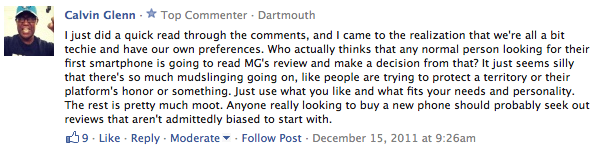
I just want to start this out by saying I love you guys. I really do. TechCrunch is lucky enough to have a really smart, well-informed readership which keeps us diligent in our reporting. You guys are also pretty hilarious, and who doesn’t enjoy a good ROFL now and then.
But if there’s one thing I’ve learned through the comments section here at TechCrunch, it’s that these Android vs. iOS fanboy flame wars need to stop.
How ridiculous, right? How absolutely petty and meaningless are the things we get fired up over?
That’s not to say that Android and iOS and their respective hardware counterparts aren’t important. I mean, it could be loosely argued that without the hardware and software (and apps and services) that we spend our lives writing about, the Arab Spring uprisings wouldn’t have been possible. The technology itself can surely make a difference in the world, and of course you should care about that.
But that’s not what I’m talking about. I’m talking about the fact that we’re choosing sides (and defending them with zealous rage) in an entirely meaningless war.
Now, don’t get me wrong. We at TechCrunch love rivalry. We love Google vs. Microsoft, Apple vs. Samsung, Apple vs. Google, Arrington vs. Arianna, and all the other fun rivalries that spring from this, our field of technology. I honestly can’t even think what the world would look like without them. They are spokes in the ever-turning wheel of our capitalist society, and they’re entertaining as hell to watch play out.
When corporations of this size duke it out in ad campaigns or in the courtroom or on store shelves, well that’s what this industry is supposed to look like. And there are other rivalries that are even more fun. The People vs. Netflix price hike was great, as was The People vs. Verizon’s $2 “convenience fee.”
It is downright amazing to see a company do a 180-degree turn based on the collective voice of their customers. It’s a beautiful thing.
But what’s happening with iOS vs. Android is different. Instead of seeing an epic clash between two companies, or watching a customers-vs.-company saga unfold, we’re seeing customers in Group A join sides with Company A, while Group B joins sides with Company B. Apple and Google are supposed to hate each other, but just because we use their products doesn’t mean we need to hurl hateful, meatless comments at each other.
There’s a big difference between a competitive rivalry and a pointless one. Ours is pointless, and for one very good reason:
Fanbois, Apple doesn’t give a damn about you. Also, Fandroids, Google doesn’t give a damn about you either.
Both companies care about the “us,” but no one individual matters to this or that corporation. And here’s another truth bomb: if you don’t give any substantial reasons for why “Android is better” or “iPhone is better,” then no one else is going to make a decision based on your comment either.
So I find it a little bit odd (read: crazy) that we’ve drawn such aggressive lines against each other. If anything, Android makes iOS better and iOS makes Android better. Fierce competition and rivalry is what makes everything better, but we don’t seem to be visualizing the big picture.
Instead, we’re saying things like this to each other:

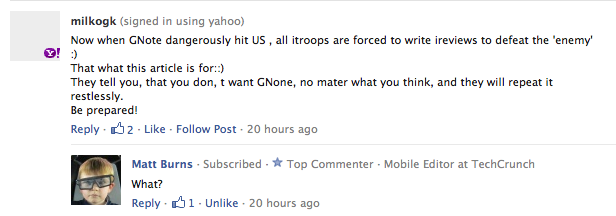

Of course, there are plenty of comments that intelligently and constructively argue the pros and cons of each platform. These comments are the reason that all the other (^) reasonless-ly nasty comments don’t make us cry into our keyboards. They also bring up new points for future articles, which is much appreciated.
When it comes down to it, though, I’m not your mom. Say what you want. I’d like to think that writing this would calm the storm and we could all start being productive human beings in a smart discussion about the value of each platform. But I doubt that will happen.
So all I really want to do is zoom out a little bit. Look at the big picture. People are dying of famine, disease, war; the world is rapidly changing; economies are crumbling and elections are underway. Things are happening that are really deserving of your passion, yet here we are throwing rocks at each other over which phone is better, when it doesn’t make a damn difference anyway.
It’s embarrassing and a waste of everyone’s time.
I’ll leave you with one of those intelligent and constructive comments I was talking about before: