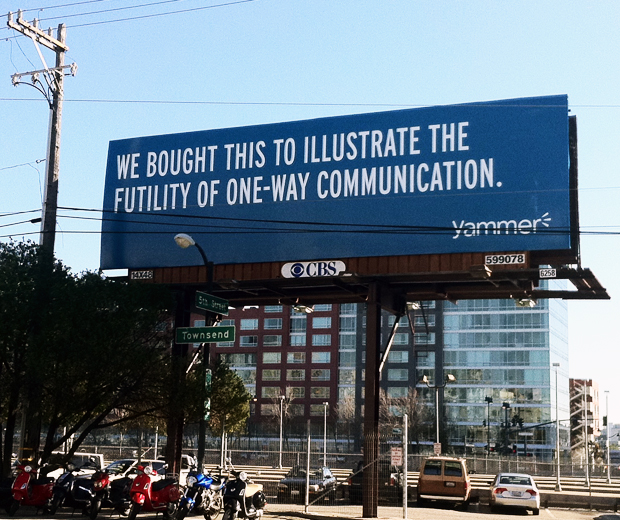
 You know how obsessed we are with billboards here at TechCrunch Aol, so imagine my joy this morning when I drove into work this morning (at 8am as always) and saw this awesome piece of artillery right in front of my office.
Yeah, our officemate Yammer has decided to wedge a billboard-sized nail in the coffin of old media (i.e. “one-way communication”) which conspicuously includes print magazines, newspapers and eh hem, billboards. Says Yammer marketing designer Aria Shen, “Simply put, we wanted to make a statement about the new paradigm of how people and organizations communicate, and figured what better way to do that than to use the oldest mode of paid media.”
Yammer, a Twitter for enterprise, says it bought the 6K per month/3 month billboard run because it’s hiring and wants to attract engineers. Good call: The infamous area around our 410 Townsend office is like startup Mecca. Soon to be neighbor Zynga has also gone the billboard route, with a 101 brand presence we’ve heard is in the 30K a month range.
As to the pricey billboard’s ultimate recruiting effectiveness in the age of infinite two-way Internet distractions? Well it caught my eye didn’t it? Maybe old media has some staying power yet?