 I often have discussions with various people in the technology industry about location-based services. I also moderate and/or sit on a lot of panels about the topic. Naturally, I constantly read and write about it as well. So how often does Google Latitude come up in all of this? Basically never.
That’s why I was legitimately shocked today when in their blog post announcing Latitude for the iPhone, Google dropped a big number bomb: 9 million. As in Latitude has 9 million active users. That makes it nearly twice as large as the often talked-about Foursquare. So how is that possible?
Well, because Google wants it to be possible. You see, they now bake Latitude directly into every Android phone through the Maps application. And while it is opt-in, my suspicion (and I’m hardly alone here) is that many people turn it on then basically never do anything with it. But it’s still a part of Maps, so technically they are “actively” using it. They’re just passively actively using it, if that makes any sense.
Look, 9 million is impressive. There’s no way around it. It’s even more impressive when you consider that just seven months ago, they had 3 million active users. At the time, Foursquare had just signed up their one millionth user. So Foursquare has grown by 4 million, while Latitude has grown by 6 million during the same span.
But again, I’m just not sure that all those Latitude users are sure that they are active Latitude users. And even if they are, I’m not sure they’re actually doing anything. Because that’s kind of the point — with Latitude, you don’t have to do anything. It just runs in the background, updating your location. It’s actually pretty hard to be “active” on it.
As it stands right now, it’s a feature, not a service. And yet it exists as a service.
Last week at LeWeb, our own Mike Arrington asked Google’s Marissa Mayer about Latitude on stage. Given her new role in the company, Latitude is now under her watch. So naturally, Mike tried to get her to admit it sucked. While she wouldn’t do that, she wasn’t exactly jumping for joy and singing its praises. Instead, she agreed that it needed some work and that the model may need to change slightly.
That means check-ins. Latitude has long danced around this concept, sequestering it to the API. But the fact of the matter remains that most people simply still aren’t ready for the constant location tracking that services like Latitude offer. I would consider myself very open-minded about this kind of stuff, and I still sort of think Latitude’s concept is weird.
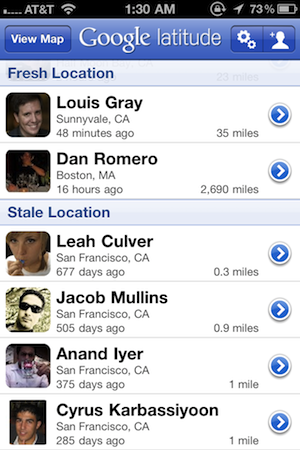
For example, since I downloaded the iPhone app, it has been running all day in the background letting those who are checking know where I am. If I want to turn that off, I have to go into the app and dig into the settings a bit. And it’s harder (and easier to forget) on Android. That’s annoying, and not that way it should be. Loopt, which also does some background location stuff, does a much nicer job with this on and off switch.
I know that Google sends you email reminders every once in a while that your Latitude location is turned on. But the fundamental problem remains: most people simply aren’t ready for background location updates all the time. That’s exactly why check-in services took off. They’re a stepping stone to that. And it’s going to be a while.
Google doesn’t seem to want to believe that. So they’re shoving it inside of Maps, creating iPhone apps, and giving users some nifty tools to show them that this type of data can be valuable. It’s a bit like passive force feeding.
But it won’t work. The timing just isn’t right.
Google can trot out the 9 million number as proof that their strategy is sound, but I believe those may be padded stats. Why? Because I’m most certainly one of the 9 million counted. And I wouldn’t consider myself to be an “active” Latitude user.
Or if I’m wrong, I’d love Google to give some more details about those 9 million users. Where exactly are they hiding? You’d think they’d be easier to find given their use of Latitude.