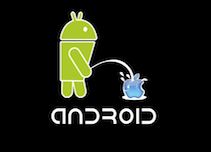
 Just in case it wasn’t clear enough, Apple’s Q4 earnings call today made it more clear than ever that Apple and Google are in the middle of an all-out war in the mobile space. Apple CEO Steve Jobs took five good minutes to trash Google’s Android platform on its “openness”, fragmentation, tablet capabilities, and a variety of other things. He also had a stat bomb to drop. Again.
According to Jobs, Apple is now activating 275,000 iOS devices a day. That stat is for the previous 30 days. He also noted that some days, they’re getting close to 300,000. Impressive, for sure. But why drop such a number? Because Google did first, of course.
Let’s recap. In May, at Google I/O, Google announced it was activating 100,000 Android units a day. By June, that number had jumped to 160,000. And in August, CEO Eric Schmidt announced Android activations were up to 200,000 units a day. The subtle implications of each of these numbers was that Android was growing so fast that it was leaving Apple in the dust. Obviously, Jobs didn’t like that too much.
So in September, Jobs used his time on stage at an Apple event to announce that Apple was actually activating 230,000 iOS devices a day. Further, he called into question whether Google was counting upgrades in their numbers. “We think some of our friends are counting upgrades in their numbers,” Jobs said.
Within hours, Google responded: “The Android activation numbers do not include upgrades and are, in fact, only a portion of the Android devices in the market since we only include devices that have Google services.”
At the time, I joked that it would probably take a day for Google to announce they were now activating 250,000 units a day. Turns out it took about 30 days. In an interview with Newsweek, Android chief Andy Rubin noted that some days Android activations do surpass 250,000.
And so today we have Jobs one-upping that with the 270,000 number — topped with the 300,000 number on some days.
It’s worth noting that Apple is very deliberate in announcing their numbers in terms of “iOS devices” and not just “iPhones”. Apple has never clarified this, but you have to assume they mean all iOS devices — meaning iPads and iPod touches as well.
Press conference from Google announcing 301,000 Android activations a day in 5, 4, 3, 2…
[photo: flickr/tony hue]