Get Extra Early Bird Tkts to September's Disrupt SF by midnight July 31 »
The iPad Is Step 1 In The Future Of Computing. This Is Step 2 (Or 3).
by MG Siegler on Feb 16, 2010

In 2008, I attended a meeting in Madrid, Spain that featured the coolest demonstration I had ever seen. The problem was that I wasn’t allowed to talk about what I had seen because the company was still in stealth-mode. More importantly, several governments, including the U.S. government were still exploring various parts of the technology for next-generation computing systems, so parts of this were very confidential. By the end of that year, Oblong Industries had revealed itself, but still little was said about its project. Finally, people are starting to talk about it.

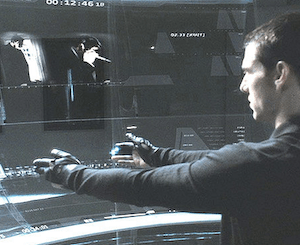
While we may not have been at this year’s TED conference, apparently, Oblong was. And apparently, it wowed the crowd. And it should have. If you’ve seen the movie Minority Report, you’ve seen the system they’re building.

No, really. The co-founder of Oblong, John Underkoffler, is the man who came up with the gesture-based interface used in the Steven Spielberg movie. And now he’s building it in real life.

The demo I saw a couple years ago was stunning, but it was still just a video. Apparently, at TED, the audience got to see it in action. NYT’s Bits blog detailed some of it in a post yesterday. For those not at TED, Oblong has also made a few demo videos in the past, which I’ll embed below. Again, this is Minority Report.

Oblong’s coming out party couldn’t come at a better time. Following the unveiling of Apple’s iPad, there has been a lot of talk about the future of computing at a fundamental level. That is to say, after decades of dominance by the keyboard and mouse, we’re finally talking about other, more natural, methods of input. The iPad is one step to a multi-touch gesture system (as is this 10/GUI awesome demo), but this Oblong system is the next step beyond that.

Other systems, including Microsoft’s Project Natal for Xbox, are promising similar types of gesture interaction as soon as this year. But the reality is that a system anywhere near this solid is probably still years out. Minority Report, the movie, takes place in 2054, for example. And while that is just a movie, Spielberg instructed the people working on the tech for it to really try to come up with what they thought we’d be using in that time. That said, Underkoffler told Bits that “I think in five years’ time, when you buy a computer, you’ll get this.” Of course, that’s the entrepreneur talking.

For now, I’ll just have to continue to dream about using a computer like they do in Minority Report. But the dream is getting closer, it seems.

Advertisement
Advertisement

Responses

Comments rss icon

  • Was that video real or CGI? If real, it is the most awesome thing I’ve ever saw. No joke.

    5 years ago laptops were rubbish. 5 years from now, maybe they will be gone the way of the dinosaurs and Oblong will rule. Let’s hope!

    • Pah! Mind control is the future, not making a fool of yourself in front of a large display. Pretty nifty stuff, though.

    • My five-year-old laptop is running sweetly, thank you very much.

      A daft interface (an awful movie). Who wants to wave their arms around like a stroke victim just to check their email?

      • I agree 100%. While this is super cool for specific interactions it doesn’t translate to real world applications like email and surfing the web.

        First off is how much it will cost, and how much room it takes up. It looks cool for massive government installations but do the same thing in front of a 11″ netbook and you’ll look like a moron.

        Second is that it’s not as intuitive as it looks, this isn’t pinch to zoom, you’re going to need to learn alot of complex 3D gestures to use this. And for what? Complex interaction with photos?

        Third, lack of accuracy. It’s nice for virtually grabbing an image and rotating it but notice the lack of clarity while drawing with fingers. People who use Photoshop will know how useless it is unless you have nearly pixel perfect control.

        Finally, is simple human nature. People are lazy and if there is an easier way to do things people will prefer that. Almost everything done onscreen can be done with a keyboard and mouse with next to no physical effort. As fun as it would be to command fleets in a 3D world using my hands in the game series Homeworld, I can do it just as well slouched in my chair with a keyboard and mouse with less effort, significantly less room, and significantly less price.

        I love the “Minority Report” ideal as much as any techie but it’s not practical for mainstream use. I’m sure the government will have fun with it as well as some major companies; plus it will become a staple on CSI and related crime dramas. But it’s not the future of home computing.

        • The way we use and interface with data is an evolving process. We live in an age of expidential information and new ways to navigate this explosion of data need to be created. No, this is not built for video games. Its potential not only lays in the reduction of mechanical interfacing methods, but also the transition between cyber information and real world space. That is of value.

  • The reason why the iPad is a major milestone has a lot to do with it improving/making things easier for/impacting a lot of people, this on the other hand is extremely niche technology.

    • iPad is not a game-changer for now.. Although it might be a budding device made for a non-existential market.

      Just think, what it could replace in the future? (Your Coby, PMP device, Your LCD in your Car, Those vtech for the kids, etc)

      I believe, this year won’t be an iPad year. But believe me, after 3 years.. I think we will look back and remember this day, why we disdain iPad so much, because it turns out on that day.
      iPad is a part of your home already. More details: http://bit.ly/apple-ipad-scrutinized-details

      • I agree. The iPad will be a “game changer” in the same way that iPhone was a game changer: Prior to its introduction we had a lot of special-purpose devices and special-purpose phones whose primary interface was the button.

        Today, everyone and their brother is selling a touch screen phone. You may not have bought an iPhone, but you are or will be using the technology that it introduced to the masses.

      • The iPad is not a game changer right now… but with the right killer application it could be. See – Could this be iPad’s Killer Application ? http://bit.ly/9k6c9e

  • this is beyond awesome !!

  • This is cool stuff. I can’t wait for some practical use cases to come out for personal computing. Natal will probably be the pioneer of this. But the next decade of computing will be fantastic for everybody.

  • 5 years until this is standard on a computer? I suppose it’ll also also be standard for a consumer to build in a 1,000 sq ft multi-screen dark room into his home.

  • it’s not even transparent

  • Awesome!! This really looks to be our future.
    I cannot see everyday use of this tech yet, though.

  • Have to say this actual scares me. Imagine a world where government agencies would be able to view a 3D world in real time, from their bunkers…CIA recording telephone conversations would seem peanuts to what might be achievable in a decade from now.

  • Great for presentations…..but personal computing?

    • The physical training classes in my school days struck my mind seeing this.
      Such large movements of hands is just going back to olden days for me. It’s a great development though. If this is aimed at research companies, huge industries, its great; for personal computing, I doubt it.

      • My thoughts exactly! Minority Report has been like the holy grail for interactive designers for awhile now, but i always had the same issues with this interface. You have to be standing up all day, waving your arms around like some ostrich on acid…
        If this is the future of computing, i guess we should all start working on our Deltoids.

        Also, waving arms and rotating palms are not as accurate as pen and paper and even mouse gestures (by the way, neither are finger-poking gestures like Apple seems to think we should all be doing on the iPad) so in a way, such interfaces are actualy setting us back in terms of the accuracy (and therfore the productivity) of input devices.

        This is still a very promissing platform for some scenarios but i seriously doubt it will realy be “the future of mainstream computing”.

        Unless, of course, we’d all evolve into ostriches.

        • I think that accuracy is an artifact from the keyboard/mouse convention. You need accuracy because you have to find the UI. In multi-touch or whatever we are calling this stuff, the UI is changing all the time to present only the most important/relevant UI to you. In other words, you don’t have to be accurate.

          • Ummmm….. I’d say such accuracy is a result of expecting it from such devices as pens and pencils.

            We could write “finger-paint” style with our fingers, but pen and pencil points let us condense a lot more information into a smaller space.

      • We did this 15 years ago with Nintendo 3D glove and an SGI. It was easy to do. We manipulated molecules with our hands. It was very tiring and turned out to be completely unusable because of the whole arm moving, hands in the air thing.

  • touch-interface + cloud-based apps -> the future?

  • I get tired just by looking at it. Is it practical? Maybe thats how the mouse looked to people back in those days.

  • If what i just saw was really happening The mouse and keyboard dooms day clock has just started

  • This is awesome, but have you seen this: http://www.ted.com/talks/lang/eng/pranav_mistry_the_thrilling_potential_of_sixthsense_technology.html ? Very similar concept, but built by one enthusiast for few hundred dolars. And it’s portable. And it already works. In fact if you are talented, you can propabably make this device yourselve.

  • The iPad is step 1? LOL…

  • Great news for computing! Additionally, I cannot wait for this kind of technology to be officially released for public usage as it will be so useful for everyone! Not only is the futuristic technology present in the Minority Report, but has anyone seen the film, The Island? That has to have some of this technology in it, though filmed in 2005.

  • Is this not just a mix of Project Natal and software. Looks good but not your every day PC. If we called these apps games you could almost be looking at a Natal demo…

  • Sorry but that thing is far away from being anything but a tech-demo

  • I have just posted an article on Applications of the Ipad . The article illustrates ways in which the Ipad could be used much different from what the creators may have thought . check it out here.

    http://chandanscorner.wordpress.com/2010/02/14/top-10-applications-of-the-apple-ipad-and-other-tablets/=

  • Yeah, and like in five minutes you will be tired as hell of waving your hands back and forth…

  • It’s well dramatic, and will be great in the learning/teaching environment, but in this form it lacks privacy. Imagine when it gets pared down to a personal level – an intimate interface in which your hands just dance…

  • dave "The Apple Fanboy" - February 16th, 2010 at 1:28 am UTC

    Human-Machine interaction will get more and more sophisticated over time, that’s for sure.

    Who has started to bring this nice concepts into personal computing ? Apple.
    The mouse….the multitouch….what’s next ? 3D workspace with spatial gestures ? maybe.

    Typically Apple doesn’t invent anything, they just make it extremely usable and natural.

    We are aiming to a total symbiosis between the human being , computers and the cloud.
    I think my kids will never study on a paper book, and never see a 2d TV or movie, this are 5 years from now to be the next trend.

    That stuff in the video is 10 years from now at the least.

    But 10 years are nothing, I would like to see some concepts of what we can expect in the next 30-40 years.

  • Okay.. so we all need a large computer room in our basements now?

  • People are going to get physically exhausted from moving their arms and hands around like that. Typing and swiping (on phones) requires minimal movement on the other hand.

    • Thirded.

      They needed to give Tom Cruise rest time between takes in Minority Report. It’s Hollywood nonsense, you wouldn’t want to work for 8 hours a day using that interface.

      Microsoft’s 2019 video is more sensible.

      • You guys are killing me… did the Nintendo Wii bomb because people would get tired of waving their hands at length in a standing position?

        I am guessing the majority of these commenters spend most of their time in a sedentary position…LOL only in tech.

        Plenty of people stand all day waving their arms around. Stockbrokers (the few left on an actualy trading floor) come to mind. All you couch potatoes just leave the cool stuff to us more active types.

        The only way this thing could be cooler is if after booting it said, “Greeting Professor Falken. Would you like to play a game?” and then fire up Global Thermonuclear War.

        I am so geeked by this thing.

    • Like they do with the Wii?

    • “People are going to get physically exhausted from moving their arms and hands like that…”

      Then again, some people put in a little more effort into their work than sitting around in an office chair. You know, assembling cars, lifting boxes, nailing up walls, digging ditches?

      So forgive me if I fail to see how “exhausting” just waving your hands around in the air might be.

      And I might add that getting some people up and off their fat behinds might in fact be a good thing…. (grin)

      • Keeping your arm extended in front of you and “digging a ditch” as you put it, are completely different activities. The human body is DESIGNED for activities like lifting boxes or digging ditches, because it involves using your entire body to project force, not one muscle group.

        The human body is not designed for holding your arms out in front of you for extended periods of time. All the force is being projected from a small number of relatively weak muscle groups (compare the power of your biceps to the power of your abs some time. Note the massive discrepancy).

        Further, why use a system so stunningly inefficient? If you can do something with a single finger, why use your entire arm for it? Wasted time, wasted energy.

        The fundamental problem that they will NEVER manage to resolve with this kind of input system is the fact that it’s forcing the body to do something that it’s simply not designed for. Human arms are too long. End of story. These kinds of systems are cute, but impractical.

  • While the iPad is going to be a (possibly) great advance in consumer electronics, it’s not a step forwards in personal computing. On the contrary, it will be a giant step backwards since the whole platform will be closed and the only software will be that approved by the gatekeeper, Apple.

    Personal computing should be open, not controlled by some entity with a vested interest in keeping out the competition.

    • You challenged my opinion. I don’t think that everything can be open or open source. It would be extremely hard to create a multi gesture environment in an open source community.

      1.) First by definition anyone can contribute and it is really difficult to trash the not so good contributions. Creating and implementing conventions is not an I do this you do that issue. You just have to have the development in your hands to make sure that everyone is going to the same direction.
      2.) Personal Computing is not just programming or software development or open access. It is design and useability, too. Open source in quite a few occasions would mean more focus on expert users less focus on novices. (Like Linux)
      3.) Apple can deliver superior useablity experience because of holding the whole process totally in hand. Optimizing code for the specific hardware and designing UI with meticulous care. I haven’t seen an open source project with that much dedication to the whole user experience.

      Of course I disagree with the idea that one “size” fits all. And if there is ONE in control of everything the user community should monitor its activity closely and put up, when something is against their fundamental moral judgment. All companies seek user satisfaction and we have the power to decide, where they are heading us.

  • The real question is – how will the porn industry use this technology as a precursor to it going mainstream?

    I can’t wait till Call of Duty 23 comes out using this interface – it’ll bring a whole new meaning to ‘gaming room’.

  • That looks exhausting to use.

  • Cool but Natal seems to go several steps further, and no gloves required either.

  • How do you write an email with this thing?

    • LOL :)
      It’s realy easy.. but don’t forget to do warm up before and stretching after :)

    • Who cares? Apparently, in the FUTURE, we’ll all communicate by editing movies and moving little vibrating letters around. I’m starting to question the assumption that this type of input is somehow more “natural.” I mean, how “natural” is it to stand and contort your hands and arms around (in what are sometimes awkward positions) for any length of time?

  • I prefer Microsoft surface. Smaller and more useful :)

  • The first video is at least a year old. Was on GeekBrief with Cali Lewis ages ago.

Leave Comment

Trackback URL
Short URL
Advertisement