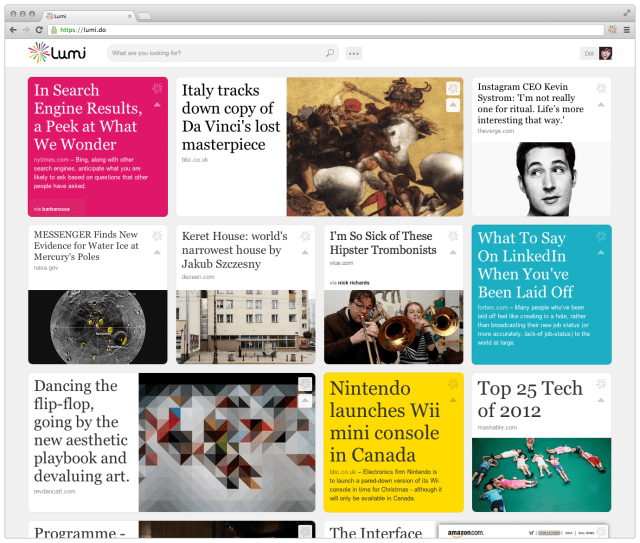
Felix Miller and Martin Stiksel, two of the co-founders of the music discovery and streaming site Last.fm, went into a kind of startup hibernation two years after selling their early-moving, prescient startup to CBS in 2007 for $280 million. Today, on a cold December day in London, they are re-emerging with Lumi, a site that wants to tackle the discovery conundrum yet again, but this time on the wider web. And they want you to help them build it, with the launch of a “prototype” of the service out today.
Think of Lumi as Last.fm 2.0. Just as Last.fm used your own music listening history as a way of building and recommending music to you — and boy was I surprised at how well it did that when I first used it years ago — Lumi does the same, but for a much bigger range of content.
Taking your browsing history, and then pushing it through its algorithms, Lumi suggests other content and other sites that will be relevant to you, presented in a series of Pinterest/Fancy-style, image-led boxes that populate infinitely down the screen.
Taking the principle behind Last.fm and widening it out is an idea the two had always wanted to tackle.
“When we started Last.fm in 2002, we tried to show that with the right kind of technology it’s possible and easy for people to discover new music they like,” the two write in an inaugural blog post. “We always thought that by taking a similar approach for the Web as a whole, it should be easy for people to discover all sorts of content.”
A lot of businesses are trying to hook into your “social graph” to make content suggestions, but — in the name of personalization and in defense of privacy — Lumi is taking the exact opposite approach. Lumi never knows what you’ve browsed, and neither do your friends, Stiksel tells me.
“Lumi allows you to anonymously and securely record the pages you visit to let Lumi know what you’re interested in. It finds popular webpages among all users and makes suggestions of pages that will interest you,” the two write in their blog post. On top of that, your own history gets combined with that of others to create a wider, anonymized pool of suggestions in — yes — a big data play.
What’s interesting is that while we have seen a number of content discovery services that “learn” what you like emerge as apps — Flipboard and Zite being two of the better-known of these — there isn’t anything on the web that is exactly comparable. Miller says that was one reason why they decided to tackle this problem. It does this by way of a browser extension you install to use the service.
So can we think of this as “scrobbling” for the wider web? Miller and Stiksel say they don’t know if that word was trademarked and part of the CBS acquisition, so they refrain from using it. Plus, proprietary or not, scrobbling has such a strong association with music, and with Last.fm.
For now Lumi is entirely self-funded by the two, and it’s opening up slowly, seeing how people use it before developing further. One suggestion or goal seems to be that Lumi could potentially become your default home page for all internet browsing, the one you see when you “fire up” your browser.
Still, the two are couching this launch with a fair amount of disclaimers. Signups today are for “early bird” users, and “it’s going to be far from perfect at the start and might be a bit bumpy for quite some time,” the two write in their blog post.
But, in a world where Google and Facebook/Twitter are the two bookends for how many of us have come to interface with the Internet, it’s perhaps not a bad time to try out something else. If you go to have a look, let us know what you think in the comments below.