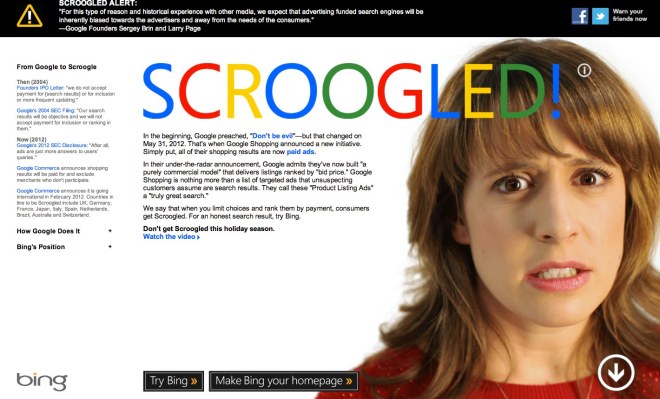
Microsoft started a rather controversial anti-Google campaign this morning that alleged Google is essentially misleading its users because all of the company’s shopping results are now paid. The “Don’t Get Scroogled” page is getting quite a bit of attention today, but at the same time, there is also some unease about how Bing organizes its own shopping results.
Bing, after all, recently partnered with eBay’s Shopping.com. While Bing previously allowed merchants to submit their own feeds for inclusion, the company now says that it is “not accepting new merchants for this program.” Instead, Bing says, merchants should work with Shopping.com. One of the reasons for this according to Bing is that “paid offers will be highlighted throughout Bing Shopping, including search result and product pages.”

It’s worth noting that Shopping.com describes itself as “an efficient advertising platform offering merchants direct response and targeted advertising solutions across a network of leading publishers.” Bing, in this context, is just another publisher in the Shopping.com network.
It’s worth putting this into some context, though: the fact that Bing is not taking new merchants into the program right now isn’t something unheard of, but a move the company has done before ahead of the holiday season to ensure the service runs smoothly. Overall, Bing works with both the Shopping.com feeds and the merchant feeds, and gets data from its web crawler.
There are legitimate reasons to worry about Google’s move towards a fully paid platform for its shopping results and what this means for the company in the long run.
Google, which wouldn’t go on the record with a statement about Bing and Shopping.com, would likely say, though, that while Bing accuses it of ranking by price, price is only a signal in its ranking mechanism. Also, because of the Shopping.com relationship with Bing, it’s not always clear which results were paid in some form or another and which weren’t. On Google, it’s clear that all of the results are paid for.
Both Google and Bing argue that they clearly mark any sponsored results. The two companies disagree that their competitor is actually doing so, though.
Of course, we asked both Google and Bing for reactions.
Here is what Stefan Weitz, the senior director of Bing had to say:
Bing includes millions of free listings from merchants and rankings are determined entirely by which products are most relevant to your query. While merchants can pay fees for inclusion on our 3rd party shopping sites and subsequently may appear in Bing Shopping through partnerships we have, we do not rank merchants higher based on who pays us, nor do we let merchants pay to have their product offers placed higher in Bing Shopping’s search results.
Here is Google’s (rather bland) statement about this controversy:
Google Shopping makes it easier for shoppers to quickly find what they’re looking for, compare different products and connect with merchants to make a purchase. With new 360-degree, interactive product images, social shopping lists and a fast growing inventory of more than a billion products worldwide, Google is a great resource for shoppers to find what they need, at great prices for their loved ones this holiday season.