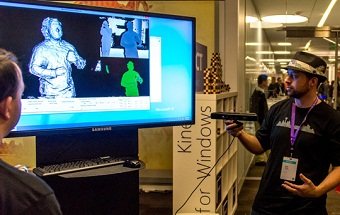
Kinect Fusion, the Microsoft Research project which uses the Kinect sensor to create 3D models of objects and environments, will be made available in the Kinect for Windows SDK, Microsoft announced today. No word yet on when exactly that integration will go live, however – Microsoft only confirmed it will come in “a future release” of the developer toolkit.
That same SDK was just updated in October, however, which brought a number of new features, including access to extended-range depth data beyond 4 meters – a necessary upgrade for something like Kinect Fusion to properly function, we should note.
Originally a research project from Microsoft’s lab in Cambridge, U.K., Kinect Fusion works by taking the incoming depth data in the Kinect for Windows sensor, and uses the sequence of frames to build a highly detailed 3-D map of either an object, or even an environment, like an entire room, for example. The tool averages the readings over hundreds or thousands of frames in order to achieve more detail than it would get in a single reading.
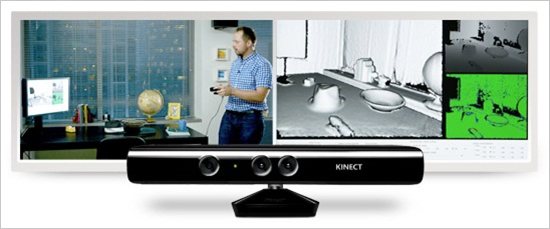
To capture the data, you can either move the Kinect sensor around the thing you’re capturing in 3-D, or you can move the object in front of the sensor. In a pretty nifty demo provided to The Verge back in December 2011, Microsoft’s Kevin Schofield explained the technology very simply, saying “we’re building a model of the world by taking lots of individual frames and putting them together.” Kinect Fusion also updates what it’s seeing and rendering on the fly, as new objects (or people, in the case of the demo), come into the frame. The technology, Schofield noted, involves a $150 Kinect sensor, while industrial versions of a similar system cost around $50,000.
In today’s blog post announcing the forthcoming SDK integration, Microsoft’s Senior Program Manager for Kinect for Windows, Chris White, points out that Kinect Fusion will make sense in a number of business scenarios where 3-D object model reconstruction, 3-D augmented reality, or 3-D measurements come into play. For example, 3-D printing, industrial design, body scanning, augmented reality, and gaming can take advantage of this type of functionality.
Microsoft gave a sneak peek of the Kinect Fusion technology to attendees at its recent BUILD 2012 conference, but wasn’t making promises as to SDK integration at the time.