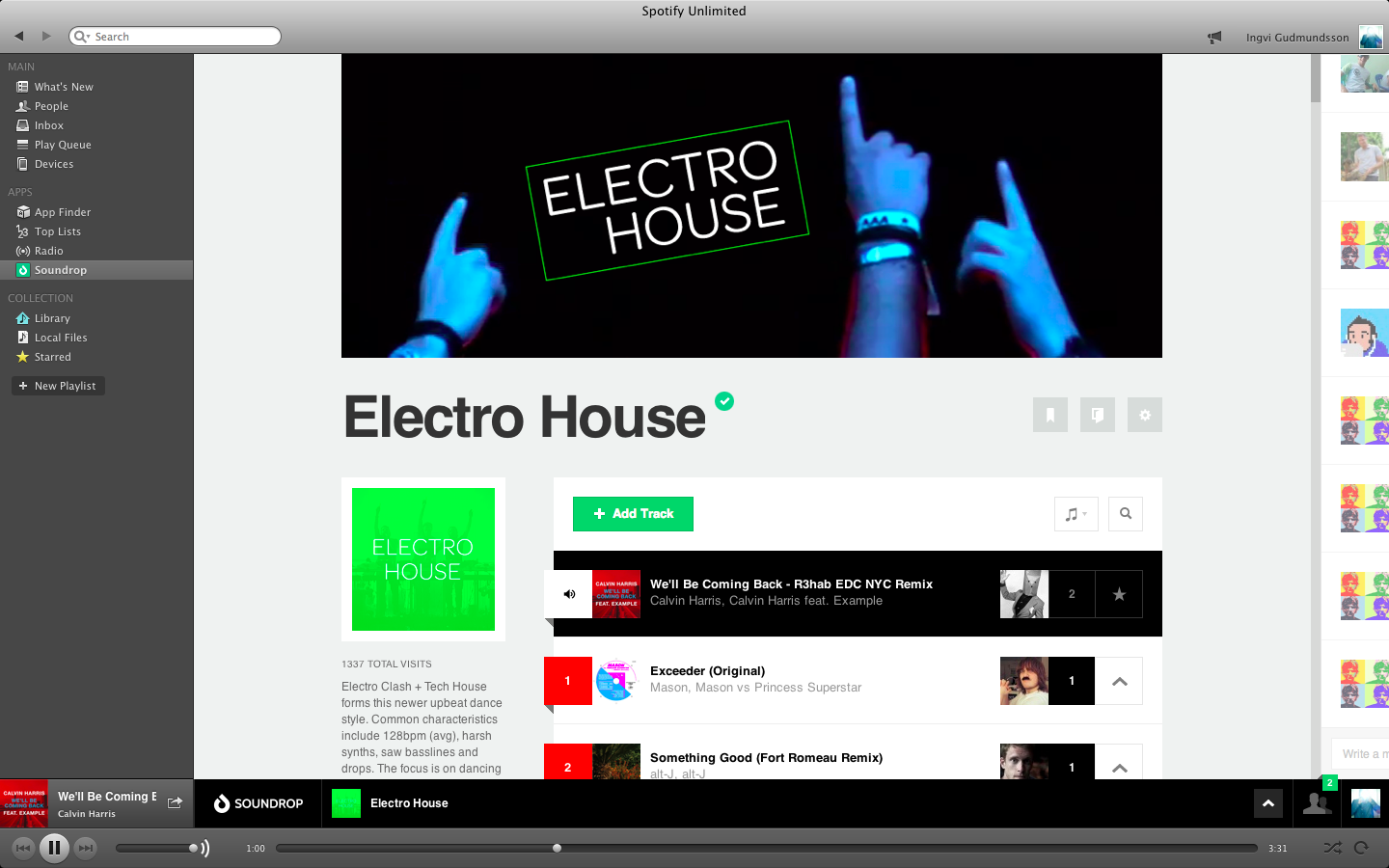
We are still waiting for official word on when Spotify will make the move to a browser-based version, or port its App Center to its mobile app. But in the meantime, third parties continue to build out their presence on Spotify’s platform — perhaps a sign of more activity coming soon. The latest of these is Soundrop, a creator of listening rooms and social-jukebox-style services (a la Turntable.fm) that has racked up over 340 million plays on its platform — making it one of the most popular apps on Spotify. To build on that momentum, today, the Oslo-based company is launching new versions of its Spotify app — and, coming soon, mobile apps — that feature a new design, more ways to be social and a better way of tracking the music you like, and a platform for record labels and others to build services in Soundrop.
The news comes on the heels of Spotify gaining a new tenant, the “music postcard” app SoundTracking.
To date, Soundrop’s has been a popular way for users to interact with Spotify — and usage is growing very fast. In June, when it announced funding of $3 million from Northzone (which also happens to be one of Spotify’s lead backers, too), it had clocked up 60 million listens through its jukebox and listening rooms. Today’s figure of 340 million plays points to the service growing almost six-fold in less than four months. The average listening time is also pretty impressive — it’s currently three hours per session.
The new features being announced today aim to extend that engagement even further: the “front lobby” lets you, as before, browse open rooms and look at recommended and trending rooms, but it’s undergone some refurbishment to make the experience a little cleaner. In the rooms themselves, the builders have added in some new furniture: you can see all the top tracks and fans in a room, chat is now easier to access than before, Facebook integration is stronger (as with Spotify itself, you can now see what your friends are listening to in Soundrop). And users now can keep favorite rooms in a new drawer to return to them more easily.
Users interested in getting the new Soundrop need to restart their Spotify app.
Meanwhile, the mobile apps — on iOS and Android — will completely replace the current versions of the apps — which have now been removed from their respective app stores. The ETA for the new mobile apps is not yet set. “It was a trade off,” Inge Sandvik, the co-founder and CEO of Soundrop, says. “We needed to focus on the Spotify app and we are working on upgrading the mobile apps as we speak.”
The main difference with the mobile apps that we know of, for now, is that Soundrop is migrating them to a new infrastructure, the Soundrop Platform, which lets Soundrop have significantly more stable usage when many people are using their mobile devices to access Soundrop simultaneously.
The Soundrop Platform, which is also underpinning the new Spotify app, is going to the basis of a new chapter in how Soundrop operates. Sandvik says that because the client side is written in pure java script, it’s allowing Soundrop to launch an SDK that can be used by other partners, like record labels. It’s a case of app-Inception. Soundrop, the Spotify and mobile app, will become an app platform of its own. Sandvik says that these partners are now building out their first artist apps and tools using that platform. “To be launched soon,” he says.
When I first wrote about Soundrop I mentioned the company’s plans to moneitize with analytics and other services based on location — a kind of dashboard that can be offered to third parties to help them make sense of what people are listening to, and to spin music to better suit users’ tastes.
This seems to be what is finally coming into play here: The platform, Sandvik says, “will offer [third parties] advanced analytics and even a CRM tool so they can engage with their users,” he says. That will include sending messages to everyone that has performed interactions, but also track what people do with the app.
While Soundrop has continued to scale its functionality, one area where it has not yet chosen to extend itself is in how it sits on other platforms: Sandvik points out that Soundrop is “agnostic to music streaming players,” meaning Soundrop, if it wanted to, could integrate Rdio, Deezer, Mog, or whatever other music streaming companies there are out there that want more third-party integration. However, that won’t be happening soon. “It’s easy for us to add new content sources, but at this time we’ve decided to support only Spotify,” Sandvik says. “We are big fans of the Spotify platform and see a lot of opportunity with them. Also, we have a lot to execute on our product roadmap before we scale out.” When asked what other music services might get incorporated: “No one mentioned, no one forgotten.”
The same goes for other non-music platforms. Soundrop actually already has a mobile HTML5 client — it was developed before it even rolled out iOS and Android apps — but Soundrop is waiting to launch it. “The reason is that we wanted to wait until we introduced our party/event mode and big screen view of a room [so that Soundrop can run on TV/projectors],” he says. That iteration is “coming soon.”
It’s also worth pointing out here that a move to offering an HTML5 version of Soundrop would fit in very nicely with what we’ve been hearing about Spotify’s plans both to go web-based, and to port its App Center to mobile.
As for Windows Phone, Sandvik calls this a “target platform” but points out that so far, since it only works with Spotify’s music service, it’s bound by what Spotify has itself. “We are dependent on Spotifys libspotify to do the ‘listen with’ functionality [and] so far [Windows] is not supported by them.”
As for the future, there are other areas that you can imagine should appear in an app focused around group music listening, such as video. And to match the company’s big ambitions, it will need some big money, too. Sandvik has in the past told me he is under NDA with several VCs. Today he notes that given that the company wants to be doing more in the U.S., that might be a hint as to where its next round of funding may be coming from, too.