Aggressive demonstrations in and near Panasonic’s and Canon’s Chinese factories have forced the companies to temporarily suspend operations. According to the French news agency AFP, demonstrators are motivated by nationalistic reasons and events that occurred over the past few days.
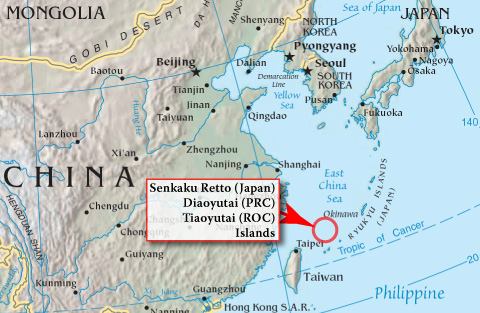
The Japanese Government bought a private yet critical archipelago in the East China Sea: the Japanese call it the Senkaku Islands, and the Chinese call it the Diaoyu Islands. The island group is just one of many islands responsible for the strained relationship between the two countries because of geostrategic motivations.
Controlling those islands is essential in order to extend the exclusive economic zones over the sea of whichever country is in control — for now, it is Japan. In the past, fishing stocks were the only incentive to claim control over an island. But over the past couple of decades, two motivations became apparent and even more important: mineral and gas resources and military domination.
An example of the importance of island control would be the infamous String of Pearls, a term coined by geopolitics experts at Booz Allen to describe the American military island bases located all around mainland Asia. And of course, gas and petroleum are a major concern for those major industrial countries, as well.
That is why the media and tens of thousands of Chinese started demonstrating against every sign of Japanese presence in major cities. Employees sabotaged assembly line operations in Japanese companies. As a result, three of the four Panasonic factories, as well as the Canon factory, will be closed for a few days.
Canon announced that work is suspended for security concerns for its workers. But, as a fire occurred in the Panasonic factory located in Qingdao, material destruction could cost a lot as well. Diplomatic buildings, small shops, restaurants, and other companies faced the same issues.
Chinese military boats are now circling the islands, and tear gas and water canons had to be used against violent demonstrators in Shenzhen. Even though Chinese officials are still quiet, the official newspaper of the Communist Party was clear: If the Japanese Government doesn’t reconsider its decision, it should fear economic sanctions. China is currently the first economic partner for Japan.
(Map: Wikimedia Commons)