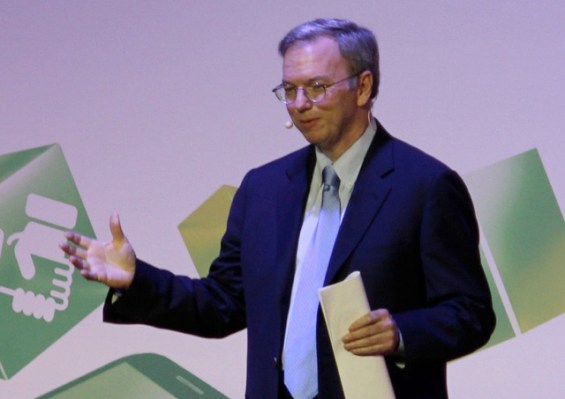
The number of people in the world has now reached 7 billion, but the number that have been online are only at 2 billion, Eric Schmidt, executive chairman of Google, said today at a keynote presentation at the Mobile World Congress in Barcelona.
“We need to be realists about technology,” he said. The future, most easily, belongs to “ultra connected people” who can embrace the future of technology, but the majority of people do not fall into that category, he said as he kicked off a speech about what he sees as the role of technology in the world today, and carefully suggested what role Google could play in the game.
Schmidt was long on some of the innovations that are happening to bring the disconnected in from the offline cold — things like mesh networks, Internet cafes and more besides. But inevitably Google’s role in that will almost certainly be played out in mobile. “If Google gets it right, there will be an Android in every pocket.”
Interestingly, he noted that there are just as many mobile connections in the world today as there are people who are not online: 5 billion.
Of course with three billion of those on feature devices, there is still a lot of work to do, and some of those moving into early smartphones will most likely not be getting LTE or the kinds of devices that have been moving the needle in countries like the U.S. But, Schmidt said, even a gradual migration to better handsets can be an encouraging evolution: “Connectivity even modest amounts changes lives.”
Some of that will not be led by Google — especially on non-smartphone devices. Facebook, for example has made significant inroads into getting people using its service through products like Facebook Zero, and through different innovations from mobile carriers and vendors to use basic 2G infrastructure to give people access to the social network. “Anything that gets people more connected is good,” he said.
But will Google and Android ever make their way to feature phones as well? “Why don’t you just buy a cheap smartphone,” he joked. More seriously, Schmidt said that he predicted that by next year this may no longer be an issue because of falling prices. “Many of our partners are working on phones in the $100-$150 range,” he said. “The ultimate goal is a $70 device.” He noted that when a phone is sold in the channel at that price, the price down to consumers would be between $20 and $30.
At the moment, Schmidt said, Android is seeing 850,000 activations per day, and some 300 million devices have been activated in total — a doubling in the last six months. “We’ll need to produce more people soon” to meet the growth trajectory, he joked.
Some of that growth, of course, is not exactly benefiting Google at the moment, because it’s on forked versions of Android that do not include any of Google’s services — be they the Android Market, maps or (most importantly of all) Google’s ad products.
Schmidt was surprisingly level on that point, and even said that Google knew it would be this way.
“This is completely allowed by open source, and we understood that this stuff would happen,” he said. “It’s their choice.”
The solution? He said Google hopes that “the pressure from consumers” will get some of those platforms to eventually join up with the Android ecosystem.
Ice Cream Sandwich, the latest version of the OS, seems to be his great, vanilla-flavored hope at the moment. “It’s huge,” he said describing its capabilities. “There’s nothing of that scale on the market today.”
But in the race to connect, those 5 billion people might not all see it that way. And it will be interesting to see whether Google has a plan up its sleeve to work around that.