“Kill Hollywood,” is the latest battle cry from Silicon Valley. If you are Paul Graham, that’s not a bad way to motivate young would-be founders to create new startups.
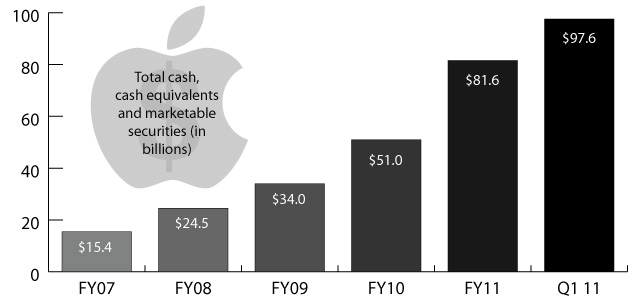
But what if you are Apple, trading spots with Exxon on any given day for the most valuable company in the world, with nearly $100 billion of cash in the bank, looking for the next industry to overturn to keep fueling your growth? There aren’t that many new markets out there that can make a difference to Apple at this point. Hollywood is one of them. If you are Apple, however, you don’t want to kill Hollywood. You want to buy it.
Apple wants to bring Hollywood into people’s homes in an entirely new way. Hence all the chatter lately of a real Apple TV in the works. However, before TVs can become more than a hobby for Apple, there is a major roadblock it must get past. The reluctance of Hollywood to license its best movies and TV shows at the price Apple wants to pay.
In that light, all the cash Apple has been hoarding and building up for years now becomes more intriguing. Its staggering piles of money now total $97.6 billion, to be precise. What are they going to do with all that cash?
One thing they could do is buy their way into Hollywood. Think about it for a second. Today, Apple could literally buy Time Warner ($38 billion market cap), Viacom ($29 billion), and Dreamworks ($1.6 billion) combined, and still have $30 billion left over. If it waits a few more quarters it could snap up News Corp ($49 billion) as well. Only Disney, which is worth $70 billion, would take a while longer to save up for.
But it is very unlikely Apple would just snap up all the major media companies. It would be a post-acquisition mess, not to mention the antitrust issues it would raise. No, all Apple needs to do is take a few billion dollars of that cash and start licensing the rights to stream first-run TV shows and movies. It could easily compete with cable. It needs to compete with cable if it truly wants to build a TV replacement.
As I’ve written before:
. . . does anyone really doubt that eventually the Internet will triumph here to smash the rigid program guide that cable and satellite companies shove down our throats? Most of us only watch a few dozen channels regularly, yet we pay for 500. If we could subscribe on a per channel or per show basis, many of us would. It’s just so obvious that the better experience starts with letting people watch what they want, when they want, on whatever device they want—whether that’s their TV, laptop, iPad, or mobile phone.
Imagine any show or movie on demand on your TV, way beyond what is available in iTunes now. There is no program guide, no schedule. Everything is there, organized according to your taste or what’s popular that day. Just as Apple provides a store for hundreds of thousands of apps—some free, some paid, some subscription—it could do the same thing with videos. TV shows and movies would be treated like apps. Some would be free. Some you could pay to download or rent to watch, like you can today. But there would also be subscription options.
You would subscribe to a show, and be able to assemble your own programming slate by picking and choosing the shows you want to pay for. Not sure about a show? Watch the first episode for free or pay to watch it once. If you get hooked, then get the subscription.
And if Apple charges only a fraction of what you pay for cable today, with much more flexibility to pick and choose the shows you want to subscribe to, well then, whatever it costs Apple to get to that point will be money well spent.