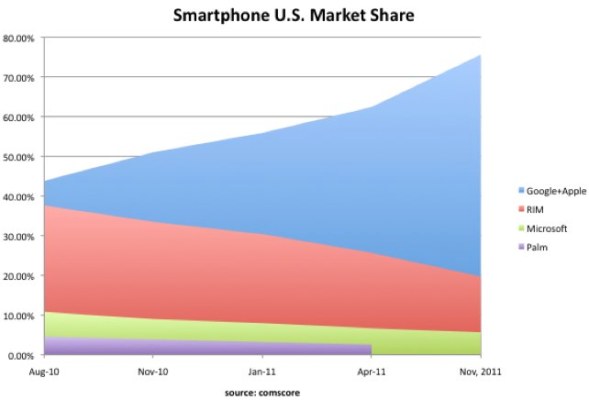
Chart: How Google And Apple Won The Smartphone Wars

Monday, January 2nd, 2012

Erick Schonfeld is the Editor in Chief of TechCrunch. He oversees the editorial content of the site, helps to program the Disrupt conferences and CrunchUps, produces TCTV shows, and writes daily for the blog. He is also the father of three adorable children. He joined TechCrunch as Co-Editor in 2007, and helped take it from a popular... → Learn More

Goog-Apple smartphone share

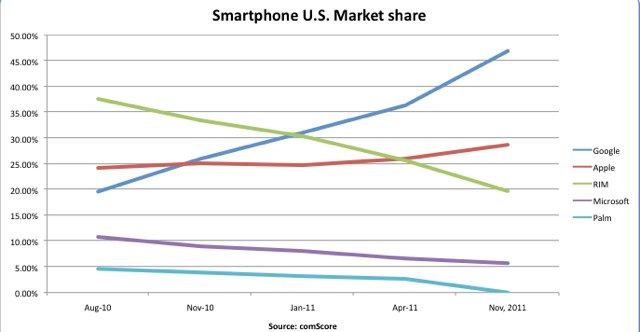
What a difference just one year can make. In our Year in Tech post, I pointed out that 2011 was the year that Apple and Google won the smartphone wars. I put together the chart above from comScore U.S. mobile subscriber estimates to illustrate the dramatic shift in market share in the smartphone market. In less than 18 months, Apple’s and Google’s combined market share of U.S. mobile subscribers for iPhones and Android phones went from 43.8 percent to 75.6 percent between August, 2010 and November, 2011.

During the same period, RIM’s Blackberry tumbled from 37.6 percent to 19.7 percent (an almost 18-point drop). Microsoft’s mobile share was also nearly cut in half from 10.8 percent to 5.7 percent. And Palm, which had almost 5 percent share 18 months ago, basically disappeared (comScore stopped reporting its share).

In the space of little more than a year, Android and Apple gobbled up three quarters of the smartphone market in the U.S. Combined, they gained 31.8 points in market share over this period. When you drill down further, almost all of these gains went to Android, which added 27.3 points of market share versus a more modest 4.5 points for Apple. There is some evidence that Android growth is slowing in the U.S. (nothing can keep growing this fast forever). But the fact that market dominance can shift so rapidly (a year ago, Blackberry was still the single largest smartphone platform in the U.S.) is quite startling.

Shift happens, and it is happening faster than ever. I’d be surprised if there was ever a year when PC market share changed so dramatically.

Product: Android
Website: code.google.com
Company Google

Android is a software platform for mobile devices based on the Linux operating system and developed by Google and the Open Handset Alliance. It allows developers to write managed code in Java that utilizes Google-developed software libraries, but does not support programs developed in native code. The unveiling of the Android platform on 5 November 2007 was announced with the founding of the Open Handset Alliance, a consortium of 34 hardware, software and telecom companies devoted to advancing open standards...

Learn more
Product: iOS
Website: apple.com
Company Apple

iOS is Apple’s operating system for their mobile devices. It debuted in 2007 with the release of the first iPhone, but has since been extended for use with the iPod touch, iPad, and Apple TV. iOS’ user interface relies on users’ direct manipulation of the product screen with multi-touch gestures, including swipes, pinches, taps, and reverse pinches.

Learn more
Website: rim.com
Launch Date: February 23, 1984
IPO: NASDAQ:RIMM

Research In Motion (RIM) is a Canadian designer, manufacturer and marketer of wireless devices and solutions for the worldwide mobile communications market. The company is best known as the developer of the BlackBerry smart phone. RIM technology also enables a broad array of third party developers and manufacturers to enhance their products and services with wireless connectivity to data. RIM was founded in 1984. Based in Waterloo, Ontario, the company has offices in North America, Europe and Asia Pacific.

Learn more

Sponsored Ads

Sponsored Ads

Sponsored Ads