Just last week, Google was promoting the fact that “Google+” was the No. 2 fastest-growing search term of the year in its annual Zeitgest list. And it did have an amazing pop when it hit “10 million members” a couple weeks after launch last summer. People wanted to know what this new Google+ thing was all about. And since it didn’t exist the year before, on a percentage basis the growth in the number of searches for the term was astronomical.
If you are not paying close attention and hear that “Google+” was the No. 2 search term of the year, you might assume that a lot of people are still searching for it. But you would be wrong. The Zeitgeist site shows all sorts of stats about that pop in searches for “Google+” back in July.
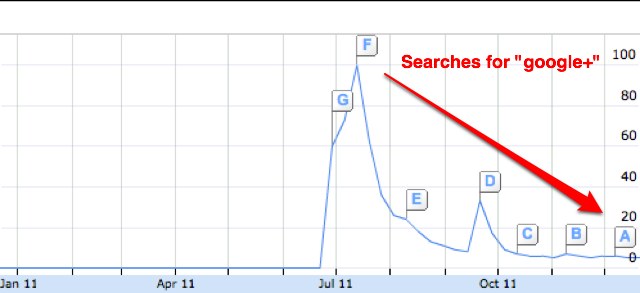
What you won’t find there is the overall trend of searches for the term, and the fact that searches have been declining. In order to find that you have to go to Google Insights for Search, a terrific tool that lets you plot search volume for any term. You can see the chart for “Google+” above. The trend is not good. There was an initial spike at launch, then a lot of hype around the 10-million-user announcement, and then a smaller spike in September when it opened up to everyone. Then the search volume just kind of peters out.
Why is this important? Searches are an indication of pure intent. People search for what they intend to do. Venture capitalists look at search volume data all the time as a gut check to see whether there is any interest in a startup’s product. The same logic applies to products at big companies like Google. If fewer and fewer people are searching for “Google+”, it makes you wonder if anyone is actually using it. Remember, just because Google+ has tens of millions of registered users, that doesn’t mean those people ever came back after Google made them click to register.
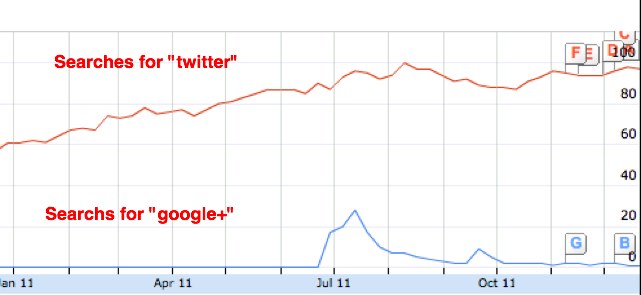
All you have to do for a reality check on this approach is compare searches for “Twitter” to “Google+” (see chart below). Interest in Twitter dwarfs Google+. (Don’t even try to compare it to searches for “Facebook”—that spike turns into a flat line). People search for what they intend to do or want to learn more about. They even search for “google” or “gmail,” but not so much for “google+.”
The fact that the “Google+” line isn’t as big as the one for “Twitter” or “Facebook” would be fine if it was growing. But it’s not. It’s going in the opposite direction.