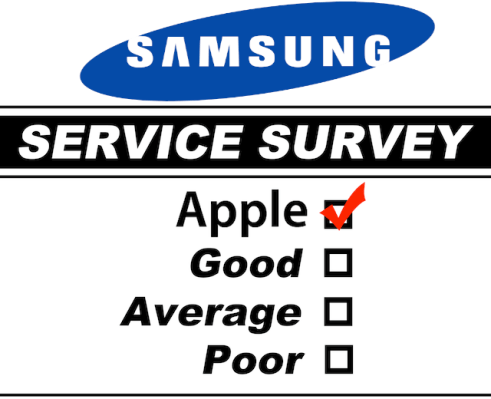
“You’re a copycat!” “No, you’re the copycat!” Apple and Samsung have entered the pre-trial discovery period in their dispute over whose smartphones and tablets violate whose intellectual property. In hopes of securing evidence that even Samsung’s customers mistake its products for iPhones and iPads, Apple has requested that Samsung turn over records of customer service calls where one company’s products were confused with the other’s.
That evidence could help Apple ban sales of Samsung’s Galaxy 10.1 tablet in major markets, so the South Korean electronics company is trying to frame the request as unfeasible. Samsung has now formally denied the request, citing that the request’s broad scope would include calls where customers criticize Apple’s products, which are supposedly so numerous that collecting them from calls where their products were confused would be take too much time and effort.
Yep, Samsung’s defense is that it is flooded with hate calls about another company’s products — products that are consistently rated as having sky-high customer satisfaction. The denial proudly claims customers frequently call Samsung to rave about their products and rage against Apple’s. This seems unlikely, as most people hate calling customer service as much the problems they call about. It may be difficult for Samsung to convince the court to uphold the denial on the grounds that enough users go to such the trouble just to complement them.
Here’s the full-text of Samsung’s flimsy excuse, courtesy of Edible Apple:
For example, it is possible that Samsung customers may have contacted the call centers to comment on how they disliked their previous Apple product, but enjoy using their Samsung product. This would not be responsive to Apple’s requests, because the consumer is not expressing any confusion as to the source of the product he or she was calling about.
If Apple can attain these records, it might find logs of customers asking where to find iPhone or iPad features on Samsung devices, or referring to Samsung features by their Apple titles, such as saying “FaceTime” instead of “video chat”. The holy grail would be Samsung customers calling up and actually thinking they own a device manufactured or associated with Apple because their designs are so similar. The thin excuse seems to indicate Samsung has something to hide.
Even if it did receive a lot of these Apple-bashing calls, it’s unclear whether that would actually make it significantly more difficult to comb through the records. Samsung’s going to need a better excuse. Otherwise, Apple may be able to leverage its popularity and visibility to reference mentions of its buzzwords, ingrained in Americans through marketing, as evidence of intellectual property infringement.