
MG Siegler is a general partner at CrunchFund and a columnist for TechCrunch, where he has been writing since 2009. His focus is on Apple.
Prior to TechCrunch, MG covered various technology beats for VentureBeat.
Originally from Ohio, MG attended the University of Michigan in Ann Arbor, MI. He’s previously lived in Los Angeles where he worked in Hollywood and in... → Learn More
Facebook is the social network. But it’s still not really all that social. Yes, you chat here and “like” things there. But it’s not the same as going out to a bar with a group of friends. Shaker, a new startup launching today at TechCrunch Disrupt, aims to turn Facebook into that bar.
The easiest way to think about it is as a mixture of Second Life, The Sims, and Turntable.fm all mixed together using your Facebook data and connections. Your Facebook profile becomes a walking avatar. Your pictures are placed on an actual (well, virtual) wall. You can choose what music is playing in the room for everyone to hear. And you interact with other Facebook users as avatars. You can even buy people drinks.
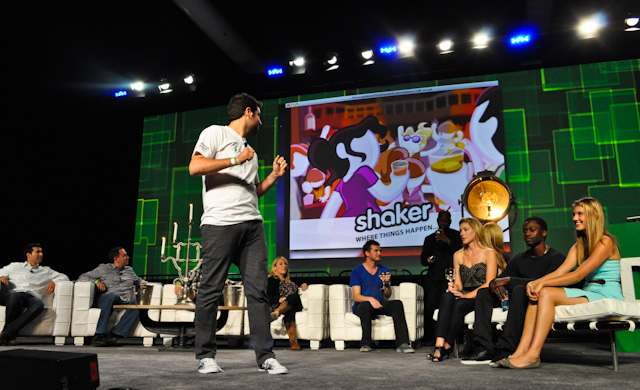
Shaker is a fun, interesting way to socialize on Facebook without feeling confined to the more static and flat elements of the service. Shaker’s idea is that if you can make Facebook itself more like a bar, real social interaction will happen more naturally. It’s one thing to chat with your friends on Facebook, but it’s extremely hard to try to meet new people. That’s what Shaker is hoping to enable.
They do this by using color codes to show you not only your connections on Facebook, but also friends of friends. These are people you may not know, but you have at least one thing in common with — a mutual friend. Shaker also looks at profile information to show what else you may have in common with seemingly random people in the room. For example, you may have the same birthday as someone. Or you may both like the same band. Etc.
Another elements include proximity based chat, a Tweet wall, and a “smart phone” social discovery tool to look up information about people in the room.
The team has been alpha testing a version of the Shaker app in their homebase of Tel Aviv, Israel. The response has been extremely viral so far, the team says. So much so, that they had to shut it down to stop word from getting out too much before Disrupt. As a part of the Disrupt launch, they’ve created a special TC Disrupt-themed room for attendees to hang out in .
Shaker has raised about $3 million in funding so far.
Expert Judges Q&A Session:
Josh Felser, Freestyle Capital; April Underwood, Twitter; Jim Lanzone, CBS Interactive; Michael Marquez, CODE Advisors
AU: There are some interesting concepts here, to make social more fun and richer. But users only have so much time. What are you competing with for time?
A: The time we’re competing with is the time you spend anyway on Facebook. That time is huge — almost 2 hours a day for young people. We’ll make it more fun and casual.
JF: Love the demo. But synchronous model is hard. Asynchronous as well?
A: We did bet on synchronous. It’s a big bet, but it’s one we’re making.
JF: What’s ratio of registered users to simulataneous?
A: We had to block the invitations, it was going viral. We were at 80,000 MAUs after blocking invitations. People complaining that the bars are too crowded.
JL: It reminds me of casual Second Life. But it doesn’t have the gaining users problem. And it gives them something to do.
MM: I like what you’re doing to figure out what you have in common with other users. But what are you doing more than making it about inviting other people?
A: The location system isn’t yet built-in. But we’re using algorithms to bring together people who will be relevant to you.
Presentation:
Awkward moment. We can't seem to plug that music. Okay, we'll do it without music? No music. Alright. I got a feeling that tonight's going to be a good night, that tonight's going gonna be a good night. That tonight's gonna be a good good night. Got a feeling, that's tonight's gonna be a good night.
That tonight's gonna be a good night. That tonight's be a good good night. OK stop. We all know how socializing in real life looks and feels like. And we know that that's not the way we socialize online today. Bet none of you ever told yourself, "I had a great night on Facebook last night And that's not so much because there's something wrong with you or him.
It's because the way social networks are built today, great as they are these simply do not provide those type of experiences. How can you compare this to this.
Yeah.
Shh, ah, what is it? I'm Jonathan the CEO of Shaker and And that's Alfred, another founder and CEO. And we want to present to you Shaker. With Shaker, for the first time, you'll be able to socialize online much like you do in real life.
OK Three weeks ago, Shaker launched a private beta in Tel Aviv. What we're going to do now is dive live to the site and start shaking Okay, start Shakers, the music thing here. so music is important for hangout experiences.
And start shaking. So, I'm dancing Okay, you recognize me? Of course you recognize me. This is me in blue. This is my profile picture on Facebook, hanging on top of my head. Now the People that you see here are real people, hanging out in real time, right now in Israel. It's 3am, so most of them are in their PJ's.
but they're dancing on the bar and listening to the same music. Who are they? The ones in blue and my favorite friends. The ones in yellow are friends of friends, and the rest are gray. People in Shaker act naturally--they walk around talk to other people and grab a seat by the bar. So, lets see who's here.
Yossi. Yossi is our co-founder. We can see here that he's dancing and talking with a girl. She's a friend of a friend. She's yellow. On Shaker, if I want to talk to someone, I have to come closer to approach him so he can see me. Let's try and do that, Andy. So the moment I join the chat, my new manifestation of a Facebook profile just walks there and joins them.
I'm in chat with Yossi and Christy. Now Christy, which is a friend of a friend, while I'm talking to her, I can check her out and see what do we have in common. I can open her profile and see. So, we have four things in common; We're friends with Yossi, our co-founder, that's cool. We're both fans of David Bowie, which is always cool, and we both attended Burning Man a week and a half ago.
So that's three conversation starters Even before I bought her a drink. Will she accept? Andy don't embarrass me. So, one thing you to understand. This girl, Christie[sp?], which I find lots of interest in, is not accessible for me on Facebook. The way social networks Built today. Those kinds of gathering, with relevant people cannot happen.
Let's see what else he's sharing. Profile pictures from Facebook. pictures, I can see some additional info that she is sharing. So, Christie[sp?], feels comfortable sharing some of her Facebook info with people in the room that are here right now. Well, let's have a walk here in the room and see what else is going on.
This is like wall, you can see it. This is the like wall. The like wall are the likes and interests of the people in the room projected on the wall for everyone another one to see together. I can click on one of the 'Likes' and see who likes it. So, for instance, click on one of them She was like a musician and I can see, call actually in route.
I can see what do I have in common from him? this is how I can actually get to know the people around me. Ladies and gentlemen, Shaker opened the private beta just three weeks ago in And it exploded. Tens of thousands of people are flooding Shaker as we speak. They love being able to do more than post and comment.
They love being able to have meaningful social relationships and experiences online. We have been waiting to share this with you for a long time. This is not a game, not even virtual. This is real life. The revolution of experience already begun. Shaker is much more than any specific hang-up. There's a platform of social experience layered on the top of existing social networks.
so obviously the people who are there and the type of venue will determine what kind of experience you're going to get. Imagine, for example, a sport bar, when you can root the team or talk smack. You can imagine Rhianna's fan page turns into a huge concert hall where all of her fans listen to the music.
If it works, and you can imagine Washington Square Park, where NYU freshmen can gather even before their orientation.
It is inconceivable that in the future, fun, casual experiences like those will occur in the physical world only. Some of them will occur online. It's time to bring the social networks to life. So you can log on now to www.atshaker.com And there are exclusive tickets there, for the first to arrive there.
And we're opening, for this special week, a venue for TechCrunch Disrupt, so the people here in the audience can join us, some of the readers. And if you didn't make it in, I see already people getting on it. If you didn't make it in stop by our booth to get a VIP ticket. Thank you. Shaker, everyone.
I have to say LinkedIn would be better if it was like that. That would be pretty cool. Alright, I don't know if the music's going to carry on, so let's, maybe we should all just, no Any questions? Anyone want to jump in? Sure, I have an extra judge just sitting at the end we got a new guy. I will come to you.
I think that there's are some interesting concepts here. It's clear you guys are trying to make the social experience even more. fun and richer. One of the questions in my mind is, you know, users only have so much time they can spend on various services so, what do you think you're really competing with for time, here?
I mean are you competing with dating services, is this a place to meet people that I don't really know? Or do you think that this--you're really, frankly looking to Compete with the time that people already spend on Facebook, and Twitter and LinkedIn and those sort of services? So, Shaker's suppose to be a platform, where you have able to have a venue, really create different experiences.
Different experiences will compete on different sets of time, different sets of people. The time that we're essentially competing with, is the time you spend anyway on Facebook, and the time you socialize on Facebook today, in manners that are not that natural, are not always fruitful. And that time, which is huge, you know that average for young people is almost two hours a day, that time is the time that we can get them on Shaker, at times when they want to socialize in a more casual and fun way.
So yeah, if it's a bar, then when we open the bar in Israel that you just saw, there are many, I wouldn't say dating because it's not dating sites, but it's a clear thing. You see a lot of flirting acts, people dancing on the bar and hooking up together in night.
Josh, I'm gonna bring in. I love the demo, it's as good a demo as I've seen here.
Thank you.
So, congratulations on, kinda, bringing those physical and online worlds together. So I've tried to build a synchronous business myself, and I know how hard it is. So do you also have an asynchronous model also will work in this world or does it have to be synchronous experience.
I must say that we did place our bets on the synchronous model, and I know that it might short in the time of people on the platform, that we are not experiencing that in Israel. We have great time on site--over I think 24 minutes now--which is great But there are not asynchronous natural social interactions.
Imagine that we have this room empty and then each time one of us would come and have his own Social experience, walk away, then another one come. So we're really trying to create that. And I think we have been able, you feel the energy here. we're willing to take the risk of, you know.
So what's the ratio of registered users to simultaneous?
The ratio of how many people? So, until now we've a few rooms, we were able to get, I think the most 1000 was something like that. 900?
We block it, you have to understand, we blocked invitations viable channels in Israel.
There is someone here to blame.
We're standing right now at more than 80,000 MAUs after only three and a half weeks once we blocked in So we're only allowing 540 people to be here at the same time. If you go to our fan you'll see that people are complaining that the bars are too crowded. obviously compare it to the ratio, the population in Israel.
It reminds me of a casual version of Second Life, except that it solves 2 problems that Second Life had. One is getting users. It was always very hard for to attract, and so if you're in Facebook -- and also I think it gives them something to do. People going to Second Life for the first time would spend a half an hour trying to figure it out, and then they wind up with some island with some trolls kicking them into the netherworld.
And this actually brings them with something to do. You know it also, it's like turntable, but you know, the party goes outside of just music. I think that's interesting.
Michael?
I mean I like what you're doing with, you're kinda adding more of the features trying to find out what you have in common with the person, I definitely think it's a more immerse social networking experience. The question I have for you is; you talk about bringing the physical world into the social network world, like, what are you doing that's kinda actually doing that's kinda actually doing that more than just, kind of, making it so that I have to invite other friends into a room?
Is there something that you're doing around the kind of location based services or things like that where, let's say we have fifty people right now they would all be in a room. Can you talk a little more about that?
Oh, certainly. So, location-based systems are not yet built into it, but what we're doing and you tapped into this when you talked about all those commonalities so we use algorithms to bring together people that are relevant to you, based on all those commonalities. So if it's your age group, or your location, or your Affects interest or your a radical place where you live or where you work so you can take this data.
All the data we have on Facebook of social connections. We use algorithms to decide who are the better people that you may want to spend it with. And we learn it, as people gather data.
OK, we're out of time so a big round of applause for Shaker.
Thank you, very much.
I feel like Shaker have discovered the Randomly placing supporters in the audience to cheer at optimal performance, so kudos Shaker. I kind of like the candles. I sort of want You should probably look
Backstage interview:
Guys, how did it go?
Went well. I mean, the music didn't play at first, but other than that, I think, the energy was, you were still feeling the energy and what did you think?
I was really excited; it was great coming here and showing you something that we keep in the heart for a long time. So it was great.
Do you think the judges bought in to your product?
I think so, I mean, they asked questions that were right at the point in the sense of they pinpointed the things that we work on so hard. The algorithms, bringing together people, and the question of what can you do with all the variety we have on the platforms, so, I think very much so. And in regard to Second Life, that question was exactly what we are trying to say.
Is there anything that you guys want to say now that you've had a chance to think about your presentation on stage that you didn't get to say on stage?
Anything special. No. What about hi to Mom and Dad? That was really, we wanted to say that but you know.