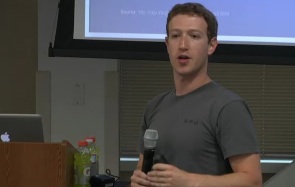

Even as Facebook revealed some new chat products on Wednesday, the elephant in the room was Google’s latest attempt to create a social network, Google+. Mark Zuckerberg tried deflect direct comparisons by saying, “Every app is going to be social.”
But he did make one remark, which suggested how he really feels about Google+ and one of its main features, Circles. Zuckerberg didn’t mention Circles specifically but he did state:
The definition of groups is . . . everyone inside the group knows who else is in the group
This might seem obvious unless you’ve played with Circles. The Circles feature is how Google+ handles groups, but it is not completely intuitive and problems can arise when different Circles collide It is designed to let members set up different groups of people, or Circles, to share things with.
But Circles are one-way, or asymmetric. Everyone sets up their own Circles and nobody knows whose Circle they are in. Secret Circles would be a more apt description. Zuckerberg seems to be suggesting that they are not really groups because instead of everyone in the group knowing who else is in the group, it is the exact opposite: nobody knows which groups they are in.
Circles are so confusing that Ross Mayfield created the Slideshare below to explain it all. Facebook has a “symmetric sharing” model where two people mutually confirm that they are friends, and then can start sharing stuf with each other privately or publicly. Twitter has an “asymmetric follow” model where people Tweet out publicly and anyone can follow what they are broadcasting without that person necessarily following back. It’s one-way.
Google+, however, has an “asymmetric sharing” model where you can share one-way with people, but they don’t have to share back. It’s kind of like the Circle of Trust in Meet the Fockers (watch the video clip in the third slide), only not quite as funny.