
As I’m sure you’ve learned by now, Google recently blocked Facebook API access to download Google contacts. Facebook hacked its way around that, and Google subsequently issued a statement that they were “disappointed”. Facebook Platform engineer Mike Vernal then responded in the comments of one of our blog posts about the slap fight, defending Facebook’s policy and calling it – cough – “consistent”.
And the battle of the Web giants continues.
Take a look at what Google is telling users who would like to download their Gmail contacts’ information and import the data into Facebook (first spotted by Digitizor):
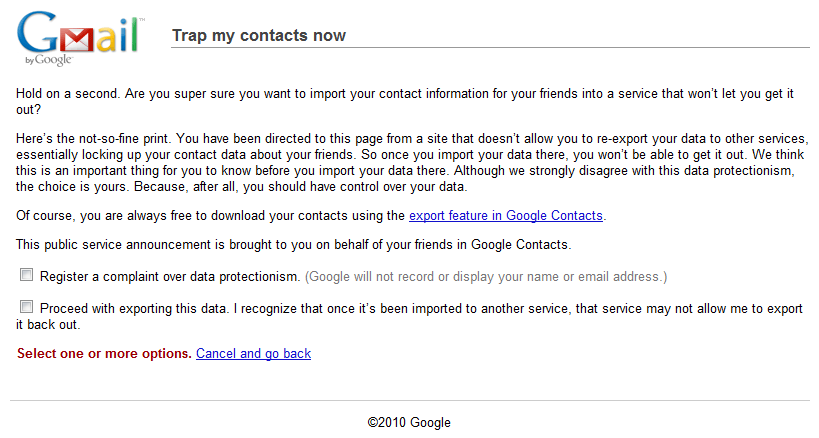
Click the image for a larger version, or read the full notice here or below:
Trap my contacts now
Hold on a second. Are you super sure you want to import your contact information for your friends into a service that won’t let you get it out?
Here’s the not-so-fine print. You have been directed to this page from a site that doesn’t allow you to re-export your data to other services, essentially locking up your contact data about your friends. So once you import your data there, you won’t be able to get it out. We think this is an important thing for you to know before you import your data there. Although we strongly disagree with this data protectionism, the choice is yours. Because, after all, you should have control over your data.
Of course, you are always free to download your contacts using the export feature in Google Contacts.
This public service announcement is brought to you on behalf of your friends in Google Contacts:
[_] Register a complaint over data protectionism. (Google will not record or display your name or email address.)
[_] Proceed with exporting this data. I recognize that once it’s been imported to another service, that service may not allow me to export it back out.
Select one or more options. Cancel and go back
Wow. Just wow.
Yes, that’s Google explicitly warning you that your contacts information will be effectively trapped inside Facebook without the ability to re-export the data, and giving you the option to register a formal complaint over data protectionism (to what end remains unclear).
For the record, they’re still letting you go on with exporting the data if you please. Which unfortunately means a lot of Facebook users will probably do exactly that before reading the warning and understanding the message Google is trying to convey.