With LinkedIn Signal, Twitter And LinkedIn Collide

Wednesday, September 29th, 2010

We were just, we were actually just chatting back stage about nothing at all. Yeah, well.

Things were happening, you know.

I figured.

Jeff, thanks for joining us.

Yeah, of course thanks for having me. Let's meet in about 10 minutes.

Nice to see you.

10 minutes to enjoy the conversations with you left. It's significantly cooler in here than it was yesterday. It was, it was a hundred degrees on the roof. Yesterday it was almost 80 degrees in this room. Yeah. It wasn't pleasant.

Nice and cool. Takes him about an hour to wake up. Okay Jeff, we have a few minutes with you only. So, I really want to get right to it. In last year, founder Reid Hoffman told us that linkedin should go public anytime it wants to. Where do you stand with that? When are you gonna go public? Do you have the manager team in place now to do that? So, I think with regarding on public, it's a question we get asked quite a bit. And ultimately for us, going public or other forms of financing are tactics that enable us to ultimately achieve our long term objective, which is to connect the world's professionals. And we announced, earlier this, we just surpassed 80 million members. By some estimates there's as many as half a billion professionals in the world. And that's growing into some of the developing economies in the world continue to grow. So, still a lot of upside and its very early stages for us, very early. And that would be one potential option we have along the way. So, you refuse to answer that question then? That's the answer for it.

You can't answer it. I know. That's why it's so fun to ask.
Yeah.

LinkedIn has evolved over the years but, not as quickly as some other services and, you recently started making some acquisitions. You just acquired...

ChoiceVendor.

ChoiceVendor. Last week?

Yeah.

Yep. Is that... should we expect more after this in the near future, was that a, sort of a one off or? What are we gonna see here?

Yeah, that's actually the second acquisition we've announced in the last 6 weeks. The first being mSpoke. mSpoke was, both, technology play and a talent play. We're increasingly investing mechanisms to generate relevancy from this huge amount of information that's flowing through LinkedIn.

And mSpoke has a great track record, and they have some wonderful assets and talent. With regard to ChoiceVendor, we've been keeping an eye on those guys for a while to be on a Review site.

And the founders, two extremely talented guys, ex-Googlers, and they've built a really fantastic team. Now we're gonna be able to immediately later them into some of our highest priority products.

So, I think with regard to, to you know, acquisitions going forward., you can continue to see us looking for the the right kind of talent acquisitions, technology acquisitions that would fit such a strategic fit.

We had a chance... you and I had a chance to sit down at the Fortune brain storm event this summer and we did a video interview, which is great but, after that, after we turned the camera off, we then spoke for another half hour and it was actually one of the best conversations I've had all year where you felt comfortable being off camera, I think, or just talking off record about your thoughts onto the internet where we are today.

And, it relates somewhat to -- if you look at John Doerr's statements this year about the third wave of the internet and the main reason I wanted to get you here at Disrupt was so you could talk to the audience about the things that you and I talked about there.

Sure.

Can you start talking about that 'cause it's really kind of stuff? Yeah, just go. Absolutely.

So, what Mike and I talked a little bit about was in the context of the last 15 or 16 years of the consumer web and the evolution of the consumer web which I think breaks down broadly speaking into three waves: The wave of the portal, the search engine, and the social network and interestingly enough, I think each subsequent wave rose out of the fact that the previous wave have unmet need or needs. About the thing that offer you these waves share in common is that ultimately relevancy was a key determinant in the amount of value that was created the amount that was created. The amount of disruption that took place when compared to legacy industries.

So for example, in wave 1, the wave of the portal, there was Yahoo and companies like Yahoo. And their mechanism for relevancy was the surfer for the editor that would manually sift through all of these new sites that were coming on to the web to say, these are the cool sites of the day or to build out a directory which help makes sense of the internet.

The challenge there was that wasn't necessarily built to scale with enormous acceleration in the number of the websites that existed. And so that opened the door for the second wave, the wave of the search engine.

And of course companies like Google built out a massively scalable infrastructure, and you saw again huge disruption and this time, the mechanism for relevancy was the algorithm. And when that algorithm was applied to this huge where Google was growing essentially everything on the web that they could access . It, again, massively changed behavior, huge value was created and we started to search for everything. But as powerful as search is, there are still, at least, three on MET needs. The first, is that wheareas search does a great job with objective fact-based queries, like what's the population of China, doesn't do as good a job with Subjective based queries, like what's the best Chinese restaurant for me? And I think, that was one on MET need. The second was, search engines do an incredible job of returning results for things in the index. But the vast majority of knowledge, ideas, opinions still reside within peoples heads and search engines can't get at that acknowledge.

And lastly, you know, John Batelle once said search is really a database of intentions. You tell it what you want to provide you a result. But a key part of human nature is discovery, serendipity. And so these three unmet needs I believe in part gave rise to this third wave, the wave of the social network. And by virtue of the fact that people are now sharing their identity, building networks and sharing information and knowledge at here to fore, you know, unseen rates. We now have another mechanism to determine relevancy. And I think the key here, Mike is gonna be which of the companies building our social platforms are gonna be able to extract what we used say was a signal from the noise, and now it's really a signal from that never ending stream of information on your computer screen. What, I was actually fascinated by that. But what's the fourth wave? Because that's the one where you can build the next Facebook or Google today, right? 'Cause if you know that, let's go do that.

Yeah so, I think it's a great question. Any idea where that might be in the future? I think it depends. If we take, if we just take a segment of the web. Let's take media for example, which could be instructive for other trends. I think the definitive media company, the definitive digital media company for this century Has really yet to avail itself of these technologies that we now have, and I when I talk about technologies, they're actually very consistent with the 3 waves that we were just talking about.

I think absolutely essential in delivering the media experience that people now expect, there will be 3 components. One is essentially a search operating system or the ability to leverage a machine learning to generate the most relevant content for the individual user.

The second is essentially a social operating system which by virtue of leveraging a graph, you'll be able to drive down the cost of distribution through virality and network effects. And the third is curation and there's no substitute for a manual editor who has their finger on a pulse of a culture, the zite guys, and essentially dropping a pebble into the pond with relevant content that then ignites virality or enables machine learning to suggest that that's most piece of content for others. And what's so interesting about this. This potential emergent trend in media, is that the companies who posess these assets are largely coming at it from their own DNA. A search engine will rely on machine learning more than they will any other elements. A social network will rely on their graph and a pure play media company will rely on editorial or curation. And, I think, the company that takes the lead and really starts to define this next wave in media will converge and integrate those 3 competencies.

You were at Yahoo for 7 years, is that right?

Yeah.

And you were responsible for over 3 billion in revenue? My first question on this is Carol Bartz, will she leave the company before the end of the year or after, do you think?

Sorry, you'd have to talk to her about that.

I thought backstage you were saying you had some information on this.

No. I'll tell you, you know, it's funny you say that, one of the things I've learned...

Here we go, yeah.

Is not necessarily a headline grabber that you're looking for but one of the things I've learned after becoming the CEO of LinkedIn is that until you actually sit in that seat regardless of what the company is, it's very difficult to understand some of the challenges or some of the restrains, the parameters through which CEOs make their decisions. So, you have a whole different sense of appreciation for CEOs of other company.

Okay. If you were the CEO of Yahoo! and now that you have the appreciation of being a CEO of a large company, what would you do over the next 12 months, 24 months to make that company work?

So, I think the direction of the company is going. I think it's increasing focus around media is interesting. Yahoo!'s in a very unique position because if you look at those three competencies we were talking about earlier, Yahoo! who has access to all of them?

So it was a principle in the search engine business. It is now working with Microsoft on the back end of that, still has some enormously talented search engineers, folks that understand how to generate relevancy. And, I think that competency can be applied to elements outside of search.

I think Yahoo is in a position to do for browsing what Google did for search. And I think they can do that by leveraging the engineering talent they have by leveraging implicit social graphs through address books, through buddy list, through integration with 3rd party social networks and platforms and above all else, leveraging what I think is the company's greatest competency which is curation at scale.

Yahoo's home page is still one of the most powerful assets anywhere on the web when it pertains to the digital media. Okay. If LinkedIn vanished Today, God forbid. And you're offered the job to run Yahoo, would you take it under any circumstances?

I am 100% focused on LinkedIn and thankfully we're not going. LinkedIn in my world. Okay, you're not gonna answer it, so. You guys have something new you're going to launch here today. Esteban, is he here?

Esteban Kozak, I think is right off stage and we're gonna be launching.

And what is this called?

It's called Signal.

Signal?

Signal. Okay.

And it's very consistent with this notion of trying to extract a signal from the stream and this is really something that LinkedIn is now investing quite a bit and prioritizing which is how can we generate insights for our professional membership that enables people to be better at what they currently do.

So with that. We need to have Esteban's mic turned on.

Hello. Hello. Here we go. So while we do that, let me tell a little bit about myself. My name is Esteban Kozak. I'm the Principal Product Manager at LinkedIn for Homepage and the activity stream. And at LinkedIn, we're not only seeing rapid growth in the number of members joining this site. We're also seeing an explosion of information being generated by our users. Now, this is great, we love growth. But at the same time it could mean information overload for some of the people consuming that information.

So, one of my goals for homepage is to actually make it a very easy and intuitive venue for any professional to actually extract value from the vast amount of data that flows through LinkedIn on a daily basis. So today I'm gonna be launching this product here, Signal. You all are gonna be the first ones, the first users.

At the end of this presentation, I'm gonna be posting a URL that will let the first 500 people here in the audience -- that URL have access to Signal and we're gonna be rolling this out until -- everyone on it by the end of the year.

So, let's get started here. What you're seeing here in my screen now is the entire LinkedIn stream in real time as it happens.

As you can see, you know, since the time I logged in and now, there's more updates, so I can actually click to see what's new and actually it's real time.

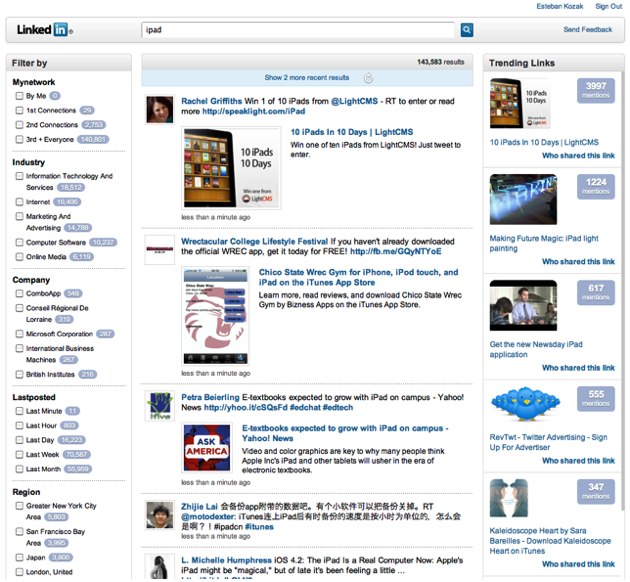
It looks like just a tweet something about this conversation we just had and what you're seeing here is on the left rail, I have the ability now to expand and refine the entire stream based on both my professional graph in all that structure data that we have in profile. On the right rail, here what we see is called as trendy links. We see the most popular links are shared based on under my searched criteria.

So, I have first the reconnection selected. So this is the same view that I would have if I wanna go to my the LinkedIn Homepage. But with Zynga I can do a lot more. For instance, I can see everything that my colleagues at LinkedIn are talking about in just you know, a single click.

So, I refine entire stream into a very narrow slice that I care about. I can also expand my view. So, imagine that I wanna see what all internet professionals in my extended network that live in Argentina, my home country are talking about. I can do that very easily. As you can see working through the filters, I select internet and lastly Argentina, and here we go. Just in a few clicks and expanding that view and I'm looking at everything that this, this population I care about is talking about.

Now, I can refine, I can expand the entire stream and I can actually search it based on any topic.

So TechCrunch is a big topic this week. So we're gonna give that a try. We're gonna search for TechCrunch.

You can see what people are saying. You can see, you know, the trending links at the top, not surprisingly, you know, the acquisition is a big news.

Now Mike, would you like to know what AOL employees are saying about TechCrunch?

All right, let's give it a try.

We're gonna actually go to here, at AOL . Bring it in. So 78 posts. And here you have that exact conversation.

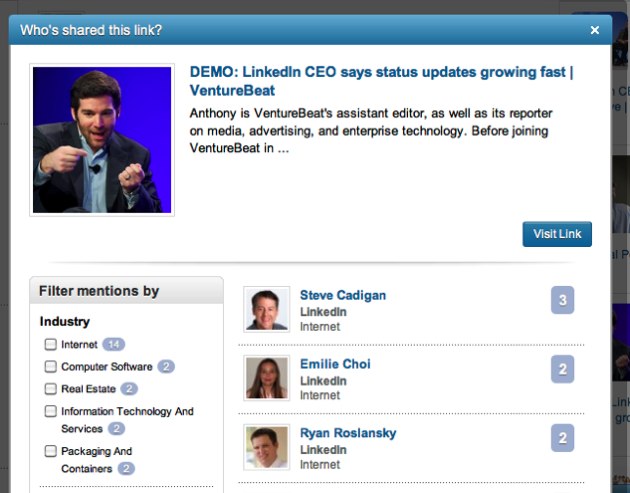
You're seeing what these employees are saying about TechCrunch, in just one click. Now also, what we can do is, you know, based on any link that is shared , we can see who shared that link. This is the professional graph.

So, if I click on the first article, I go to the article but I can see who shared this link. So, I'm looking at right now are all the people that share these particular, you know, link, this article and again, refine based on industry company and region.

So, once again, I could very easily see who AOL shared that particular link. One of my favorite things to do is actually search by name, I think it allows you to basically see everything from and about anyone.

You know here in California, there is -- We're gonna be voting for a new governor coming up in November, Meg Whitman, former CEO of eBay is running.

So, we can search for her to just get a sense of what we were saying. So here's a conversation, you know, in real time, top articles about Meg Whitman and one of the interesting thing is that now if you look at the company you know, our filter here. I can actually see what the Jerry Brown campaign is saying about Meg Whitman. And then I click on that. I just wanna warn you, I'm not responsible for what they're saying. But , let's check it out.

Here it is. This is what what they're saying. And, as I scroll through you can see that even Jerry Brown is part of the conversation here. And this is actually, you know, I click on the profile. This is Jerry Brown's profile. Attorney General of the state of California. There is just one last thing that I think it's pretty powerful. You know, not only I can actually , you know, search or refine. Signal is actually a great way to accomplish, you know, any tasks for most professionals.

So, imagine I'm a job seeker. I'm looking for a Jay Ruby job at Google.

Ruby is a fairly new forum language.

So what I'm gonna do is, I'm gonna do, I'm gonna search for Jay Ruby and then I wanna see what Google employees are saying about Jay Ruby. I click on Google. I can scan that conversation. I can see that John here happens to be a second degree and he actually is going to [xx] this week. So let's check his profile. I can check him up and actually, I'm gonna see who in my network could actually provide a warm introduction and see some here are interest in Google. I'm gonna check Google's page on LinkedIn.

We just actually launch the new company pages yesterday. And what we are seeing with here is a personalized view of Google. I'm seeing my connections working at Google today. I can see jobs at Google. I can even follow Google. T here's 67,000 professionals following Google right now, learning the second Google posted job, learning what that job is all about and if they want, just you know apply tight from there.

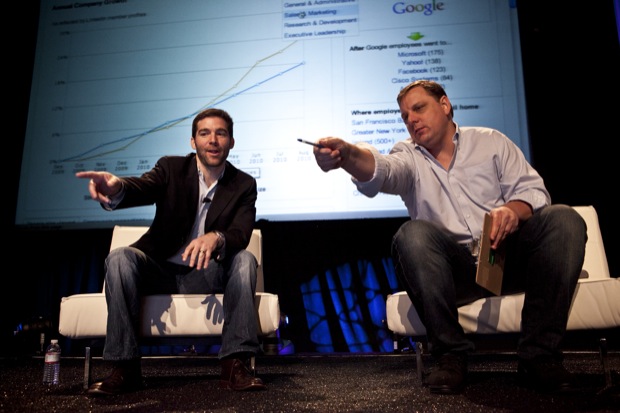
And I can also check stats. This is actually one of the most coolest thing about of how many pages, you know, based on the school I attended I can actually see my chances of landing a job at Google as the distribution based on top schools, and if I'm interested I can even, you know, see how they, you know they stuck up against industry standards on the RnD spending. One very cool thing about this page is it's also being able to see where people are, you know coming in and leaving from Google. I know Mike used this recently in one of your posts. So with that, I wanted to close this quick demo, and as I promised, I want to give the first hundred people access. So, what I'm gonna do, I'm gonna post on LinkedIn. This is gonna be available in profile and on any real time search engine that you like. So with the URL that I have here, the first five hundred people will actually have access to LinkedIn Signal, and please send us your feedback and we're looking forward to round this up to all users in the next couple months. It's freezing up here, which is better than it was yesterday. I think that's pretty cool. I saw this last week briefly, although you guys bought lunch for us so I was somewhat conflicted but it's awesome. I think the thing that is interesting though is as a user, you have to link yourself into Twitter. You have authorized it through the API and I think people will start to do that .

But, once enough people have done that, I think the data starts to get -- it gets really interesting. Well, just to be clear, if you want to integrate your LinkedIn status on Twitter and vice versa, you bind your accounts but everyone who now have access to Signal will have access to these streams regardless of whether or not they have authenticated.

Thank you very much. Thank you.

Thank you. Next stop Eric is going to interview Yusuf. I got

LinkedIn’s CEO Jeff Weiner has just unveiled LinkedIn Signal at TechCrunch Disrupt, a new feature that neatly marries the worlds of LinkedIn and Twitter and allows users to apply the professional social network’s filters to Twitter’s firehose. Think of it as a window into Twitter (and LinkedIn’s updates), through the eyes of LinkedIn.

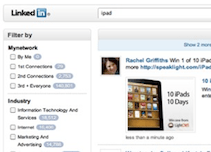
LinkedIn Signal, which is currently in limited beta, allows users to sort through Twitter updates of LinkedIn members (you opt in by syncing your accounts) and the site’s own updates on a very granular level. The feature’s page offers three main panes, on the left side there is a dynamic list of filter options, the mid-section shows the stream of relevant updates and the column on the right shows “trending links” that may be relevant. So far, there are 8 main filters: network, industry, company, the date the update was published, by geography, school and hash tags (all powered by LinkedIn’s structured profile data).
Signal guides you through your query by showing the number of results per filter option, which helps users decide whether their filter is too broad or too narrow. The search feature, which can be set as a user’s homepage, lets you save past searches, allowing you to track tailored topics, like comments about your boss.

The trending links column is also interesting here because it tries to surface special links and news stories related to your search— as the company points out in its announcement, a search for “TechCrunch” will yield different results than one for “Meg Whitman.” Amusingly, you can also see which LinkedIn users have shared a link (this is sortable by industry, company and region). Just like Twitter’s “trending topics,” the section not only encourages user engagement but it provides a possible monetization opportunity. “Promoted link” anyone?
So why does this matter?

LinkedIn Signal is somewhat limited since it only pulls in its own updates and Twitter’s feed (the company is considering future tie-ins), which of course has to be confined to LinkedIn members, in order for all that data to be sortable and make sense. However, LinkedIn’s size should make search results fairly meaningful— according to the latest stats from LinkedIn there are more than 70 million users and the site’s status updates have grown 10x in the last 12 months.

Beyond a curiosity, I could see this becoming an interesting tool for researchers and professionals, especially journalists like myself. For example, if the CEO of a multi-billion dollar technology company was abruptly ousted by his board (not thinking of anyone in particular here), within seconds, I could find out what that company’s employees were saying about the CEO and what links they were pointing to.

However, at the heart of this is LinkedIn’s attempt to be more relevant and social in the world of, well, social. Personally, I signed up for my LinkedIn account because I wanted a more professional alternative to Facebook for my work contacts and it’s been an indispensable tool for this reason. However, while I interact with Facebook and Twitter on a daily basis, I don’t feel compelled to visit LinkedIn with any real regularity. That’s the consumer pattern LinkedIn needs to change. As we’ve seen from Signal and from recent product announcements, such as the new social layers wrapped around groups, LinkedIn is certainly driving in that direction, now, will the consumer respond?

Intrigued? We have exclusive access for 250 TechCrunch readers, click here.

Here is Leena Rao’s backstage interview with Weiner:

Jeff Weiner is the CEO of LinkedIn, where he started in December of 2008 as Interim President. He came to LinkedIn from positions as an Executive-in-Residence for leading Venture Capital firms Accel Partners and Greylock Partners. Prior to joining Accel and Greylock, Weiner served in various leadership roles at Yahoo for over seven years, most recently as the Executive Vice President of Yahoo’s Network Division. In this position he led a team of over 3,000 employees, managing products reaching...

Learn more
Company: LinkedIn
Website: linkedin.com
Launch Date: May 1, 2003
IPO: LNKD

With over 100 million users representing over 200 countries around the world, LinkedIn is a fast-growing professional networking site that allows members to create business contacts, search for jobs, and find potential clients. Individuals have the ability to create their own professional profile that can be viewed by others in their network, and also view the profiles of their own contacts. Competitors to LinkedIn include sites such as XING, Doostang and Ecademy. Of note, LinkedIn won...

Learn more

Sponsored Ads

blog comments powered by Disqus

Sponsored Ads

Sponsored Ads

Upcoming Events

SXSW 2012

Austin, Texas

Disrupt NY 2012

New York City

Disrupt SF 2012

San Francisco, CA