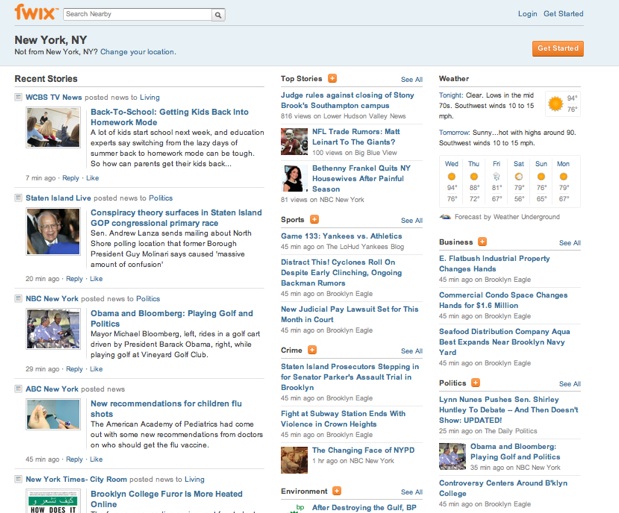
For the past two years, Fwix has been building a hyperlocal news site for cities and neighborhoods around the country in a very automated fashion. Its homepage for every city has been three columns filled with recent news and blog headlines, along with other local data like weather (see second screenshot below). Today, it is scrapping that approach to become more of a hyperlocal places directory.
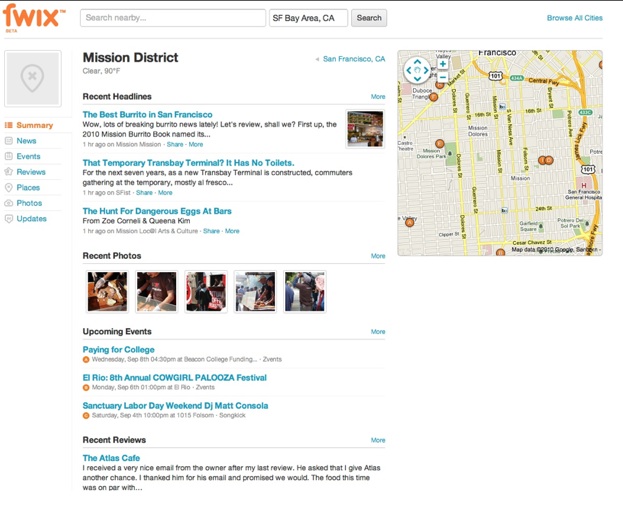
“We are automating Patch and building richer places pages and city pages,” says CEO Darian Shirazi. With everyone on the Web crazy for Geo and trying to tap into local commerce, places directories are becoming more valuable. (They are also better for SEO). Whereas AOL’s Patch is building out a directory of places in 500 small towns by hand, Fwix is creating an automated directory filled with maps, news feeds, events, photos, reviews, Tweets, status updates, and check-ins.
In a sense, Fwix is really a cross between AOL’s Patch and Google Places, which is also created by automatically indexing of parts of the Web. Fwix can create a places page for 50,000 neighborhoods and 15 million businesses and points of interest. It culls local data from 30,000 blogs and news feeds; status updates from Twitter, Foursquare, Gowalla, Google Buzz, and BrightKite (but not Facebook); geo-tagged photos from Flickr, Smugmug, and Picassa; local deals from Groupon, LivingSocial, and MobileSpinach; evets from Eventbrite, Eventful, Zvents, Stubhub, Ticketmaster, and Upcoming; reviews from Yelp, Citysearch, OpenTable, Yahoo! Local, and Zagat; and government data from SpotCrime, FixMyStreet, and SeeClickFix.
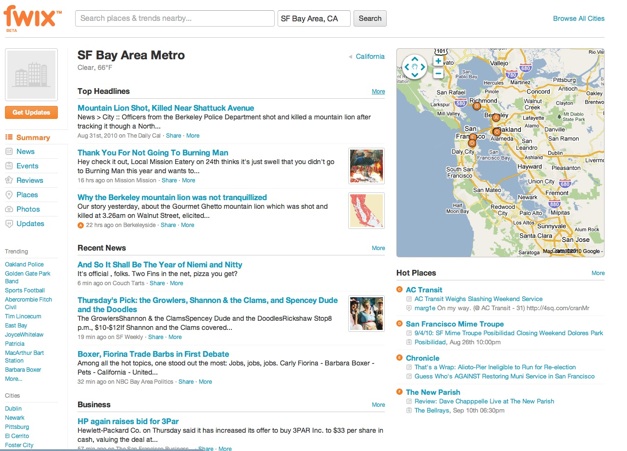
The layout of each page is now centered around a map with dots linking to recent stories, check-ins, Tweets or what have you. In the middle column there is a stream of recent headlines, geotagged photos, events, and reviews (most of which are linked to the dots on the map). Below the map are hot places where a lot of check-ins, news ,a nd Tweets have been occurring lately.
When you are looking at a city level view, the left hand navigation bar lets you zoom into specific neighborhoods. Each business or place also has its own custom page. Fwix also picks up trending keywords from local news feeds and Twetets.
Most of the individual elements which go into Fwix’s new places directory are available through its API, although the completed directory is not. As I’ve argued before, it is time for an open places directory so that companies can stop duplicating efforts contribute to one big places directory that keeps getting better and better for everyone. The problem is that a lot of licensed business directory data is mixed in with the open stuff, but we’ll get there some day.