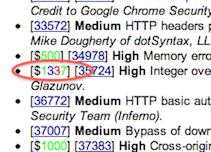
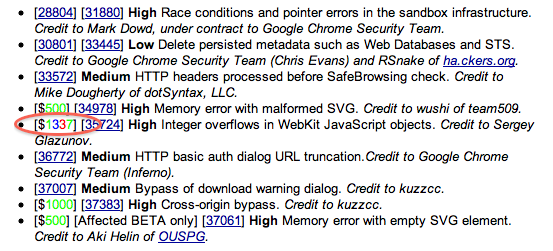
Back in January, Google announced that it would follow Mozilla’s lead and start offering cash bounties for bugs found in the code of Chromium (the open-source browser behind Chrome), or Chrome by the community. Google both matches Mozilla’s $500 and ups the bounty all the way up to $1,337 (yes, 1337) for “particularly severe or particularly clever” bugs. This week, they rewarded the first of those.
As noted on the Chrome Release blog, Google made four cash payments on Wednesday. There were two $500 prizes (both for memory errors), one $1,000 prize (for a cross-orgin bypass), and the first-ever $1,337 prize. The lucky receipient of that was a man named Sergey Glazunov, who located a bug that Google is calling, “High Integer overflows in WebKit JavaScript objects.”
This crowd-sourced bug hunting seems like a great idea, especially for a browser moving through development as quickly as Chrome. Chrome has only existed for a year and a half and already they’re testing version 5.0. Stable builds of both the Mac and Linux version of the browser are likely to launch at some point over the next few months.