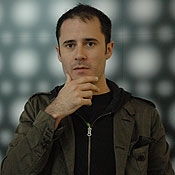
 We’re here at the SXSW festival in Austin, Texas where Twitter co-founder Evan Williams doing a keynote Q&A with Umair Haque. Williams may use the time to talk a bit about Twitter’s upcoming ad platform. Update: It’s actually an “At Platform” called At Anywhere — more here.
Interestingly enough, Twitter saw its first burst of popularity three years ago at this very conference.
Below find my live notes (paraphrased):
UH: Ev you have something pretty interesting you want to say today?
EW: Yeah, we want to announce something. We wanted to announce our new “At Platform” (undoubtedly to be spelled an @ Platform) – a way to integrate Twitter into any website. “At Anywhere” – basically this allows you to place the Twitter hovercards on any site. We have 13 sites we’re launching with including Amazon, ebay, Yahoo, Digg, Bing, Meebo, Salesforce.
UH: So what can you do with this?
EW: You can easily tweet from any page that is using this. Also, maybe you want talk to authors of posts without going to Twitter itself, you can just hover over their name and tweet them. Twitter is a very easy way to keep in touch.
UH: So this helps you contextualize information. But why would sites use this?
EW: A connection to users you didn’t have before – and it keeps people coming back. And it will result in more followers for a site. Also, hopefully more people who are your fans using twitter to talk about you or your content. And you can bring in users’ tweets talking about your site.
UH: So it’s a platform to juice up site’s networks and virility. But it’s an “At Platform” not an “Ad Platform”.
EW: Yeah, it’s about lowering the barrier for information.
UH: What makes 21st century businesses different? Like Twitter? The first principle to me is experimentation. Why are you willing to explore different possibilities?
EW: Experimentation lets you create value. “Whatever you assume when you start out, you’re wrong.” Most of the great businesses of our time have experimented. Like Google.
UH: So it’s about creating value, then figuring it out?
EW: Yes, it’s about creating experience for users and businesses. There is a ton of business use on Twitter today — it’s one of the biggest uses. We want to make that better, easier, faster.
UH: What is Twitter evolving to?
EW: What is Twitter has always been a tough question to answer. We think of it as an information network — different from a social network. It’s about getting info and also sharing. You can take advantage of Twitter without sharing anything about your life. We need to increase the signal-to-noise ratio.
UH: So better information, better connections, better choices.
EW: Yes.
UH: Experimentation is about iteration. So how does that happen at Twitter?
EW: We have a bunch of awesome people in the company now. We’ve grown very quickly over the past year. Our employee growth curve is almost like our user growth curve now. We have people on focused teams, like mobile, or internationalization. We’re worried about central thinking and slow processes. So we tell our teams to “go for it.”
UH: So what’s your role?
EW: I don’t get into the nuts and bolts of code, cause things would be a big mess. I spend most of my time thinking about the high level issues. And I think a lot about the company – how do we scale the company, about our culture, etc. How do we define the characteristics we want. I think there is a parallel between the service and the company — openness is huge, transparency.
UH: So openness is very important. Help us trace the arc of openness at Twitter.
EW: Yeah, it means a lot of things. We debated if openness or transparency. “A window is transparent, but a door is open.” The users have taken Twitter and morphed it into what they want it to be. Now developers are doing the same thing. Openness is really a survival technique.
I sit down with new employees when they start and go over 9 assumptions you should have about working at Twitter. One key one is assume there are more smart people outside the company than insides.
UH: What about giving the golden goose away? Why be so open?
EW: That was a big question for us – the deals with Bing and Google. These were the first guys we shared our full stream with. There’s a lot of debate about that. Because we don’t have a business model yet, so why give it away? But we went back to the principle of giving users the most value.
There are 50 million tweets a day, how do we show you the best ones for you? Right now, we don’t do a good enough job of that. But with these partnerships, we have more chances to do that.
UH: Was there a lot of internal debate about this?
EW: Yeah, there was a ton. But we decided it was good. And now we’ve expanded the deals – like with Yahoo. And a few weeks ago we talked about giving this data to thousands of others.
Now third party developers are building a lot of value. Like adding pictures to Twitter.
CoTweet and HootSuite are really interesting too. Twitter.com isn’t a good interface for doing customer support, but those guys are. CoTweet just got acquired by a company that wants to focus on that more.
We’d love to see much more focus on creating these deep experiences that create value.
UH: So experimentation and openness. Other companies want control, like Apple. How open are you guys?
EW: We’re pretty open – there is some control we need to employ because if we were infinitely open we’d be doing a disservice to users. Openness can work against you still. It has to be managed a lot. Having an open API makes it easier to make apps that will spam users. We send cease and desists everyday to companies making spam tools. We have to exert some control.
UH: I think shepherding is a good way to put it. So you had some interesting use recently – such as the earthquake in Chile.
EW: I got an email recently about the earthquake, thanking us for helping with the situation. This is very gratifying for us because we’ve always held it important for Twitter to reach the weakest signals in the world. We started out with a big focus on SMS – and it’s still really important to us. Because it reaches so many people. We have deals with 65 carriers around the world to send these SMS tweets.
We’re at the beginning. We’re seeing really strong growth in India where SMS is huge. And in the Middle East.
UH: I think this changing the world stuff is the future for entrepreneurs. It gets to the heart of the point about inclusiveness. So – what is an “active user”?
EW: To me it comes back to – is someone getting value out of Twitter? If they don’t have an account it’s hard to know, like people who search Google for tweets. In the beginning we put a lot of focus on telling the world or your friends and family what you’re doing. But now there is something interesting on Twitter for everyone – like the Flaming Lips being on Twitter, you can get updates on the band.
And as more people start getting information on Twitter, they’re more likely to get involved.
UH: Someone has started using Twitter inside the White House, right?
EW: Yeah, it’s really interesting that it’s from in the White House. It’s an official channel, but they’re using it a different type of way. It’s about reducing the walls between people with a lot of influence, and those who they influence. And that’s the most profound promise of the Internet. This is the wave I started on 10 years ago with blogging. It’s about the democracy of information. Anyone can put information on the web — that’s huge.
UH: Tweet Minister in the UK aggregates the tweets from members of parliament. This is re-wiring society in some ways. But we also have a counter-force – like state control of information.
EW: In some regions, yes, this is bad and hurting the web. But the Internet is a tidal wave that you will not be able to keep out. Like in China, who knows how long those firewalls will hold up – but not forever.
UH: Yes, there are many ways to get through the firewalls already. There’s a lot of pressure on them.
Let’s talk about “betterness.” I booked a trip to his five star resort in an exotic land. When I got there, it was a shack. The manager couldn’t do anything — so I put it on Twitter. Within 15 minutes the booking company called me, and in 20 minutes I got a new hotel. In a half an hour my vacation was fixed.
EW: That’s great. Our hope is that this is the norm, not a fluke. We have a bit of a dichotomy, because there is more everyday you want to search for. We don’t just want to maximize that, we hope to make Twitter more useful to you. We want to decrease time you spend on Twitter, not increase it.
Recently we went through a process to define our operating principles. The number one principle is “be a force for good.” Another principle is “pay attention.”
UH: David Pogue did a campaign against hidden charges from the carriers. It’s the same thing with the hotel operator and me. I know you’re a big fan of Warren Buffet – he also believes in creating real value.
EW: Yes, from a business perspective, Twitter needs to fundamentally be about helping people make better decisions. Or the help something happen that normally wouldn’t. Like the donations to Haiti through text message — we weren’t taking the money, but it spread virally through Twitter. People want to help each other out, we need to reduce the friction.
UH: Is that what you want to do with the new At Platform?
EW: Yes, totally. We’ll see what happens, the obvious stuff is more tweeting, but I think it’s a lowering of the friction as well.
UH: You ask yourself, how would i make Walmart better? Why ask yourself that?
EW: Because as we look at how businesses are using Twitter – we want our tool to help businesses get better.
The world is so often a black box where there is no communication. There’s a lack of dialogue and a lack of transparency. The promise of all these technologies is that this goes away. You close the loop.
UH: Outline for us your big picture goals.
EW: Fostering the open exchange of information. To be a force for good. The ease of exchange of information is important. Help out other people with something as small as a retweet. That’s our ambition.
UH: Google is all about archiving the world’s information. Yours is different — creating new information.
It’s all about advantage though – what’s your advantage.
EW: Our advantage will only come if everyone wins. We only do win-win deals. Because any deal where someone is losing is unsustainable. That’s why we haven’t turned on the revenue yet — there’s a lot of low-hanging fruit, but none of it is sustainable.
Creating an advantage for other people and not giving them a reason to work around you – that’s key.
UH: Is the Internet making a better media industry?
EW: I think there’s a huge shift going on – but it’s an ecosystem where everything is involved. This user-generated content just makes things richer. Blogging and traditional media work together. Twitter compliments traditional media. I was talking last night to some guys from CNN – it’s helped them change what they do. It’s a win-win.
UH: How will the At Platform speak to that?
EW: Hopefully these guys will us it to get the new out there.
UH: What makes you tick?
EW: There are two types of entrepreneurs. What drives me is creating things that didn’t exist before. Your product or service should be at the end of the sentence: “wouldn’t it be awesome if…”
It’s creating new stuff versus extracting from old stuff. There are people who look at money as the goal versus the teams. I create businesses to make new things. It’s a fuel for creating more things in the world. I’ve been lucky to stumble upon things that have helped change the world.
UH: Why focus on these things though?
EW: Largely luck. But maybe it’s what interests me. Twitter was a side project of Odeo – my cofounders came up with it. Blogging was a side project too at one point.
UH: If something is awesome, people will use it.
EW: Yes.
Also, helping others succeed is a sub principle of ours.
UH: Tell us one or two more of them.
EW: Be a force for good, pay attention — make things happen is another one. There’s also building a culture of trust.
UH: What are your big lessons to other entrepreneurs?
EW: Create something you want to exist in the world. Another is focus. Many people are trying to do a lot of things when they should be doing one thing. You may be wrong with whatever you’re trying out, but you’ll try other things.
A lot of the great companies are now coming from outside Silicon Valley. You don’t have to be there.
That’s a wrap.