TechCrunch Disrupt Is Coming May 24-26 »
Late Last Year, Google Overtook Apple In WebKit Code Commits
by MG Siegler on Feb 6, 2010

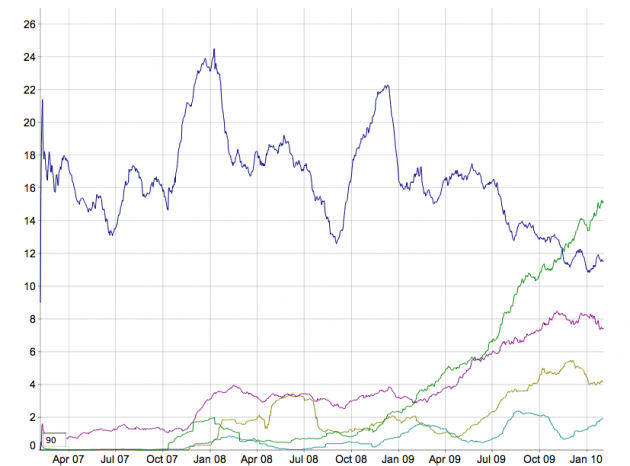
Today, the blog Chromium Notes, which is written by a developer who works on the open source project (that Google Chrome is built on top of), posted a very interesting graph: one that shows the number of code commits to WebKit. Notably, it appears that Google has overtaken Apple as the organization that contributes the most commits to the open source project.

Now, the author is quick to point out the caveats of the graph (and does so for four paragraphs), and notes that he was hesitant to even publish it because of how easy it is to misinterpret. The graph, while it shows commits, doesn’t weigh more important ones versus less important ones. Nor does it in any way measure the ways in which companies or individuals contribute to WebKit in other meaningful ways. That said, it does clearly show that in late 2009, Google surpassed Apple as the company that now contributes the most (again, in terms of commits) to the project.

WebKit is the open source web browser engine that both Apple’s Safari and Google’s Chrome browsers (among others) are built on top of. As such, it should be obvious why both are so heavily involved in the project (others on the graph include Nokia and BlackBerry maker RIM).

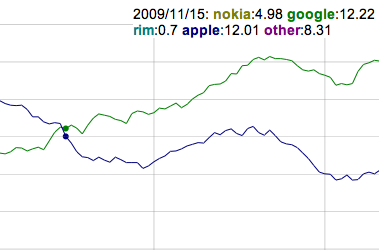
The graph ranges from 2007 to the present. According to it, on November 15, 2009 Google surpassed Apple in number of commits for the first time. Google has been ahead ever since, and the gap between the two appears to be growing. That said, the two big spikes for Apple came during major releases of Safari, so when Apple releases another version, it could spike up ahead of Google once again.

I’ve included a picture of the graph below (Apple is the blue line, Google is green, “Other” is purple, Nokia is gold, and RIM is light blue). But be sure to check it out on Chromium Notes’ site as you can drill-down to see more detail there. The author has also posted the code for the graph on github.
Advertisement
Advertisement

Comments rss icon

  • So this graph really doesn’t mean anything. A nice follow-up to this story should be asking programmers what they think of people measuring commits. Also, asking the ever popular “How many commits were done to fix previous commits?” might be fun.

    • Jean-Michel Decombe - February 6th, 2010 at 4:42 pm UTC

      +1

      It is extremely complex to come up with any sort of meaningful measurement. At a minimum, you have to take the feature and bug databases into account, weigh each individual entry, and see how each commit affect them.

      Generally, it is better not to publish anything than to publish something meaningless. Although… there is always the positive aspect of fostering discussion around the given topic and educating people.

    • +1

      A great post showing meaningless data… what… whatev. How many of the commits were to add and remove spaces for tabs?

      • Means absolutely nothing in terms of contributions to the code base.

        But it tells us that both Google and Apple are actively developing the framework.

    • Commits slowing down means that there are fewer bugs to fix, fewer new features left to implement in the raw engine which is A GOOD THING.

  • “That said, it does clearly show that in late 2009, Google surpassed Apple as the company that now contributes the most (again, in terms of commits) to the project.”

    How can you say that after the disclaimers right before that sentence? Without adding a weight to the commits, the number is absolutely meaningless. Some days I only post one commit to SVN at work, but it’s huge. Other days, I post many that are really minor.

    This blog post is really just fluff. If you want to spark discussion on who is truly contributing more, investigate and find out what was in the commits.

  • This is non news. As the story reads, Apple’s commits tend to spike when Safari is near a release. Safari is in the middle of a development cycle now. Plus, keep in mind that Apple did the bulk of the heavy lifting on WebKit. By the time Google got around to committing to the project, it was already the fastest, most compliant rendering engine in the wild.

    • What about the KDE guys? They created KHTML aka WebKit in the first place.

      • Thiago Bocato dos Santos - February 7th, 2010 at 5:21 am UTC

        Only to add: the WebKit core, rendering and Javascript processing was developed by KDE team and the by the time when Apple entered the project the mess started. Shitty code, bad communication and low will to collaborate. A lot of dirty work had to be made by de KDE team to put things to work together. Apple don’t have authority to talk about open code. They are notorious for mounting on another people’s work and taking the crown. And if Flash works bad on Safari, some blame are theirs because they deliver a lot of confuse API changes and break the code continually. Apple don’t have even moral to blame Adobe staff.

        • “And if Flash works bad on Safari, some blame are theirs because they deliver a lot of confuse API changes and break the code continually”

          Nope. For example : http://flashcrash.dempsky.org/
          Flash crashes under Firefox and Chrome too. The only not-so-bad version is the ActiveX one for internet explorer, which is less buggy.

        • Hey Thiago – It’s called a fork. Apple took KHTML and forked it to create WebKit. Apple has been pretty good about documenting the changes they’ve made so the KHTML team can commit patches back to KHTML.

          KHTML was a good starting place, but let’s be honest. If it wasn’t for Apple’s (and now Google’s) development resources, the KHTML line of rendering engines would have never developed to where it is now – which is the fastest, most compliant rendering engine available – on any platform.

    • Thiago Bocato dos Santos - February 6th, 2010 at 6:09 pm UTC

      And how about the contribution from KDE/Konqueror? The comment speaks like only the rotten fruit contributed to WebKit before Google. Konqueror/Chrome are my fav browsers. And Chrome on Linux makes Safari eat dust.

      • ok, you’re just an Apple hater. your previous comment was BS too. that story about the KDE team and their “perfect code” messed up by Apple is just a joke. btw, did you use Konqueror a few years ago ? i think you didn’t.

        Anyway, just download and read the source code : WekKit’s code is super clean. then you can download and look at the Firefox’s source code to compare…

      • Try this little exercise, sparky: go check out the snapshot of KHTML before and after Apple made their big check-in when right after Safari 1.0 shipped. Learn something, and then STFU.

  • Webkit browsers will probably have 90% or more of the market before the year is up. Webkit unlike other open source browser initiatives has the support of well armed and extremely successful companies. For these folks, webkit is the fastest way to change the web browser landscape and influence how the web can evolve. As IE falters and Mozilla gets bloated, Chrome, Safari and others will dominate web browsers. Soon video without Flash will be common, super fast JavaScript will deliver easy to code desktop type experiences for a whole class of applications and the web browser will fulfill its potential as THE universal computing platform.

  • Well put Google and Apple in one title, people are gonna click~~~

    I now understand why Andy Ihnatko quit Apple vs Google for one month.

  • Some people work for weeks on their local machine and commit once in a great while when they have fully developed and tested a feature.

    Some people commit half done work every day as progress in a development branch.

    So what does this really mean? Probably nothing.
    How much of this code was reverted or never merged to trunk?

    • > Some people commit half done work every day as progress in a development branch.

      That’s the way it should be. When working with a team, committing only once every few days (or even weeks) is a very bad practice as you’re likely to break other people’s code

  • I think the important point here is that Google is committing significant resources to the WebKit open source project. Whether they do more or less than Apple hardly matter, because now we all get to use better web browsers.

  • Jean-Michel Decombe - February 6th, 2010 at 4:23 pm UTC

    The number of commits is meaningless. Some people commit every five minutes.

  • I used to know someone at work who thought SVN was just an “annoying type of FTP client” and was doing hundreds of commits per day. Needless to say he wasn’t around for long…

    • I’m sorry, I have to call that as probably being bullsh1t as authentic and entertaining as Robert Scoble stopping a driver from using his cell phone right after somebody at Google did the stunt first.

  • Duh? Google’s whole strategy “OS” thing is a fracking web browser … they have nothing else. ;)

  • One would think Google could get their code right the first time, but no, everything Google is beta.

  • So Apple does most of the development for 2 freakin years and in 1 freakin month Google commits more changes than Apple and this is news?

    MG i am dissapointed in you.

  • Competing in amounts of commits is like competing in who uses CMD/CTRL-Z the most.

    Next headline: “ZOMG, Google made less typos than Apple while contributing to the webkit project”.

  • WebKit was originally derived by Apple Inc, so Booya!!!!

  • Looking forward to hearing more about Google phones this year too

  • getting really tired of reading techcrunch. less and less each week…

  • Seems no posts here from anybody actually doing anything on Webkit, just cheerleaders and those, like myself, who think the meme might matter.

    It might be interesting to have some live examples of what a “commit” means from different sources. Even — especially! — from a knowledgeable person not affiliated with either Apple, Google or Nokia. For now, can anybody say anything more insightful than “multiple teams are involved in Webkit?”

  • what a pathetic article by a pathetic journalist.
    MG Siegler go get a life. A total meaningless article with no data to back up.

    I can do 10 million useless commits that surpasses both Google and Apple does that mean i am developing something great, Dude where is the logic?

    One thing i figured out 80 % of techcrunch journalists doesn’t have the most important thing needed for journalism “COMMON SENSE”

Advertisement

Leave Comment

Commenting Options

Trackback URL
Short URL