TechCrunch Disrupt Is Coming May 24-26 »
Where Did Internet Explorer's Browser Share Go?
by Erick Schonfeld on Feb 2, 2010

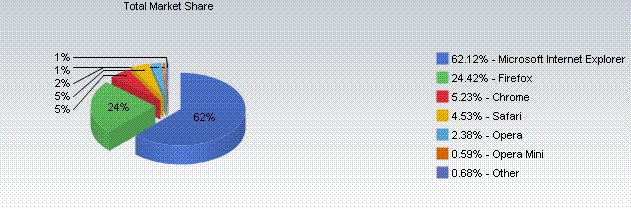
Yesterday, browser market share figures came out from Net Applications, and the big news is how Chrome is moving up the ranks at the expense of Microsoft’s Internet Explorer and even Firefox, compared to December.  But you have to look further back to get a sense of what is really happening.

The various flavors of Internet Explorer (IE6, IE7, and IE8) together have 62.1 percent market share, down from 68.5 percent last March.  That is a 6.4 percent drop in about a year.  During the same period Chrome went from 1.6 percent share to 5.2 percent.  Firefox and Safari each gained about a percentage point each over the same period to 24.4 percent and 4.5 percent, respectively.  (Although Firefox is a tiny bit down since November, when it peaked at 24.7 percent).  If you add up the gains from those three—Chrome, Firefox, and Safari—that is where most of IE’s share went.

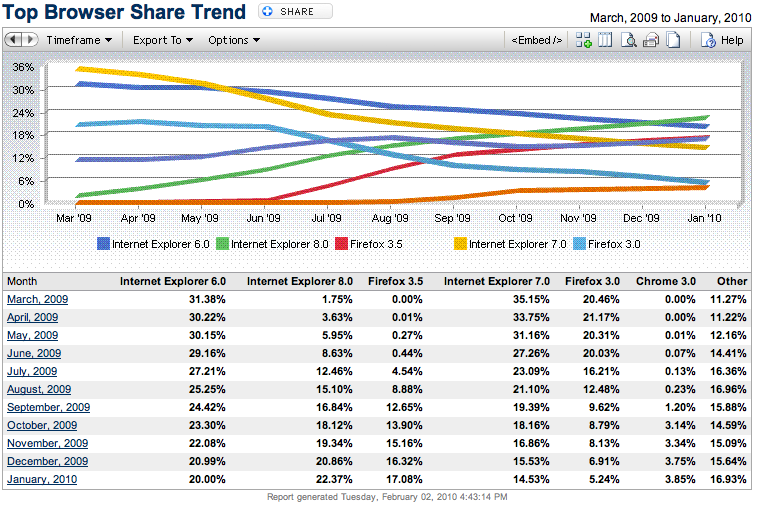
But even that doesn’t tell the whole story because if you look at share of individual versions of the different browsers, you can see another dynamic in play.  Namely, a big part of the share shift can also be explained by the uneven rate at which people abandon older browsers like IE6 for newer ones like IE8 or Chrome.  Let’s look at the share shifts just among IE6, IE7, and IE8.  The pitchforks are out for IE6, people hate it and Websites (especially those run by Google) think the sooner it dies, the better. Even Microsoft wants people to move away from IE6.

IE6’s individual market share has dropped by about 11 points since March, 2009, from 31.4 percent to 20 percent.  Meanwhile, IE8 took almost twice as much share as IE6 lost, it’s up  almost 21 points from almost nothing to 22.4 percent share.  So why did IE show an overall drop?  You can blame poor old IE7, which lost exactly as much as IE8 gained, going from 35.2 percent to 14.5 percent share.

But taken alone, IE8 actually gained more than any other browser during the period (up 20.6 percent), followed by Firefox 3.5 (up 17.1 percent).  Chrome’s 5.2 percent share gain was spread across its Windows and Mac versions.  So IE8 is making stronger gains than you might think from simply looking at the overall IE share numbers.  In fact, in January, it finally surpassed IE6 in market share and is now the largest single browser. As IE6 and IE7 continue to dwindle, IE8 needs to capture as much of those legacy users as it can.  With almost 35 percent share left between them, IE8 will no doubt continue to see rapid individual share growth simply by getting people using older versions of IE to upgrade. It helps that IE8 comes pre-installed with the Windows 7 operating system also.

But those users are also prime targets for Chrome and Firefox (which is still going through its own transition from 3.0 to 3.5).  Chrome, in particular, has the most to gain here.  It only needs another 5 percent to double its market share, whereas IE8 can win over another 20 percent and still see IE’s overall share go down.  It remains an open question where the overall shares will settle when all of this shakes out over the next year or so.
Advertisement
Advertisement

Comments rss icon

  • Internet explorers market share dissapeared with the IE6 security flaw.

    • net applications is a shitty source anyways. i guarantee IE has more like 70% marketshare.

      • ie 8.0 is an excelent and fast web browser like mozilla firefox.

        • A rock is a hard aggregate of minerals.

          I can’t believe I’m actually posting this. Thanks for the observation!

        • Internet Explorer is hardly in the same class as Firefox. The only reason it has such a high % is that Microsoft did such a fine job of entrenching themselves during the desktop era.

          But everything is moving mobile now. Where is Microsoft in the mobile browser area? Nowhere (windows mobile is a joke).

          What matters now is what apple and google are doing on the iphone and android. And since both of those platforms have a webkit browser I think I have a good idea of what the %’s will be in a year.

        • Don’t kid yourself…it’s a pig…a pos.

          You see, Microsoft wants to hold the internet back as much as possible because it’s their biggest competition….they WANT IE to a) be popular and b) suck.

          If the internet truly thrived to its potential, nobody would care what OS they’re using…and that’s starting to happen. Hence, MS’s first layoffs ever.

          Case in point: ECMAScript (Javascript) 3.1. MS picks a fight with EVERYONE ELSE and ends up with their very own Javascript standard. Why? because they need fragmentation to survive. Read on: http://en.wikipedia.org/wiki/ECMAScript

    • Remember, the last news about the firefox being the most-pop browser since December last week 2009? and Internet explorer as the second — Safari 3rd.. and statcounter calling Google Chrome as ‘others’, Now just a span of 1 month. Chrome claims the 3rd title. And maybe just maybe a future domination starting with the IE 8.

      An in-depth review: http://bit.ly/firefox-most-popular-not-so-sure

      IE is dead now, not only because it has security flaws issue, but it can’t cope up with the demands of the netizens today.
      Who say’s chrome will be deadlast now?

  • Is anyone surprised? really? Especially after the latest excitement.

  • The really worrying factor is most of the so called IT concerns and corporates still use IE6..They are not willing to change from it..

    And I have seen some from a Fortune 1000 Outsourcing IT company still designing sites for IE6!

    Some inside that 60,000+ do n’t even know what is meant by “Tabbed browsing”

    • that’s because half their internal apps don’t work on IE8, FF, or Chrome!

      • Yes exactly.. It really angers me near to my desk when I see somebody still using IE6 to develop applications for even Fortune 100 clients..

        Be it corporates like Wal-Mart or Indian outsourcing companies like Infosys etc., they are still using IE6

        I think they are completely in a different environment from “us”

      • Cant those corporate developers just use the meta http-equiv=”X-UA-Compatible” content=”IE=6″
        in their applications or better yet send a HTTP Response Header from the server and not have to touch the code at all.

    • Keep in mind that of those 60,000 employees, probably 2/3 of users and using machines from 2005-2006 (or earlier even). There’ll be a big performance hit when moving from the built-in browser to the newest IE and honestly, open source apps aren’t loved by every company BECAUSE they are just that – open source.

      In another 5 years the IE6 browser debate should be completely dead, but it’ll still show up here and there because many companies will refuse to upgrade all machines past XP. But after that, we’ll just have 5-10 flavors of browsers to deal with instead of one: IE6.

      Maybe having a common platform (good or bad) across the board isn’t such a bad thing. At least it’s easier to track down issues that way.

      • This is the right time to upgrade to IE8 for those organizations otherwise there will be huge costs associated with it..

        Performance hit? What kind of Performance hit ?Those 60,000 are still using a tabless browser to develop and test the code..they would be wasting more time in it..

      • Any company that sticks with IE6 for the next five years probably won’t be using the world wide web.

  • With all the security problems IE has/had I’m surprised they have as much market share as they do. Guess people don’t pay attention

  • Hopefully, now that the stable/general-release build of Chrome has extensions, it should see a lot of growth.

  • if chrome starts to grow fast, this will be a google centric world, much more than it is now, be alerted!

  • I blame Windows 2000 Sever for the whole IE6 becoming corporate standard, you can’t upgrade the browser from IE6.1. I know a lot of businesses still running IIS 5 and therefor this whole loop with IE6.

  • Someone posted this earlier on another TC post but I thought it was effin funny. The best IE6 dismissal messages ever shown! http://bit.ly/c9wxKv

  • The sad thing of the story is that IE6 is still #2.

  • The fact is many internet users don’t know what browser they use. We get that all the time, someone will report an issue, we ask what browser so we can test and they say “how do I find that out”

    It would be great to get a coalition of sites together to force (or strongly suggest) users to go to a modern browser IE8, Chrome, FF or Safari.

  • Opera used to be my favorite browser. I wonder why it is so low still. Chrome has been around for a year or two and already has nearly double market share of Opera

  • At least Google is trying, with the Google docs and sites not working on IE6.

  • “The various flavors of Internet Explorer (IE6, IE7, and IE8) together have 62.1 percent market share, down from 68.5 percent last March. That is a 6.4 percent drop…”

    [pet peeve]

    uhm…no it’s not.

    while it’s true that a change from 100% to 94% is a change of both 6 percent and 6 percentage points, a change from 68.5 percent to 62.1 percent is not a drop of both 6.4 percentage points and 6.4 percent. it’s actually a drop of 6.4 percentage points and 9.3 percent.

    [/pet peeve]

    while i 100% (pun intended :) ) support the proposition that there is no qualitative difference between blogging and dead-tree journalists, there are others who do not…..

    getting this right will be another quill in your arsenal.

  • My internet explorer browser is still messing up. Flash shockwave will not load properly

  • IE sucks really… I use Safari with my Mac and I love it. Fast and does what I need it to do without getting spyware. :)

  • Here’s my question…does this even matter? The browser wars were for the 90s. Now it is all about content.

  • I believe as long as Windows XP or older version of OS stands, IE6 would be there as well.

    Somemore most of the old CPU is more than enough for Windows XP for daily basic usage purpose, but is not powerful enough to use Windows Vista / Windows 7.

  • Chrome along with Firefox are really gonna threaten IE.

  • Increase in MS of Chrome is not surprising. People need simpler UI and light browser. Latest versions of IE are bulky and takes up lots of memory when many windows are open.
    I personally use Firefox and I am really satisfied with customization it offers. Let’s hope chrome coming out with add ons!

  • They should all just adopt Webkit as the rendering engine.

    All websites would look the same across all browsers and the difference in browsers would appear around the pages not in them.

  • W3Counter’s Trends graphs are much easier to read than Net Applications:

    http://www.w3counter.com/trends

  • I’ll be interested to see what happens when European users are given the browser ballot screen. I’ve noticed that sites that didn’t work properly with Firefox now work flawlessly, so I guess some sites are expecting a shift.

  • In due time, they’ll lost it all. But obviously its still very far from now. here in my country, people still retardedly believe that if its not IE, the internet has no sense. lols

  • This is so odd to me. Why would people stick to IE 6 when IE 7 and 8 are available. Especially since IE 6 has so many problems. That’s not to mention the various other browsers like Firefox, Chrome, Opera etc. that could be used.

  • Good riddance. We are really getting tired of developing work arounds for IE6

    http://www.makescreativematter.com/google-drops-support-for-ie6/

  • It’s interesting. the real question is when will the SaaS solutions that only support IE..start supporting other browsers? whats the magic percent that will make them start supporting multiple browsers? A while back IE market share was about 70 percent.. so it was an easy call to say just support IE.. but at 60 percent? thats a different story and quite frankly different from a strategy point.

Advertisement

Leave Comment

Commenting Options

Trackback URL
Short URL