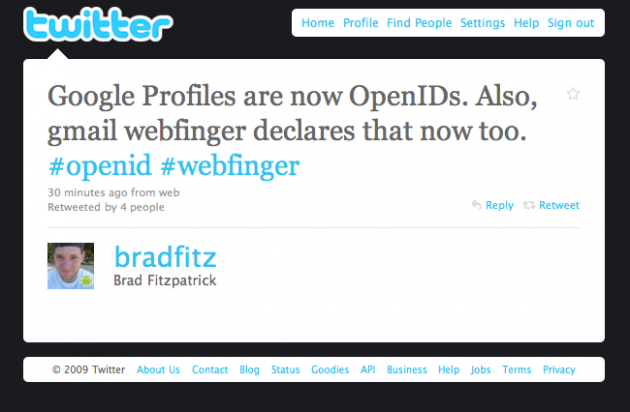
As part of its push to go more social, Google has been attempting to unify its various account profiles into one Google Profile. And now it’s more useful. Google’s Brad Fitzpatrick has just tweeted out that Google Profiles can now be used as OpenIDs.
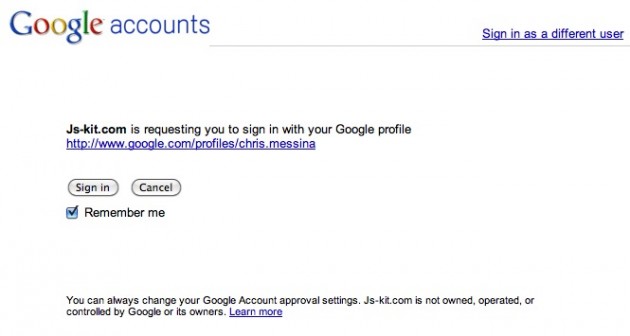
What this means is that you can sign into any site that accepts OpenID simply by using your Google Profile domain. Luckily, a few months ago Google started allowing these profiles to have vanity URLs, like /mgsiegler, instead of the previous /32090329039402903. Chris Messina, a huge proponent of the open web movement, has just sent out a picture of what signing in with OpenID via your Google Profile looks like (below).
Despite its good intentions, OpenID has yet to take off in mainstream usage. The problem, it seems, is largely about presentation. Most people have no idea which of their various accounts can be used as OpenIDs, or really even what OpenID is. Google backing it a bit more with these profiles obviously helps, but will it take OpenID mainstream? Probably not.
More interesting may be the second part of Fitzpatrick’s tweet. “Also, gmail webfinger declares that now too.” It’s not entirely clear what he means by that, but it would seem to suggest that we’re getting closer to being able to use our Gmail addresses as a web ID. WebFinger is a protocol being worked on by Fitzpatrick to allow you to attach information to your email address (in this case, you Gmail address), so it can be used as a solid means of identification.
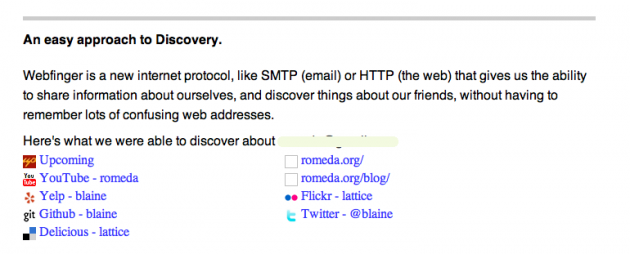
Update: Kevin Marks (former Googler, now with BT) has pointed me to webfinger.org an example site built by Blaine Cook (formerly of Twitter). The site allows you to easily set up your Gmail account with Webfinger right now. As you can see in the example below from Cook’s account, many of the social networks Cook is a part of are pinned to his email address.


FB Connect and Twitter, are they causing any harm to open ids?
So how about adding an openid button next to the facebook connect one? I’d use it
+1
+1
+1
Though I would be very indecisive as to which I would actually use.
+1
Me too
+1 Open ID .. i never really use FB connect
me too
Will probably propagate the use of OpenID even more. That is great news!
The better news would be if Google decides to accept openIDs from external sites for services like Google apps, Latitude, Picassa, Youtube etc. Until then this is equal parts self serving and promote open standards. I support open standards but we have to understand that this is also a push to collect more user data. Google would love to see everyone in this world to create a Google Profile. Once you get used to having one there will be incentives to link it to your friends Google profiles and viola Google can re-create Facebooks social graph and drain traffic from Facebook. Remember there have been various attempts by Google to own a big social network.
Good for the web and all people
.
Web is becoming more complex and needs to get integrated & organized so OpenID, OAuth are few ways of doing it, glad to see Google backing this initiative as it’s also good for them for tracking more web pages:).
This article has been nominated for ‘Social Media Story of the week’.
: http://bit.ly/8fEil4
Congrats to Google profiles as a trusted/branded endpoint for openid is spot on. Twitter and Facebook as well as others can do the same. I hope sites like wp, posterous, tumblr and cliqset follow suit.
Soon authentication via various openid supporters will not be an issue. Oauth/WRAP may well be the next battle ground?
how is this different than fb connect
OpenID is an open standard. I run my own OpenID provider on my domain name, as a WordPress plugin, for example. FB Connect is, well, just Facebook
You could already use your Gmail for OpenID.
The problem is that Google sucks at OpenID….every time you register your account username will be unknown(google)
The webfinger integration means that you would just use your Gmail address to indicate who you are – ergo it links to your Google Profile, which is the OpenID that contains all of your “info”. So in a round-about way your Gmail address becomes your identity.
OpenID was a good idea, but Twitter & Facebook Connect made it dead simple for websites to authenticate users.
OpenID was going to be the solution, but the problem was, so many services wanted to be a provider (yahoo,google,aol,etc). I have a yahoo account, google, I forgot my AOL password (I don’t care), I don’t know what to use if I want to login with my OpenID. It’s confusing, and there wasn’t a real set of API for web-dev to make it work on their site.
But FaceBook with FB Connect made this really easy for web-dev with their strong and easy API. The same for Twitter.
So, web-dev can just copy and paste some codes and voila, they can authenticate users with FB or Twitter.
But one the main factor of OpenID failure that I noticed, it just lacks the cool factor. On FB I have all my friends, pictures, I do almost everything on there related to my online social life. It feels more hip and more comfortable. So when I see a FB connect button, I tend to log with faster, then trying to do it with OpenID.
But hey, I’m glad Google turns profiles into OpenID, but FB is the internet and it will get stronger and stronger.
And how do you note see this as the simple fact that Facebook wanted to be a provider so much that instead of implementing OpenID and risking not gaining users who already had OpenID somewhere else, they just up and created yet ANOTHER single sign-on technology?
Haha
Is it just me or does looking up a name at the webfinger.org link in the post return an internal server error?
I’d love to use my Google Profile with a custom domain name. Could be part of Google Apps or simply work like setting up Blogger on your domain.
Contrary to MG’s point — OpenID has gone mainstream, in a similar way to IMAP or SMTP. That is, it’s powering the identity and single sign-on transactions of millions of people everyday — but, to MG’s point — they just don’t know it yet.
The more often you see the “sign in with your X account”, the more OpenID is creeping into the everyday web user’s experience. This is certainly a good thing, considering the fact that OpenID is an open protocol that anyone can implement.
The problem is that we’re running up against what we call the “NASCAR problem” — where, because “OpenID” as a concept and brand hasn’t been well socialized — we’re putting companies and corporate brands in place of people’s names and faces. Thus, rather than signing in to leave this comment as “Chris Messina, who hosts his account with Facebook”, I would be clicking the Facebook Connect button — signing in first as a Facebook user, and second as an individual.
This duality won’t scale — and requires a word to describe what this kind of universally-accepted account is. “Passport” was probably the right name, but gosh darn it, someone took that one! The industry seems to okay(ish) with the “OpenID” brand — and now it’s just a matter of making this technology — and its capabilities — synonymous with a smooth and easy sign up and sign in experience.
Google’s push in this direction certainly helps in that regard — but it also just helps to put Google’s logo up next to the Facebook Connect buttons.
It seems to me Google has been allowing/using profiles for single click sign-on. I’ve seen it as an option for several months. I’m just wondering what happens as the ubiquitous “G” moves in with the others how much its presence will overshadow the rest. In this way, your identity on the internet is validated by Google. A commercial interest shouldn’t have this much power.
Question for those smarter than me: I use gmail as my primary email address. If I now attach OpenID to my profile (along with the other Google real estate), should I be more, or less, concerned from a privacy and security perspective?
It depends on whether you use the same password for your Gmail account as you do on other sites. If you use only one password, or reuse your Gmail password anywhere else, your Google account as an OpenID can limit the potential exposure of your password since, with OpenID, your password is only shared with your identity provider (i.e. Google) and not with the remote site.
On the flip side, it does mean that Google will now “know” wherever you login, but that’s no different than if you already sign up for other websites using your Gmail.
Net-net: this really doesn’t change much from a privacy standpoint — unless you don’t use Gmail for account registration and/or you use a different OpenID provider.
Precisely, @ariherzog. FB seems to offer somewhat granular control over privacy, which I don’t detect in GOOG profile elements.
It’d be nice to have a central “spot from which to connect to the world” without thereby revealing an email address.
I think, using a GOOG name as an Openid has an Achilles heel on that point.
Your mail address and private data has already been sold by Google. Don’t worry. Nothing (more worse) can happen
Ummm, Google has been an OpenID provider for a loooong time. Everyone who has a GMail account — which is well over 100x the number of people who have a profile — can use OpenID.
The endpoint is https://www.google.com/accounts/o8/id, but best of all, you don’t have to remember ANYTHING because every OpenID selector on the market includes a single-click Google button.
This is, at best, a minor announcement that effects maybe a few dozen people worldwide.
This.
I agree with Chris that OpenID has now broken into the mainstream, but mass adoption by the mainstream is a big mountain to climb. Google Profile domains as OpenIDs is gonna help that happen better and faster, so that’s a good thing.
While I’m sympathetic to Chris’ point about “branded logins” not scaling well — it does promote a narrow oligarchy of account providers, I think the model that will prevail here is one that acknowledges the reality we have now, which is that the masses all have accounts provisioned by the handful of major providers, and makes “branded sign ins” quick and easy while *also* offering a staightforward UI and experience for everyone else who wants to use IDs from some provider that *isn’t* one of the “Big Six”.
RPX (see rpxnow.com) provides one implementation towards this goal, and we see the “mainstream surge” starting to happen with OpenID (and proprietary logins like Facebook Connect, too), and its largely driven by these branded logins; having “sign in with your Google account” available for your users seriously enhances the chances that visitors will engage.
I’m interested in what lies ahead for accounts that are hung off Google-managed domains. Given the developments chronicled in this post, it seems a natural step to make accounts for “xyz.com”, where “xyz.com” is a domain Google manages for the customer, eligible as OpenIDs, too. If Google manages “xyz.com” as the domain for my small business, there’s value in making something like “xyz.com/profiles/mgraves” available as OpenIDs that can be used by the accounts within that domain.
I think that’s where Chris identifies the scaling problem, where the “Nascar effect” starts to bite hard. If I’m xyz.com/profiles/mgraves, that’s NOT something I will associate with “Sign In with Google” when I see it in sign in pages. Google manages that domain, but I don’t think of it as a “Google account”.
That means branded sign ins are not the total answer. There’s lots of interesting ideas in play as to how to make those “custom OpenIDs”, powered by Google or someone else easy and simple to use, but the winning user experience hasn’t emerged yet.
This seems to be a duplication of ClaimID by Fred Stutzman and Terrell Russell: claimid.com
ClaimID is an OpenID provider, however, they only support the 1.1 version of the protocol — they also seem to no longer be actively maintaining ClaimID.
Rather than seeing this as a “duplication”, it’s just another place to have a public profile on the web.
See also: http://hi.im, http://identoo.com, http://chi.mp, and a dozen others.
Why can I not login via Google Open ID here? Just a thought!
VERY useful feature. There are so many user ids and passwords out there for a user, that any consolidation will make it better for them.
admin
http://invetrics.com
its very good and usefeul…yes there shud be less ids to take care of…
Sarah
http://www.isopurewater.com/
Gee, another Sarah James bot-comment in a Google post. Hey TechCrunch, you got a spam-bot here.
but the problem is:
openid is crap, because it’s unpractical and not fail-safe and nobody uses it. I don’t know of one single service where openid based “registrations” of users even make it past 5% of the total users.
the general idea is great, but it just isn’t a real solution (yet?)
I don’t know why I’m wasting my time answering you, but here are two examples that debunk your claim:
* 37Signals was seeing over 15% of their users use OpenID earlier this summer.
http://www.janrain.com/openid/casestudy-37signals
* GetSatisfaction was seeing ~20% OpenID signins for certain communities on their support forums.
http://www.janrain.com/openid/casestudy-getsatisfaction
Here are some more:
http://www.janrain.com/openid/casestudies
Oh, and here’s one single service that ONLY uses OpenID authentication, to great success apparently:
http://meta.stackoverflow.com/questions/31021/what-openid-providers-should-we-feature-on-the-login-page
Very good answer. Thanks for the numbers.
It’s great to see Google moving into the social networking scene, look forward to seeing more integration with the Open ID standard in the coming months, hopefully turning it into a useful tool in the web designers toolbox.
I agree with most of the commenters that having a single ID with which to access ALL of the various social networking sites would be fantastic it is a heck of a ways off at this point.
I’ve never use OpendID. I ever registered once but nothing more than that.
Cool but never use it.
Gonna try it
yep
wtf
Now if everyone just used OpenID