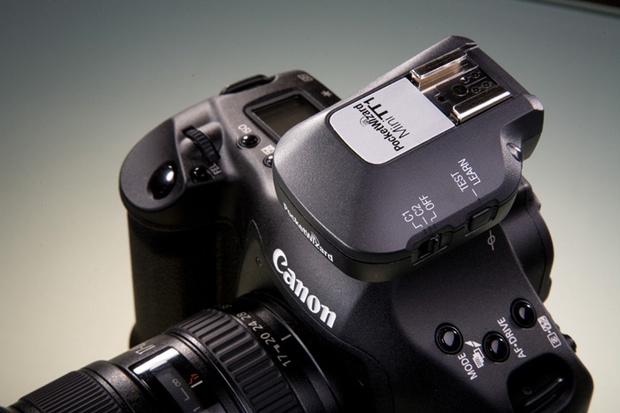
For photographers who work with sophisticated lighting setups (that would be not me, so excuse my ignorance), triggering several flashes or distant flashes can be a chore. The flash world is mostly a mystery to me, but I can certainly understand that not only do you not always want the flash pointing directly at the subject, but sometimes you may want a couple, distant, at weird angles. There exist solutions for triggering them, but it looks like PocketWizard has beat the rest with its latest offering.
The PocketWizard sits on your camera’s hot shoe and intercepts the signal your camera sends to fire the flash and any extra information that needs to be passed along — reduced EVs, curtains, and so on. It then radios it out to whatever flashes you have equipped to receive the signal. There are advantages to the PW, as well: it has a way of catching wind that the camera is about to send a “fire flash!” signal, and can preempt it by a fraction of a second, depending on your needs — perhaps enough to allow you to open up a stop or reduce ambient light. To be honest, it’s all greek to me, since my flash-fu is seriously weak. There are many other uses but you may as well ask me about the dark side of the moon for all I know of them.
You can get a lot more details at this detailed overview, and see a few important differences between the two new models as well. From that breakdown I’d say there are precious few advantages to the Mini other than its size. If you have a 5D mkII, beware of compatibility issues as well.
If you’re just looking to hand-hold your flash or something simple like that, there are probably cheaper and easier options (the Pocketwizards cost $200 and $220), but pros with real lighting setups (again, not me) may find them extremely useful.