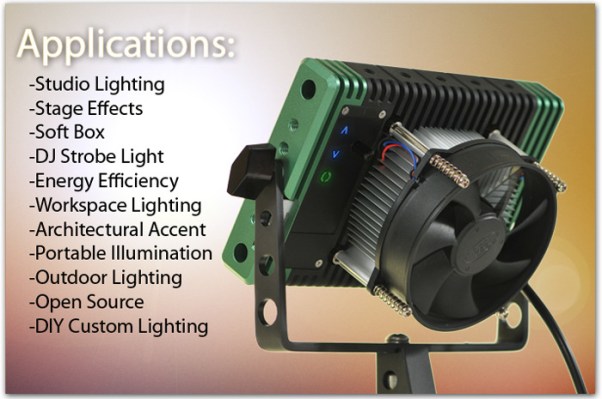
Finding good lighting is hard and controlling it is harder. That’s why the Lumapad programmable lamp is so interesting. It’s a light source that can hit up to 8,000 lumens. You can either control from the unit itself or program it using USB or Wi-Fi. Why would you want to control this lamp remotely? Because it’s such a bright light source, you can use it for DJ events, lighting video and still photo shoots, as well as running lights for onstage events. In short, you can replace an entire light board with a few of these and a laptop.
The Kickstarter project is halfway funded, and the creator, Richard Haberkern, is looking for $28,000. A pledge of $175 gets you a bare-bones model while $329 gets you a model without Wi-Fi. The deluxe, dual-color model costs $445.
Haberkern writes that the unit is surprisingly small and energy efficient.
The package uses the Electric IMP for remote control, and an on-board Arduino system controls the lamps. Most units should have a cooling fan, although Haberkern says most users will be fine without one. These lighting projects are interesting because they tackle some of the biggest problems photographers face, and they show us just what’s in store for us when it comes to figure implementations of smart lighting and open-source hardware. Who needs incandescents when you can copy the light profile programmatically?