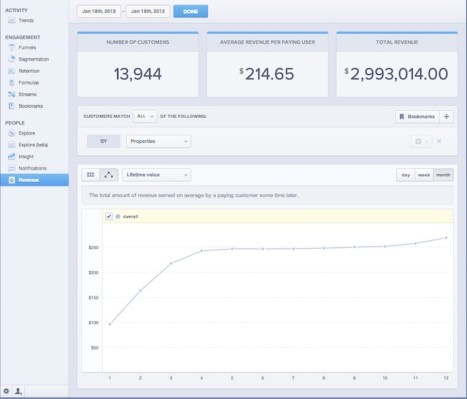
Back in December, analytics startup Mixpanel made a splash when its co-founder Suhail Doshi and its investor Marc Andreessen called for an end to “bullshit metrics”. What is and isn’t a vanity metric (to put it more politely) can be debatable, but today it’s launching analytics for something that’s squarely in the “not B.S.” bucket — a company’s revenue.
Doshi said that for many companies, revenue data is usually stored in a database, requiring some work and technical expertise to extract — which means that teams often operate with a limited idea of how much money they’re making at any given point in time. With Mixpanel’s revenue analytics, companies can view their revenue data in an easy-to-understand dashboard. The product can integrate with their existing database, and businesses can also add a snippet of code to their websites that sends data to Mixpanel every time there’s a transaction.
Even more powerfully, Mixpanel can now track the lifetime value of a customer, i.e., the total amount of money a person or a business is going to spend for the duration of their relationship with the company. Doshi said that in the same way that Mixpanel has placed a big emphasis on retention as one of the main metrics for user engagement, it’s going to be evangelizing for a greater focus on lifetime value when looking at revenue. There are certainly some data-focused companies that already pay attention to lifetime value (such as Zynga, Groupon, and Living Social), he said, but most startups don’t really know much or anything about it.
By tracking lifetime value, companies can make smarter decisions about how they advertise — if they know that their average customer has a lifetime value of $50, then they know it’s worth paying $40 in advertising to acquire that customer, but not $60.
You can also examine lifetime value in conjunction with other data collected by Mixpanel. For example, Joe Stump at project management startup Sprint.ly found that users were 1400 percent more valuable if they connected their Sprint.ly account with their GitHub account, so he’s now promoting GitHub integration more aggressively. Of course, that doesn’t necessarily mean that everyone will start paying Sprint.ly more money just because they add GitHub, but now Stump has the data to track whether his efforts are paying off or not.
Mixpanel can also tie revenue to different traffic sources. And that’s not just useful for planning ad campaigns — Doshi noted that PR is often seen as an area where companies have to sort of assume that their efforts are paying off. But with revenue analytics, Mixpanel can actually see that traffic from TechCrunch, for example, has actually driven around $100,000 in revenue over the startup’s lifetime.
Revenue data will be available to anyone paying for Mixpanel’s user analytics. Doshi argued that this data is becoming increasingly important — as the venture capital environment becomes more challenging for startups, they have to pay more attention to revenue. To put it simply: “It’s easier to raise a round if you’re making money.”