If you haven’t heard by now, yesterday Instagram announced an update to its Terms of Service and Privacy Policy that’s set to go into effect next month. Instagram was acquired by Facebook earlier this year for a $1 billion sale price, and the new ToS is ostensibly meant to make the photo-sharing app integrate better with the social networking giant.
The most notable thing about the new terms is that Instagram will reserve the right to sell access to its users’ photos to companies that want to use them in advertisements such as sponsored posts — without needing users’ knowledge or consent, or of course, giving them a share of the money.
If this sounds like a bum deal to you, you’re in good company. It looks like even Facebook CEO Mark Zuckerberg’s sister isn’t so keen on the changes.
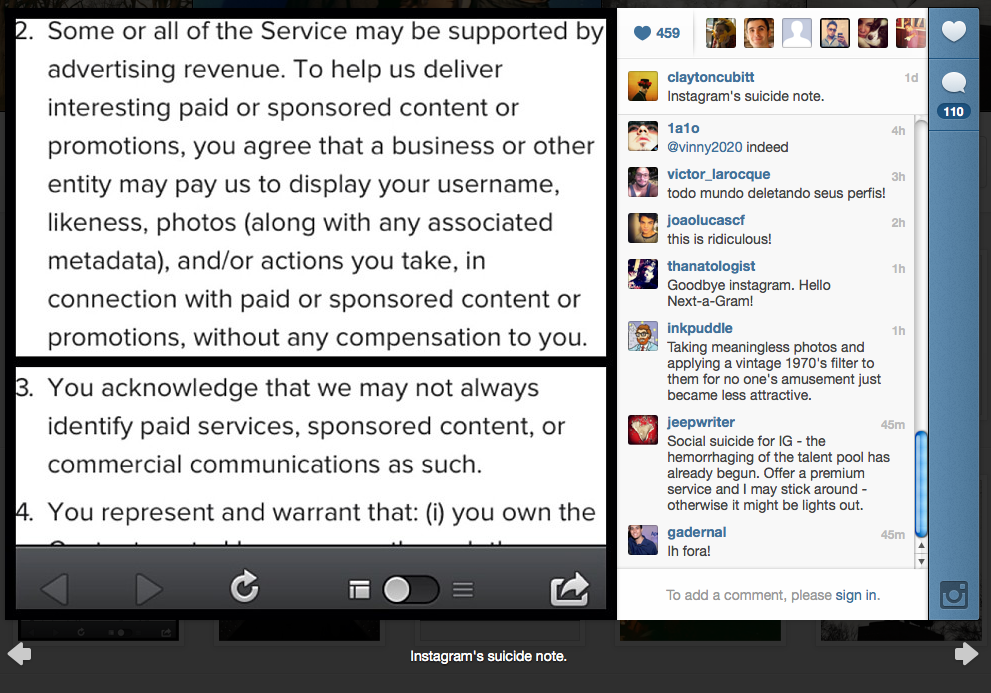
Today, Arielle Zuckerberg publicly “liked” an Instagram photo from New York-based fashion photographer Clayton Cubitt that’s essentially a screenshot of the most controversial bit of the new Instagram ToS with the caption, “Instagram’s suicide note.”
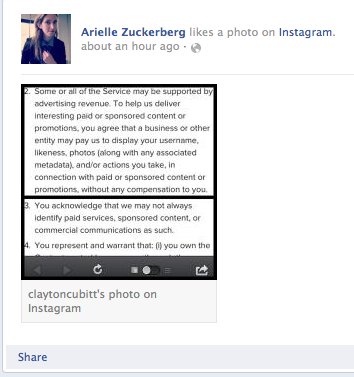
The gesture did not go unnoticed by Cubitt — he went on to post a screenshot of Zuckerberg’s “like” along with the caption, “I’m sure Mark Zuckerberg isn’t too happy with me today, but his sister was very nice.” (Actually, Clayton, Zuck’s a very busy man and I’d put my money on you not necessarily pinging on his radar of concerns… but who knows.)
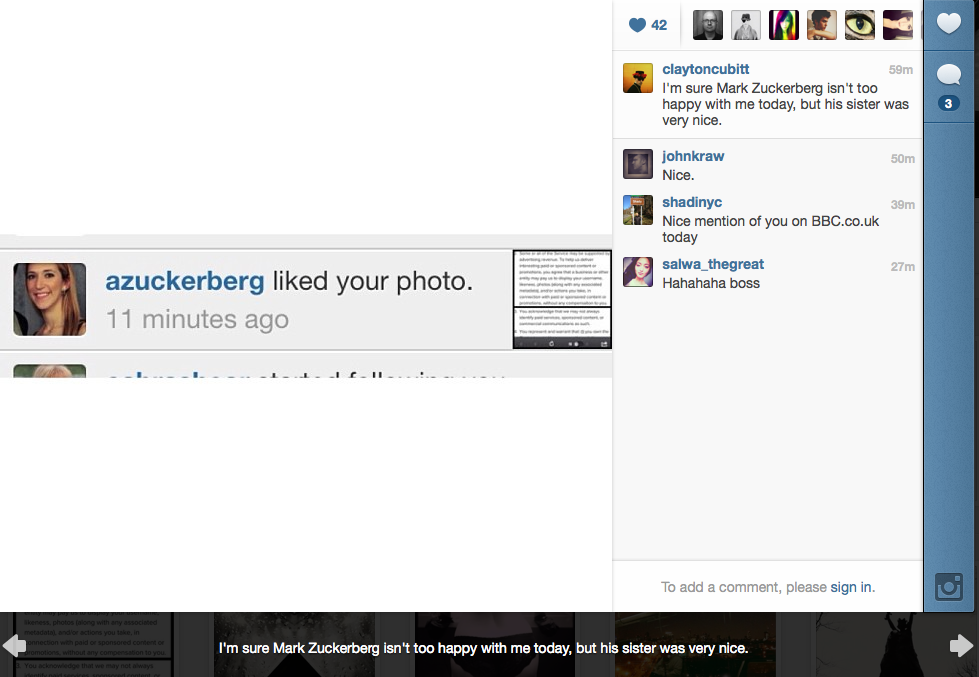
Now, it of course bears mention that Arielle Zuckerberg is a private citizen and does not speak for Facebook at all. She’s actually an employee at Google in the Wildfire Interactive division. But as someone who has made tech industry headlines several times before — and has more than 14,000 public subscribers to her Facebook updates — taking a stance publicly on this (her ‘like’ shows up to anyone who is signed in to Facebook, not just her friends or subscribers) is interesting. And her not retracting it even after having it noticed and called out is, I think, newsworthy — or blog-worthy, at the very least. It’s indicative of just how divisive these new Instagram terms are.
Indeed, the backlash may just be beginning. CNN anchor Anderson Cooper seems to have just gotten wind of the news this morning and is apparently also displeased. He tweeted to his 3.4 million followers asking if they can recommend a different photo-sharing app:
The changes aren’t set to go into effect until mid-January, so there is a chance that they may be tweaked according to public feedback — and given that this is a relatively slow news week, there might be a lot more of that to come.