When Twitter struck a deal to move to San Francisco’s mid-Market neighborhood, the tradeoff seemed pretty straightforward: In exchange for relocating to an economically challenged area, the company would get significant tax breaks. But Jack Dorsey said at the Techonomy Detroit conference today that there’s another benefit.
Dorsey, who is co-founder/executive chairman/product lead at Twitter and founder and CEO at Square (which is located close to the Twitter office), spoke to reporters after his on-stage interview and said that being in the mid-Market neighborhood has a “good effect” on both companies, because it allows the team to see and try to solve “real problems.”
After all, if you live and work in a Silicon Valley suburb like Palo Alto or Mountain View, you probably drive to work every day, and that means you might miss “the problems facing real Americans.” Dorsey said that’s why he takes the bus to work “every single day” — rather than being stuck in a “wonderland bubble.” He wants to see the basic issues and annoyances that people deal with in their lives.
Dorsey admitted that both offices are in a “pretty rough neighborhood,” but that’s changing. The simple act of moving the 1,400-person Twitter workforce into mid-Market is a step toward “reclaiming” the neighborhood, he said. Square doesn’t quite have that transformative power yet. However, it does regularly bring food trucks to the alley near the office, and when that happens, “People just come from all around. It’s really done amazing things for the neighborhood.”
It seems like Dorsey has a soft spot for cities. After all, that was the big theme at the conference, and he has admitted in the past that his dream job is to be mayor of New York City. Asked on-stage by Techonomy’s David Kirkpatrick if that’s still a goal, Dorsey said yes: “I think the mayors are the ones to watch.” Not that he has any immediate plans to leave Square or Twitter. And as he noted, “I still have to move to New York first.”
Dorsey added that he’d like to see governments evolve more quickly. A key step toward making that happen? More transparency, so people have real data on how good or bad a job that different governments are doing. That strategy has been successful at both Twitter and Square, he said. At Twitter, “We make our decisions known. We make the why of our decisions known.” And at Square, the entire team gets to see the presentation that executives prepare for the board of directors, so everyone knows “exactly what we’re telling the board and what the feedback was.”
The interview also covered Dorsey’s thoughts on the future of Square, which I wrote about in a separate post.
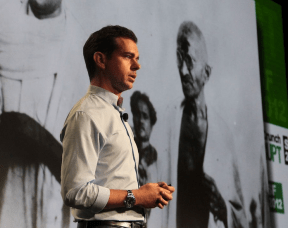
[image from Dorsey’s speech earlier this week at Disrupt]