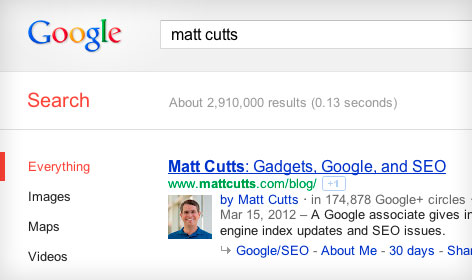
Last year, Google announced an initiative to give authors on the Web greater ownership over their content and more visibility in search. Google Authorship, as its known, has changed consistently since launch, as the company experiments with the best ways to authenticate authors and give them proper attribution.
Unfortunately, up to this point, the authentication process has been fairly convoluted. Rick DeJarnette’s post last week illustrates that clearly. There are a lot of steps and blog platforms like WordPress, for example, require additional configuration to enable authentication. It’s been confusing users to the detriment of the service.
The process, however, is evolving. It’s gone from adding code to your site’s pages to something that’s more automatic. As part of this, Google announced today that it’s made it a lot easier to link your website to your Google+ page.
Whether or not users like it, Google search was always going to get more social. Innately, people trust recommendations from their friends more than they do from strangers, or algorithms.
As Kevin Gibbons recently pointed out, Google Authorship is essentially Google’s way of bringing together personalized search with its social search — your social graph, in this case brought to you by Google+.
There are a whole mess of reasons why Google Authorship is important. For starters, it lets those who create the web’s content claim that content and make it their own, adding their name and image next to the byline of their articles, blogs, etc. That makes their content stand out. With few exceptions, content creators want to have their personal brand attached to their links — it’s good for business.
For Google, social media and author authentication help them measure the influence (and trustworthiness) of content and links and, ideally, serve better results. If results have been authenticated with authorship — they’re “owned” by personal and company brands — searchers get better results and advertisers spend more knowing they’re getting more bang for their buck.
But, “I don’t use G+, no one outside of Google does, so why would I do that?” you cry. Well, it makes it easier to have your authorship show up in search as a result. By god, reader! Own your content! Dennis Troper explains that linking your site to G+ means that:
“Your recent posts can appear in lots of relevant places across Google. For example: When users search for your brand, an excerpt from a recent Google+ post may appear to the right of search results.”
Now, page owners can link their sites in a few steps:
1) Visit your Google+ page, open its profile, and click ‘Edit profile’
2) On the About tab, save your website URL, then click the new button, ‘Link website’
3) Follow the instructions for adding a short line of code to your website’s homepage, then click ‘Test website’
According to Troper, if the set up goes as planned, users will then see a confirmation message. Then, after a day or two, “the link between your website and your Google+ page will be active, and a check icon will appear next to your URL on your profile.” That means you’re good to go.
Typepad said in a blog post today that it, too, has been working with Google to make authentication easier for its users. It’s a little bit more complicated than just adding your site to G+, but it’s still pretty straightforward. Find those steps here.
More on Google Authorship here.