
Yesterday, we took a look at the growing comfort consumers, specifically gamers, have with purchasing virtual goods and currency on the Web and mobile devices. Virtual goods are becoming a booming market thanks to the growing maturity of gaming platforms, free-to-play models and the profusion of mobile devices.
Today, international investment firm Digi-Capital published its in-depth review of the global gaming space, giving us a sense of the size, breadth, and activity of the very international gaming market last year that is contributing to the changing behavior around virtual commerce — as well as a glimpse into what we can expect from the industry over the course of 2012.
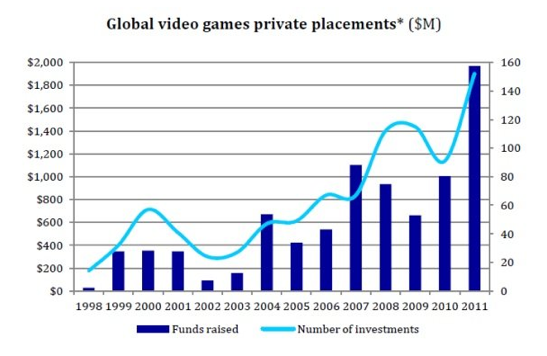
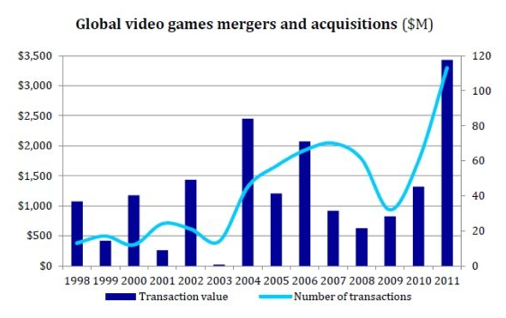
For starters, Digi-Capital found that gaming investment and M&A more than doubled in 2011, as private placements grew by 96 percent to $2 billion, the number of transactions increased by 67 percent to 152, and the average fundraising round increased by 17 percent to $13 million. When combined with the enormous IPOs of Zynga and Nexon, investment value nearly quadrupled. All in all, gaming M&A volume grew 88 percent to 113 transactions, value grew 160 percent to $3.4 billion, and the average M&A deal size grew 38 percent to $30.4 million.
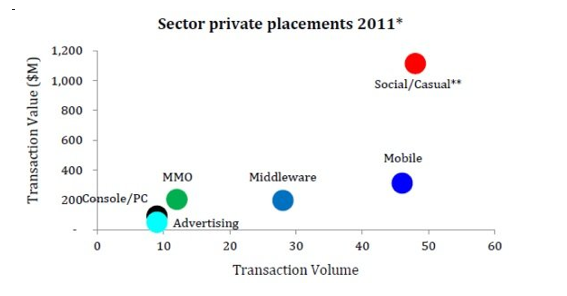
In terms of which gaming sectors saw the most investment and M&A activity in 2011? Unsurprisingly, social and casual games took home the bacon, making up 57 percent of private investment and 45 percent of M&A activity. Digi-Capital believes that Zynga’s IPO was likely the “high water mark for Social Games 1.0,” as the crowded nature of the space will make it increasingly difficult for companies to sustain user acquisition and retention.
In analyzing global gaming in terms of total daily active users and individual game daily active users, the investment firm found that a small number of companies are delivering on the promise of maintaining (and growing) their user bases, specifically referencing Wooga and King.com. However, with the trend beginning in 2011, this year will likely see continued consolidating M&A activity in gaming.
 Second to social and casual gaming in terms of transaction volume was social/mobile games, with 30 percent of private investment and 27 percent of M&A activity, although the value of private investment hasn’t really hit its full potential yet. Digi cited DeNA and Gree as two examples of how investment in social-mobile games can actually deliver ROI, with the former seeing more than $1.4 billion in revenues at a 50 percent operating margin, and the latter seeing equivalent revenues in the 12 months leading up to December 2011, with a 46 percent operating margin. Going forward, mobile-social and cross-platform games will continue to attract significant attention from both investors and potential acquirers.
And just as we wrote in April last year, large, profitable Chinese, Japanese, and South Korean gaming companies will continue to look for M&A opportunities in North America, as gaming continues to explode across Asia. The same will be true for some of the big American gaming companies, but both suffer from a lack of local knowledge, and cross-pollination.
Going forward, Digi-Capital expects online and mobile games to significantly contribute to the growth of the international gaming market, with the total market reaching an estimated $82 billion by 2015, and online and mobile games taking 50 percent of that revenue. (Interestingly, it expects the pure console sector to be “flat to down” over that time.) What’s more, the report forecasts that Asia and Europe will take 87 percent of the revenues for online and mobile games, with China leading at 36 percent, followed by Europe at 20 percent, South Korea at 12 percent, and Japan at 10 percent.
 However, while online and mobile games are growing their scale and share of the overall market, consumer markets are expected to continue to fragment, and profitable business models will become harder to come by. Over the course of the next year, gaming companies will have to develop multiple development platforms, instead of relying on one hit game, and find multiple platform and geographical distributors. Relying solely on Facebook won’t cut it for long. Rapid, low-cost game development and redevelopment cycles, fast failure, strong analytics, and true scalability will continually become more significant as the industry matures.
That being said, Digi-Capital found that there is more demand for investment among high-growth gaming companies than there is supply, as “outside major investment deals, online and mobile games companies still find it challenging to find high quality investors, and traditional VCs are becoming increasingly selective.” The current trend among VCs, the report finds, is to go after later-stage deals, but there’s potential to change as the market changes and more people flock to mobile and social games.
All in all, it seems there are plenty of potential growth and consolidation opportunities across the gaming sectors, but there’s no doubt that mobile-social, online, and cross-platform games will continue to explode over the course of the coming year, and we can expect M&A and investment activity to increase as social gaming works toward consolidation and more mobile gaming companies rise into the spotlight.
For more, check out Digi-Capital’s report here.
Excerpt image from MaxUpdates.tv