
Quora has fiddled around with its Credits system and unveiled some new features today, making two very notable changes. The first one is the elimination of the original “Pay to show to Topics” feature of Credits, where users would have to pay credits to have their questions show up to people following specific topics. Instead, users will have to pay 50 credits to ask a question, any question and all topic additions are “free.”
Users can earn credits by having their questions and answers upvoted, answering “Ask to Answer” questions or having users gift them credits.
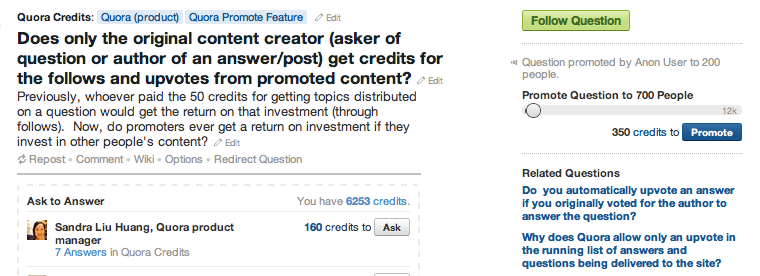
In addition to the universal question fee, Quora has added Quora ‘Promote,’ a way to use credits to give desired content more visibility throughout Quora. With Quora Promote, a user pays one credit for every two people he or she would like to have the chosen content promoted to (i.e. 100 credits for 200 people). The people are people who would have seen it anyways, a.k.a. followers of the topic and/or of the person who posted it.
When asked if ‘Promote’ was just a Trojan Horse to test out whether Twitter-esque branded promoted content will work, Quora co-founder D’Angelo responded, “We don’t have anything planned like that. This is not a monetization product for us. The goal of this is to make Quora better … We try to connect you with everything you want to know about.”
D’Angelo thinks that giving people the opportunity to get more eyeballs on a question, post or answer is in line with Quora’s overall vision, which has expanded beyond Q&A since its January 2010 launch.
“Quora is this place that gives you access to people who are interested in particular topics and an audience for things you want to share,” D’Angelo tells me, “It’s about connecting you to these other people, experts who want to answer your question or people who follow topics you’re interested in.” Quora doesn’t share traffic stats publicly but D’Angelo assures me that the demographic has diversified beyond the tech industry to other sectors like fashion and entertainment.
It remains to be seen whether or not all these complicated and somewhat arcane gamification elements will catch on with mainstream or even power users. In the meantime, at least the barrier to entry will cut down on the Newsfeed noise.