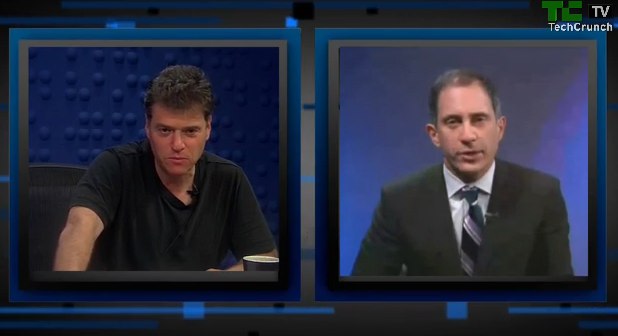
Keen On…. Adam Lashinsky: How Apple Really Works (TCTV)

Wednesday, January 18th, 2012

Andrew Keen is an Anglo-American entrepreneur, writer, broadcaster and public speaker. He is the author of the international hit “Cult of the Amateur: How the Internet is Killing our Culture” which has been published in 17 different languages and was short-listed for the Higham’s Business Technology Book of the Year award. As a pioneering Silicon Valley based Internet entrepreneur,... → Learn More

Keen On…. Adam Lashinsky_ How Apple Really Works (TCTV) | TechCrunch
Last month, we thought we'd heard the final word on Steve Jobs. We had author Isaacson on our show to talk about Steve Jobs' life. Isaacson wrote the authorized Biography of Steve Jobs. A massively best selling book, but of course there never is a last word about Steve Jobs and this month we have another blockbuster.

Another important, relevant, controversial book about Apple. This time from the distinguished technology journalist and writer, Adam Lashinky, and the book is entitled "Inside Apple: How America's Most Admired and Secretive Company Really Works". Adam's book wasn't authorized, but we managed to have an authorized Adam on TechCrunch TV.

So, Adam Lashinsky, welcome to Tech Crunch TV.

Thank you very much.

Adam, haven't we heard enough about Steve Jobs and Apple? Why do we need another book? I think we've heard enough, perhaps about Steve Job's life and his crying and what not, but I think we haven't begun to hear enough about Apple. So, I guess, as we're speaking, it's the second most valuable company in the world, and I would argue, still the least understood.

So, plenty of people know everything about Apple's products that they've got in there pockets or on their desks, and consumers feel like they know Apple and they knew this man Steve Job's, although they learned from Walter Isaacson's biography, but they didn't really know him. People by and large don't have a clue about what goes on at Apple, behind the closed doors, how Apple does what it does.

I would argue that this is highly relevant for anyone who is interested in the company, but in particular for business people who are trying to figure out how Apple does what it does particularly when, as I discuss in my book, Apple does things completely differently from what is taught in business school, and I would submit that this is an important story and of great interest to big companies, who are completely flummoxed as to how to be nimble once they get big, and it's also of great interest to entrepreneurs, because Steve Jobs ran that company as an entrepreneurial company, which is really an astounding statement considering it's a 25,000-plus-employee company.

That's not counting the retail employees.

Adam, before we get on to the details of Apple, why Is Apple the most admired American company? Is it simply because it's so profitable and because it produces such iconic products?


I think it's the iconic products that is the reason it is so admired, and I don't know if it's that they are iconic, or if it's that it's an unusual company that manufactures a product that any consumer understands that it's a designed product. People have an emotional attachment to their Apple products, whether it's the way that the product looks, the way it feels in their hand the way the user interface has this friendly, cheerful sense to it, and also that their marketing and their message is so joyous, if you will.

We could think of plenty other adjectives, so I think that this product that people feel this connection to is the reason people admire Apple.

Adam, the title of your book is very presumptuous. You tell the world that you know how the company really works. Did you go undercover? How did you find this out? No, it's not my tech - I did not go undercover in the sense that I didn't put on a fake mustache and a hat and steal somebody's ID and sneak inside the doors of Apple.

I did not do that. I did old fashioned gum shoe reporting. I spoke to many many people, primarily former employees of Apple, and asked them to tell me their stories about how Apple operates. I talk to people, by the way, at all levels of the organization. Formerly, at all level of the organization, from very senior to very junior.

And my assumption, or my operating thesis, if will, is that the experience of people in the middle of that organization are absolutely as relevant to what my task was, as sitting down and having interviews with the senior people Which is what would typically happen with a full accessed and authorized book, and or article and by the way this is exactly what you got, to his great cred from Walter Isaacsons book, you got a fully authorized from the top view and that's not what my book is and I appreciate your calling it presumptuous but, that's exactly what I did.

Adam, I've got several friends who are current employees at Apple, and even when I'm in their homes and I asked them a question about apple. They start sweating, and their eyes dart around the room, and they go real quiet. And they say well I really I talk about that. It's not my area.

Yes.

How did you get these people to open up? Did you take them to bars and feed them a bottle of whiskey?

Well. And I have an anecdote in in my book where I speak to somebody who plays in a poker game with a bunch of Apple employees, these are his friends. And he works for another technology company and he said you know we're sitting around around the poker table, and when the subject of Apple comes up, everybody shuts up and changes the subject, so your experiences are very similar to this one.

To be clear, there's nobody, there's two people quoted in the book, who, well, there's one person quoted in the book who currently works at Apple, and that's Tim Cook[sp?] the other Steve Jobs, other than that I don't talk to current Apple employees and as far as why the ex Apple employees agreed to speak with me -- first of all I cultivated people over a year long period.

This book grew out of an article that I published in May in fortune that did the same thing in a smaller version. So I would tell you that I was very patient and persistent with people and I also think that over time, more and more people were willing to share their stories. People believe that this story about how Apple operates should be told.

The key is breaking down their fear about what retribution will be for talking. That's stunning. Retribution, one of the things, one of the other things I found about some people I know, who used to work for Apple, particularly senior people, is that they all shared a deep loathing for Steve Jobs.

Did you find that?

Yes and no. I think loathing is, I think it's more complicated than that. So, I'll sort of give you a composite responsive. People will say things like, you know, extremely difficult person to work with, extremely unpleasant to be in his cross hairs but I learned more and accomplished more doing it than I ever did before and I feel like I was not being BS when people told me told me that.

I feel like it was sincere. Now these people, by definition, all left, and they again, to give a composite answer, they effectively said, I couldn't take it anymore or I had enough or enough was enough, I needed to move on with my life. But there's often this positive tinge that, my God, that was a fantastic experience.

Okay. Adam. So, how does Apple really work? In a couple of minutes, explain how this company actually operates on a day to day basis. What it is like to work at?

So, as the title of my book implies, Apple is a highly secretive company. And, this isn't just a titillating point, it's an operating thesis at Apple. Apple is a highly discreet place. So, Apple people below a certain level, and that level is a very high level, do not multitask. You have a project, you work on that project.

You know what your function is. It's also a functional organization. If your job is graphic arts, you do that across the company. If your job is finance, you do it across the company. There are no big divisional operations at Apple. Apple operates on a need to know basis. So, if you're not involved in a project, you're not involved.

It's none of your business and you're encouraged to mind your own business. So you ask on a day to day basis what is it like. You come in, you go to work, and you work on the discrete task that you've been assigned to work on. And so, I recount, for example, that for many years, when Apple participated in Mac world, Apple employees would congregate in one of the cafeterias to watch a close circuit television presentation of Steve Jobs' keynote.

The reason for this is that they were learning what was going to be in that product, every bit as much as the press and the rest of the world was learning, because they didn't know. All they knew was the discrete feature that they worked on. So, what is it like day to day? It's a very business-like, very purposeful place as someone said to me, when a meeting begins at Apple, there's no conversation about, hey at my lake house this weekend, we went jet skiing.

No, the meeting starts and you get right down to business.

Adam, what does this teach us then about the value of secrecy, because in Silicon Valley today, everybody, or most people, are espousing the value of radical transparency and openness.

Yes.

And yet, one of the great ironies is that secrecy seems to be the thing that drove Apple, that made it so valuable, that defined the company.

So, I'll say at the outset that one of the great unanswered questions going forward is, if Apple will be able to maintain it's high level of secrecy for two reasons. One, because Steve Jobs is no longer with them, and two, because there's been so much scrutiny, they've been so successful, there's books like mine, that it's gonna become a bit of an awkward dance or it's gonna be, it's going to become a bit false when they say, well we can't talk about that.

In the end, the response will be, but you've already, it's already been written about, it's already been spoken about. They're gonna need to understand how to finesse that. Now, having said that, I just think that it's, on the one hand, it's common sense that companies should keep their secrets, on the other hand it's almost absurd at how poor other companies are at keeping secrets.

So yes, I agree with you, Apple is not transparent. There's a lot of froth about transparency being a good thing. And I think that American businesses, and this goes well beyond, I should say, all business, this goes well beyond the technology industry, need to look themselves in the mirror and say, are we disciplined, are we as disciplined as we should be?

Do we keep our secrets well enough? Do we reveal our products at a time of our choosing and at the most opportune time? Do we do enough to focus our employees and to curtail mindless water cooler chit-chat? Now, Apple has been able to do all these things at a time of great success. And, another great unanswered question is, will they be able to treat their this way if they have a hiccup and if there's a downturn.

Or, to put it differently, when you asked what lessons can be learned, can companies that don't have Apple's updraft treat their employees the way Apple treats its employees. I don't know the answer to that, but I know that Apple behaved this way. thirteen, fourteen years ago when it's success was not nearly as obvious as it is now.

I love your narrative. I love your points, Adam, particularly given that it seems as if the two technology giants today are Google and Apple, fighting it out over Androids and IOS and all these other devices and platforms, because it also it seems the great debate between Google and Apple about how to arrange and organize a company.

Google, it sounds, is the Apple, the anti-Apple; whereas Apple is the anti-Google in so many ways, both in superficial and in serious ways. The most superficial example would b, so much is made of the free food at Google. At Apple, there is no free lunch. You pay for their lunch. The Apple people will say, but it's very high quality food, and I say, granted, but you pay for it and that's by design.

They don't want people to have a free lunch. In terms of organization, it's also true that one of Apple's great successes has been it's narrow focus. It doesn't do a lot of products. That's slipping. It's starting to do more and more because it has gotten so big. But, for many years, you know, when Steve Jobs first came back, he famously slashed the product line to the point where they made two laptops and two desktop computers.

Google, on the other hand, is going off in all sorts of different directions, trying all sorts of things. This wacky idea of giving all engineers twenty-percent time to work on other projects, which I think has been scaled back. It's something that Apple never, ever, ever would have, would have tolerated and in fact there is some evidence that Google CEO Larry Paige is paying attention to this and has publicly been trying to reign in the number of projects that Google is working on, and there's no doubt in my mind that he was affected by Apple and Steve Jobs in that.

Well there you have it. There's no free lunch at apple and that's why they are America's most admired company. CEO's watching, don't give your employees free lunch, force them to work on very discrete projects and make them so scared that they won't even talk about their own companies when they're in a room with one person.

Adam Lashinsky, the author of another very important book about Apple, Inside Apple. Thank you so much for so publicly sharing your views about the secrecy of Apple on Tech Crunch TV.

Thank you.

After Walter Isaacson’s magnum opus, do we really need yet another book about Apple? Yes, I think we do. Whereas Isaacson wrote the authorized biography of Jobs, the journalist and author Adam Lashinsky has written a most unauthorized and, in some ways, unpalatable book about Jobs’ company which gets Inside Apple and explains How America’s Most Admired – and Secretive – Company Really works.

Having talked to “many many people” who used to work for Apple, Lashinksy really did go inside the Cupertino based company. And what he found, he told me when he came into our New York City studio yesterday, was a highly secretive organization in which regular staff don’t multi-task and where everyone except senior executives are forced to exclusively focus on doing their discrete job. There’s “no free lunch” at Apple, Lashinksy told me, either in metaphorical or real terms – with Apple employees having to actually pay for their food and drink. Apple, he thus explained, is the anti Google – a company whose success is built on its lack of transparency and on its rigidly authoritarian organizational structures.

Lashinsky’s book, then, is an important rebuttal of today’s Silicon Valley orthodoxy that a successful 21st century company needs to be organizationally flat and open. Lashinksy may indeed be telling a truth that most of us don’t want to hear. Apple, rather than Google, is the future of corporate America. And that future will be defined by secrets and lies, rather than by transparency and truth.


Person: Adam Lashinsky
Companies:

Adam Lashinsky covers Silicon Valley and Wall Street for FORTUNE and is the author of Inside Apple: How America’s Most Admired – and Secretive – Company Really Works (Hachette Book Group/Grand Central Publishing). He has been on the magazine’s staff since 2001, and for two years before that was a contributing columnist. In addition, Lashinsky is a contributor to the Fox News Channel, appearing weekly on the network’s “Cavuto on Business” program on Saturday mornings; co-chair of FORTUNE’s annual...

Learn more
Company: Apple
Website: apple.com
Launch Date: April 1, 1976
IPO: February 26, 1980, NASDAQ:AAPL

Started by Steve Jobs, Steve Wozniak, and Ronald Wayne, Apple has expanded from computers to consumer electronics over the last 30 years, officially changing their name from Apple Computer, Inc. to Apple, Inc. in January 2007. Among the key offerings from Apple’s product line are: Pro line laptops (MacBook Pro) and desktops (Mac Pro), consumer line laptops (MacBook) and desktops (iMac), servers (Xserve), Apple TV, the Mac OS X and Mac OS X Server operating systems, the iPod (offered with...

Learn more

Sponsored Ads

Sponsored Ads

Sponsored Ads

Upcoming Events

SXSW 2012

Austin, Texas

Disrupt NY 2012

New York City

Disrupt SF 2012

San Francisco, CA