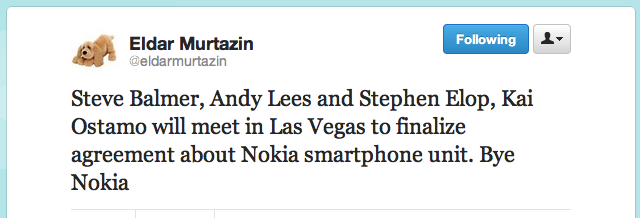
Mobile industry watcher Eldar Murtazin took to Twitter today, claiming that Microsoft and Nokia executives will be meeting each other shortly to discuss the possibility and terms of a deal involving the sale of the Finnish phone maker’s smartphone division (including “one or two” manufacturing plants).
Such an agreement between the two tech giants, which Murtazin says could be finalized in the second half of 2012, would leave Nokia with nothing but its ‘dumbphone’ or feature phone business, mapping services subsidiary Navteq and Nokia Siemens Networks, the flailing networking and telecom equipment company (a joint-venture with Siemens).
Murtazin also asserts that current Nokia head honcho Stephen Elop will resign from his chief executive role in the course of this year (possibly to return to Microsoft, where he used to run the Business Division?). Furthermore, Windows smartphones would no longer be branded ‘Nokia’.
Finally, Murtazin says the decision to make the move is entirely Microsoft’s to make at this point, and that they’re particularly interested in purchasing Nokia’s valuable mobile patent trove.
Let’s back up for a second.
First, we should note that Murtazin has been telling everyone who would listen that this deal was in the works since May 2011, mere months after Microsoft formed an alliance with Nokia to make Windows Phone the primary platform for Nokia-made smartphones.
Nokia vehemently denied that such a sale of its smartphone division to Microsoft was ever on the table, but I’m increasingly leaning towards believing that it was – and that it still very much is.
Murtazin isn’t always right, but some of his predictions about everything related to Nokia’s business have been pretty spot on in the past, and the man has had some massive scoops, often breaking major news before any official announcements were made, as a result.
We should also note that Murtazin is not the only one whispering about a potential sale of Nokia’s smartphone unit. Such a move would make sense, after all; Nokia certainly hasn’t exactly been heading in the right direction in recent years.
On that note, it’s worth reminding you that Microsoft and Nokia were also rumored (see WSJ report) to make a joint bid for troubled Blackberry maker Research In Motion just two weeks ago.
If Microsoft were to buy out Nokia’s smartphone division, the deal would be reminiscent of Google’s (pending) acquisition of Motorola Mobility, and put the Redmond software giant in a slightly better position to compete with Apple, ‘Googorola’ and other Android handset vendors.
Rumor today, reality later this year? I wouldn’t be too surprised.
Also read: Chart: How Google And Apple Won The Smartphone Wars