Google chairman Eric Schmidt recently boasted at Le Web that “Android is ahead of the iPhone.” And that may be true in terms of how many mobile devices with the Android operating system are being activated daily (550,000 versus 450,000 daily for Apple’s iOS, at last count). If Android has the numbers, why aren’t more developers flocking to Apple?
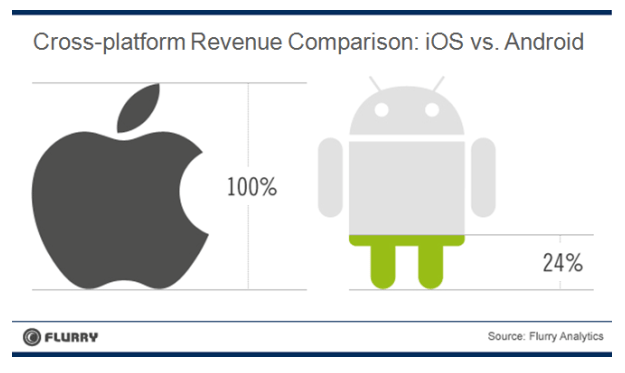
The answer is simple. They make more money on Apple devices. MG suggested as much in a recent post based on anecdotal evidence, but now we have some real data to back that up as well. Flurry, which has 135,000 apps across both Android and iOS using its analytics, just released some very interesting comparison numbers. It looked at a sample of in-app purchase data from apps with more than a million daily active users with versions on both Android and Apple. Flurry found that the Android apps produced only 24 percent as much revenue as the same apps on iOS.
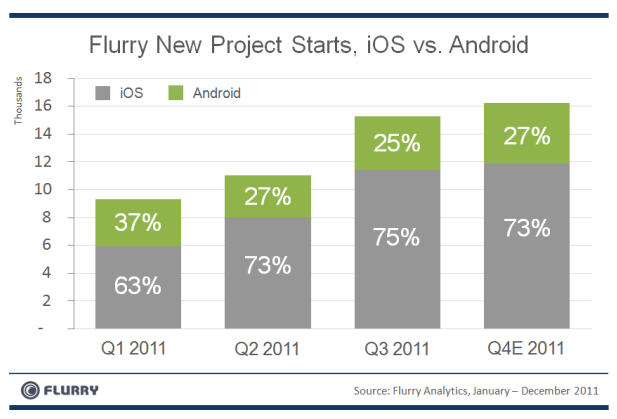
Flurry doesn’t say what the sample size was, and this only measures in-app purchases, not paid downloads, for instance. So it is not conclusive, but it does suggest why developers are still sticking with iOS. Looking at the 50,000 apps for which developers set up analytics in 2011, iOS continues to dominate, representing three quarters of new project starts in the past six months.
Android is a software platform for mobile devices based on the Linux operating system and developed by Google and the Open Handset Alliance. It allows developers to write managed code in Java that utilizes Google-developed software libraries, but does not support programs developed in native code. The unveiling of the Android platform on 5 November 2007 was announced with the founding of the Open Handset Alliance, a consortium of 34 hardware, software and telecom companies devoted to advancing open standards...
iOS is Apple’s operating system for their mobile devices. It debuted in 2007 with the release of the first iPhone, but has since been extended for use with the iPod touch, iPad, and Apple TV. iOS’ user interface relies on users’ direct manipulation of the product screen with multi-touch gestures, including swipes, pinches, taps, and reverse pinches.
Started by Steve Jobs, Steve Wozniak, and Ronald Wayne, Apple has expanded from computers to consumer electronics over the last 30 years, officially changing their name from Apple Computer, Inc. to Apple, Inc. in January 2007. Among the key offerings from Apple’s product line are: Pro line laptops (MacBook Pro) and desktops (Mac Pro), consumer line laptops (MacBook Air) and desktops (iMac), servers (Xserve), Apple TV, the Mac OS X and Mac OS X Server operating systems, the iPod, the...
Google provides search and advertising services, which together aim to organize and monetize the world’s information. In addition to its dominant search engine, it offers a plethora of online tools and platforms including: Gmail, Maps, YouTube, and Google+, the company’s extension into the social space. Most of its Web-based products are free, funded by Google’s highly integrated online advertising platforms AdWords and AdSense. Google promotes the idea that advertising should be highly targeted and relevant to users thus providing...
Austin, TX
Seattle, WA
San Diego, CA
Menlo Park, CA
Boston, MA
Disrupt Europe: Berlin Hackathon
Berlin, Germany