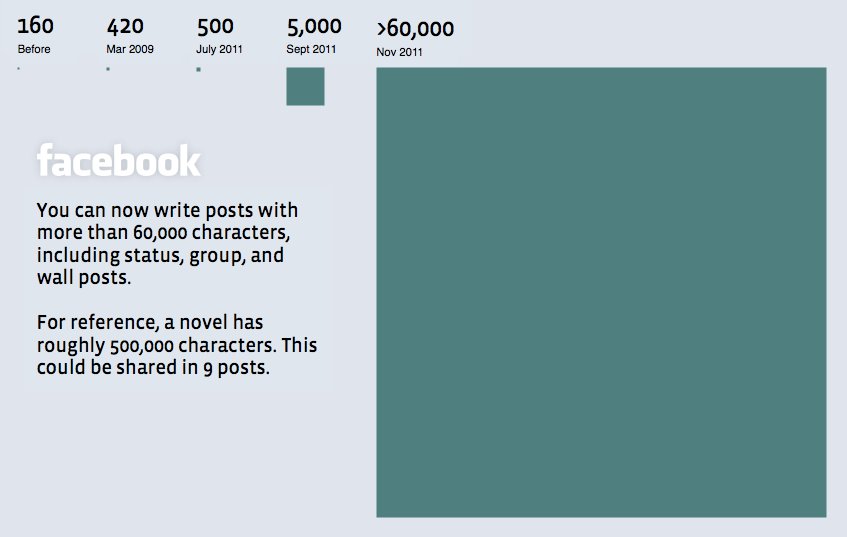
There’s a pissing contest going on. Google+ launched saying it has no character limit, though my tests show it stops publishing at 100,000. Surely unrelated, Facebook upped its limit from 500 to 5,000 in September, and today announced its limit is now over 60,000. That’s 1/9th the length of a novel. This gives users the flexibility to write full-fledged blog posts or even longer content. However, I suspect that Facebook was also trying to neutralize one more selling point of its competitor.
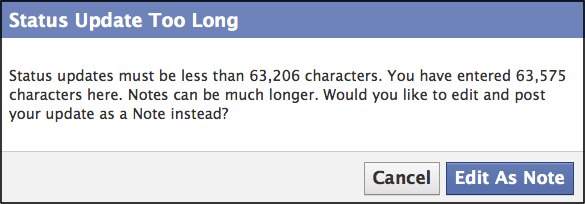
I tested the character limits of both Facebook and Google+ today. If you try to publish any more than 63,206 characters on Facebook, it tells you “Status Update Too Long” and asks if you want to publish that text as a Note instead. That’s a pretty graceful move, actually. Wanna guess how it chose 63,206? Facebook engineer Bob Baldwin wrote, “I set the exact limit to something nerdy. Facebook … Face Boo K … hex(FACE) – K … 64206 – 1000 = 63206 :-)”, in response to VP of Engineering Mike Schroepfer’s post of the announcement.
Google+ was less transparent. It wouldn’t publish anything over 100,000 characters, giving me the excuse that “There was a problem saving your post. Please try again.” So much for an infinite limit.
Facebook’s enormous user base means people are using it in all sorts of ways. Maybe someone out there wanted to publish wordy blog posts or whole chapters of their book in installments. Both Google+ and Facebook thankfully curtail epic status updates with “Expand this post” and “Continue reading” links respectively. Still, a 60,000 character Facebook post is probably never going to be read in the tiny width of the news feed, and Notes are better place for them.
That’s why I think this is another move by Facebook to whittle away Google+’s quantitative advantages. Facebook has been aggressively launching features found in Google+ since its competitor launched. In-line privacy controls, asymmetrical subscribe, better public posting capabilities, improved Friend Lists, and video chat are just a few examples. Facebook wants people comparing the user counts, time-on-site, and social graph density of the two services — things where it’s the clear front-runner. It doesn’t want people citing things Facebook doesn’t have, even if they’re unnecessary. Like 60,000 character status updates.