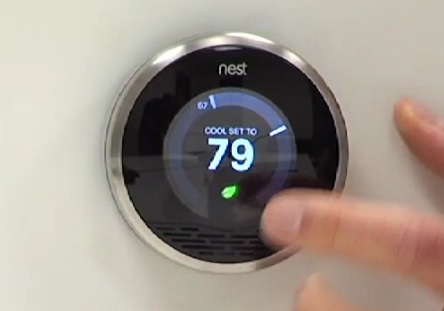
True to the Apple aesthetic it’s one big dial you can spin and push to control a sophisticated array of features.
It’ll be the first thermostat marketed directly to consumers. Can they get excited enough to plunk down a couple hundred dollars? My husband and I are finally putting a new heating system in our drafty San Francisco Victorian. After this demo, I was sold. How about you?
Let's take a look at the device. OK, let's show you the device. So, this is the Nest learning thermostat. First and foremost what you can recognize here is that it's just a wheel. It's a very simple wheel, so we actually call it a ring. And the reason why we made it this way is because 99.9 percent of the time, what do you do? You just turn the temperature up or down. So, what's the easiest way to do that? Is through a dial, a dial interface. We have one other input, which is you can press a button. So anywhere on the screen, you press the button and you can get into the menuing system where we have all kinds of different features and functions. So, simply put, it's a round thermostat. The other thing you should realize about this product is that we've used very, very high quality materials. So, we've used The best finishes, stainless steel rings. We wanted to make a cherished object in the home. Something that you'd be proud of to put on your wall. Another thing we done is, if you look here on this ring, this ring is special. It doesn't look like much, but why is it special? During our design process people asked us well what color are you going to make it? Are you gonna make it pink, are you gonna make it blue, are you gonna make it green, are you gonna make it wood? I want it to blend in with my home. So, we made all this different models, 20 different models, and every time, we didn't get it quite right. Nothing would work and then we were like, "Do we need 15 different models in the store for people to select from?" So, we looked and we looked at things and there was one silver model there and I started going like this and they started putting on different surfaces. I'm like, wait a second, it's starting to pick up the color around it. So, why don't we turn this into a mirror? Why don't we make the shape specifically like a mirror that can pick up the incident light reflecting off the walls around it and go inside to a total internal reflection, start to glow. the color around it. And so literally made a mirror. So that instead of us...you selecting the color you like, as soon as it goes on the wall, it starts to gain the colors around it. So it just simply reflects the light. So that's the product design. Very simple. Hopefully very elegant, something you like on your wall.And it has the processing power of an iPhone, right?It has smart phone guts. So, it has all the very smart phone guts that you would assume.Why does it need that?Why does it need it? Well, number one, we have to have an amazing interface, right? You have...the iPhone generation expects a certain type of user aesthetic. Right? And to get that, you need to use really great processors and graphics and screen. So we use those kinds of technologies to bring that to bear. But also because we call it the Nest Learning Thermostat, we're running all kinds of sophisticated algorithms to learn from your behavior, learn about your environment, about the weather to educate you better on the device itself about energies usage and to help guide you to save energy over time.So, give us some examples of how it helps you save energy.Okay.Because a lot of people have programmable thermostats. They don't use them. They hate them. Ultimately, they want to be whatever temperature they want to be.You're absolutely right. Actually, of those quarter billion thermostats that are out there, less than 10 percent are actually programmed once. So, if you want to save any energy? People treat these as manual thermostats; to save energy it takes 1500 changes of manual adjustments of the thermostat to save energy. Well, how do you do that, that's like 4 times a day? So, you turn it up when you get up, turn it down when you go away, turn it up when you get home, and you turn it down when you go to bed. That's 4 times 3, 65, that's a ton of manual adjustments. No one does that, right? So, they're all wasting energy. So what we decided to do was not make a programmable thermostat, not make a manual thermostat: make a learning thermostat. And what that simply means is when you install it out of the box, we have something called schedule learning, so that you simply in the morning turn it down when you go away, turn it up when you... turn it up when you get home. And we watch that, we learn from that behavior, and we just project it forward. So simply you do a couple of adjustments, we learn from it, and we just project it forward. So you treat it like a manual one, but then all of a sudden it programs itself. Kinda like magic. Tell us about the leaf, 'cause I like the leaf idea. I like getting rollover rewards for things. Okay. So if you look here...we're not going to see it.
There it is. There it is. Okay, there's the leaf. The leaf is simply a indication of when you're using your heating and cooling wisely. Why do you want to do that? It's similar to the Prius. The Prius has a echo-mode. It tells you when you're driving it properly, right? The real time feedback to the person using it. We think that's important to everyone using a thermostat. Are you using your fifty percent of your home's energy costs wisely? Should be simple: you just look for the leaf. And when does the leaf show up? The leaf is not a set temperature; it's relative to what you normally like. So if you, in a cooling season lets say, you like it 72 normally. Well the leaf will learn that you like 72 and it'll show up around 73 or 74. Why? Because one degree of savings can amount to five percent of actual energy savings. So you're like, wait a second, one degree from 72 to 73 or 72 to 74, I can save 10%. And two degrees, that's probably not going to affect me. It's to inform you, hey, you're doing the right thing. So we tell everyone, look for the leaf when they make an adjustment. Another thing we do, we've talked about schedule learning, we talked about the leaf, let's talk about auto away. So here in this grill here we have something called nesense[sp?]. It's comprised of 5 different sensors, temperature sensor of course, humidity sensor it has a light sensor and it has two other activity sensors. Near field and far field activity. It senses activity, you in front of the device itself. So, either for our field and through our room or near field when you were up close. Why do we do this? It's simply sense when you're inside the home. Like in a security system senses when somebody comes in to your home and alerts you...
Mm-hm.Well this will sense when you're in the home or outside of the home so that it can over a period of time learn that you're out of the house for two hours and actually, turn down to a lower energy set. So i'm busy. I have to rush out the door. I forget to turn down the thermostat. So it turns itself down for you. After sees your gone for 2 hours. That simple, and it turns it down to something you've actually specified, prespecified[sp?]. Like i want it to be 60 degrees when i leave the house, something like that. Simply auto away.Was there any feature that you wanted to pack into this thing that was not technically feasible or not technically feasible yet?Well, there's all kinds of magic we would love to put into it, but we think this is a great product right now. Maybe in some year when some rocket science technology comes out, we'll put it in. But this is a far and away more advancing thermostat than any other one on the market. So we're really proud of it.