Alexia Tsotsis works for TechCrunch as a writer. She attended the University of Southern California in Los Angeles, CA, majoring in Writing and Art, and moved to New York City shortly after graduation to work in the Media industry.
After four years of living in New York and attending courses at New York University, she returned to Los Angeles... → Learn More
It’s almost magical how Vocre works; Speak into the app while your iPhone is vertical, flip the phone horizontal and the phone’s accelerometer cues the app to translate and speak what you’ve said into the language of the people you’re speaking with, they then can respond, rinse, repeat.
To use Vocre, select the language and the gender of the person you’re going to be talking to, and Vocre does the rest.
Vocre views its competitive landscape as Google Translate and JibbGo, holding that what it does differently is focus on in-person dialogue and novel User Experience. Vocre co-founder Andrew Lauder says that his ultimate aim is to make it fun and easy to speak a foreign language via a phone, “Our focus is on conversation, Google’s focus is translating web pages, but if you actually want to have a conversation it’s lacking.”
Vocre uses Nuance to convert speech to text and its own crowd-sourced machine learning technology to go beyond to the pitfalls of Google Translate to make that text intelligible. Then iSpeech re-converts the translated text back into audio. Vocre aims to make interaction between users who speak different languages seem somewhat natural.
The app monetizes through subscriptions and every new download comes with 10 free translations. Afterwards users can get another 10 translations for an extra 99 cents. myLanguage, the company behind Vocre, plans on utilizing the in-house translation technology in order to add phone call and text features in the near future.
Vocre currently is available in the US App Store in 9 dialects including English (US, GB, AU), Spanish (Spain), French (France), German (Germany), Italian (Italy), Japanese (Japan) and Chinese (Mandarin/China). While right now phones need to be set to American English in order to use the app, Vocre plans on adding support for around 40 or so more languages over the next year, Lauder tells me.
Vocre currently has $50K in seed funding.
Q&A with judges Yossi Vardi, Mark Suster, Google’s Wesley Chan, Quora’s Rebecca Cox, Causes’ Joe Green
JG: How about intelligibility?
A: It won’t pick up fake accents.
R: What’s the turnaround time?
A: It’s quick, but we’re actually doing a three step process to translate so you’d think it would take longer.
YV: *Speaks in a foreign language.*
MS: If this really works, it’s great. You have to work hard to keep the middle part differentiated since the first part is controlled by Nuance and the second part is controlled by iSpeech. The thing with language is that idioms don’t translate that well.
WC: The situation where this comes in handy is a cab driver giving directions. How does this work when you don’t have a data plan?
A: Without a data plan this doesn’t exist. It doesn’t use a ton of data, but it’s there when you need it.
Presentation:
Ok, we're going to move to our next start up which is Vocre. Please you guys ready welcome to the stage Damien Dalley and Andrew. Hi, I'm Damien Dalley, Chief Product Officer and co-founder at My Language and my giant over there is Andrew Lauder CEO and founder. My language is a company that is focused on two things.
Language translation essentially accuracy and producing mobile applications, that will allow you to communicate more easily, especially when there is a language barrier. We see, we have a huge vision for connecting people. And the first step toward that vision is with our new application that we are launching today called Vocre .
In short Vocre makes it fun and easy to have an actual conversation with someone who speaks a completely different language. Are we good? Move the slide there. Imagine: stepping foot in another country and being less concerned about how you plan to communicate while you're there. You know, whether it's for something you need, say medicine for an upset stomach from eating that funky tasting taco you got from the street vendor, or you just come across someone you'd like to have a casual conversation with.
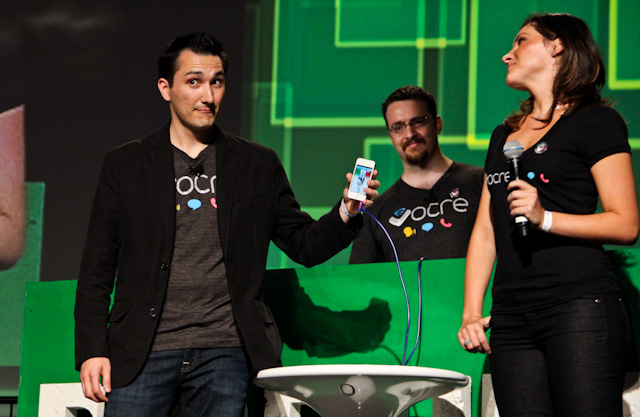
With Vocre, all you need to do is set the language and the gender of the person you are talking to, and then you're good to go. I know it sounds pretty 'science fictiony'. For all those disbelievers, please welcome our Vocre demo assistants on stage and we will show you the app in action. So, say you recently landed in Italy, and since those in-flight peanuts are a joke, you're looking for a great place to eat You might as well ask a local.
Hi, do you know of a good place to eat nearby? Sure. There is a restaurant a block away. Sorry. Had a come up. Perfect. Would you like to join me? Defito.
Definitimente.
Definitely.
Now say you're in China, finalizing a business deal. The least I will accept is one hundred million dollars.
(translation of sentence into Chinese.) You have a deal.
Thank you. Cool, right? So, what makes us so different than their translation applications. Well, aside from the technology behind it, which Andrew will cover in a minute a huge part of it is the user experience. Sorry.
If you're sitting in the back, and or your mind is blown, and you missed the details of the demo, this is how flows. After you've selected the language and gender, let's say for this example you're going to talk to someone who speaks Spanish. All you do is flip the device completely upside down and hold it upside down like a microphone.
Then speak your phrase after the beep. Soon after what you had said is going to be written on screen. Simply turn the phone, and if, for some reason it's incorrect, simply tap it and type in a correction. But if everything is good, as in this case, just flip the phone toward the person you're talking to.
And that's when the translation happens. To continue the conversation, just turn the phone again, vertical, and follow the same steps. You see, it's as simple as: record, review and translate. You see, the way we designed it, limiting the need to interact with the interface by leveraging the device's accelerometer and orientation; the byproduct is a more connected and natural type of communication.
So going hand and hand with the intuitive user experience we have some really great technology behind the sceens for Vocre. The first step is actually converting the user's speech into text. We've partnered with Nuance, who have the best speech recognition technology available. So once we have the text, we then leverage our own hybrid translation technology that we've developed over the past two and a half years, based on our user-contributed language data.
So now that we have the translation, the next step is converting it back into speech and we're using iSpeech, who have provided the best quality human-like text to speech voices that we've ever heard. So, I know you're probably saying, 'That's great, but how much is it going to cost?' I've got some great news, as part of our launch, we're actually giving the app away for free.
It'll include ten free translations. If you like it And you need more. You can purchase them via in App purchase starting at 99 cents. We're launching today in nine different languages including, English, Spanish, Italian, and Mandarin Chinese, as you saw here with many more languages. Remember, the world is full of people we're talking to.
Now, with Vocre, nothing is holding you back. Thank You.
Thank You. Well, that's pretty fucking cool. I have questions. Joe, want to jump in?
Yes, it's, I, I like that both of these are trying to solve more important things, and not more restaurant check ins. Not that's there's anything wrong with restaurant check ins. How, how unintelligible can the person be? Like if I have an aggressive cab driver, say in San Fransisco can this help me?
So the speech recognition technology powered by Nuance is really the best available. It's pretty amazing. It's really trained for native accents. So, for example, it picks up like ninety-nine percent what I say, but if I try to fake it with my high school Spanish that I had for two years, it picks up about fifty to seventy-five percent.
However, some of our other demo assistants who are by our table speak native Spanish and it picks up much better. So does that answer your question? Rebecca?
Yeah, this is very cool. I love how the interface sort of melted away and you did a good job of just focusing on having a conversation. The only thing is, what's the turnaround time for when somebody's talking, for, you know, goes on and on? Will it be able to capture that as well?
Right. So, as soon as the record beep happens, that means that we're streaming audio to Nuance to get it transcribed. The audio's streaming as you're talking and as soon as you stop, we tell Nuance, 'OK. We don't need any more transcription, and send us a text. Now when you're reviewing it, we're actually doing something behind the scenes that's a little bit sneaky.
We're translating it and converting it to audio, so that when you flip it over it's really quick.
I was thinking it would be cool when you start using it if there's a blurb about explaining what it is and not like *wudge* because then it would be otherwise highly weird.
Definitely, so today we're launching an English/U.S. device support. The app hasn't been localized to all the supported languages, so anyone with an English/U.S. device will be able to download it from the app store and use it so everything is localized there. As the next step, as our roll out continues will be the other languages.
Yursi?
He said: "I love it! I'm ready to fund it today!"
Awesome, thank you.
Mark?
Listen, it's always so hard to give feedback in a forum like this becauseYou know, anyone can do a great demo. If this product really works, its pretty exciting. My small bits of cynicism are if Nuance is doing a lot of the work on the other end, and you call the iSpeech doing work on the other end, you'll really have to work hard to make that middle tier super differentiated.
Obviously plus UI, customer acquisition and everything else. My experience with voice translation has been, unless you train it well, the accuracy is not that high. So number one, you have a translation problem. Not for you, because you can translate it, but for the other person.
Correct.
And the second thing is the idioms of languages which don't translate. I've lived in nine countries. I've tried every fucking product out there and the idioms don't always translate that well. But if you can get this right, magnificent. And we've got to try to get British to American translation working as well.
Yeah, that would help.
It's there.
Yeah.
Wesley?
I'll be quick. When I travel I always find that the situation toward this would become handy or usually a cab driver giving directions or I'm in a restaurant or I'm ordering something. Half the time my phone doesn't work because there's no data plan or some crazy roaming rate where I'm paying eight cents a kilobyte or eighty bucks a megabyte.
How does this work when you don't have a data plan?
Without a data plan it doesn't exist. We require the Cloud, because if you're going to put everything on the phone there's not a lot of capacity. There are some translation apps that work on the phone alone, without any data. The problem is that they can only support a few thousand words. Our system supports over one and a half million words in US English.
So I would use this in the case where I'm desperate enough to go pay eighty dollars a megabyte to go read this over. Ya, it doesn't use a ton of data, but it's there when you need it. That's what we're. All right, so I have to make sure that situation.
Yes. All right. I get it. Thanks. Or if you have Wi-fi available of course.
Perfect. Ok everyone. Thank you. Ya if the next start, our check ins are basically screwed. Ok, please
Backstage interview:
How does it feel to launch at TechCrunch Disrupt?
It feels great, actually. The thing we didn't actually share on-stage is we only started conceptualizing the product two and a half months ago. So it's been a crazy drive to get here with a good product.
What do you think about some the feedback that you have received?
It was actually really good. The toughest question was in respect to data plans. You know, making sure-, do you need internet connection for this, and I think we responded to it well because there's limitations to technology. It was Mark, I believe, who asked about the vernacular, the specifics of each individual language and can your product transfer?What do you think about that?
Well, essentially, with the technology we're leveraging, which is Nuance, it's essentially the best speech recognition that you can get. It does a really good job with native languages or native speakers in that sense. And you know, essentially it's made for that.
On a scale of 1 to 10, how would you Rate your performance on stage?
I say we did a 9.7, I'd say. And when the judges are doing their deliberations, what do you think they're saying? I don't know, I have no idea. I think they enjoyed, I think they're going to enjoy it, I think the audience enjoyed it so, think we did a good job.