Rip Empson is a writer and rabble-rouser at TechCrunch. He covers startups, music, social, mobile, health, education. You can reach him at rip[at]techcrunch[dot]com → Learn More
At the TechCrunch Hackathon on Saturday, the 108-year-old, All-American automaker, Ford, teamed up with the newly-American music service, Spotify, to showcase the growing opportunities for developers looking to take advantage of in-car gadgetry to integrate their apps and mobile services.
Today at TechCrunch Disrupt in San Francisco, Ford looks to continue pushing forward with in-car connectivity and gadgetry, announcing a partnership with Bug Labs — an open-source hardware and software provider that tinkerers and engineers can use to create their own digital devices. The two companies will be collaborating on a new in-car research platform, named OpenXC, which looks to transform the car into a plug-and-play platform that will support open-source hardware and software to allow developers to make the car a playground for all kinds of cool new technologies.
OpenXC, which is based on Bug Labs’ Bug System, will allow users to create a personalized driving experience through add-ons like visual and audio feedback interfaces and environmental sensors and safety devices — simply by snapping Bug Labs’ hardware modules into the consoles of vehicles.
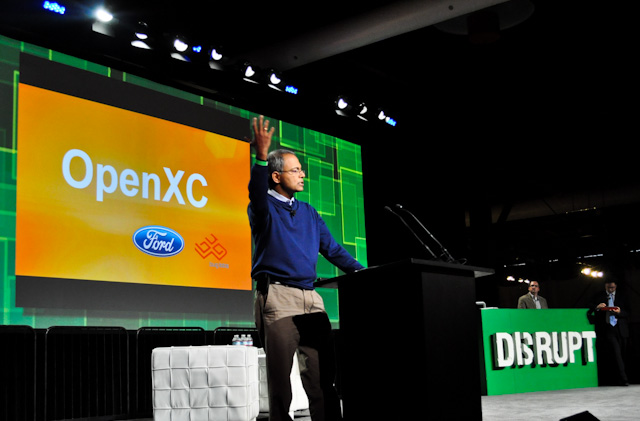
According to K. Venkatesh Prasad, the senior technical leader for Ford Research and Innovation, OpenXC is designed to create a platform that is completely open to the developer community, allowing engineers and hackers to offer cool in-car solutions to the consumer at reasonable prices. While Bug Labs has teamed with developers and enterprises like Verizon, Sprint, AT&T, Pitney Bows to design and test innovative devices, Ford is the first automotive OEM to collaborate with Bug Labs.
Across the board, cars are getting smarter, and the opportunity for innovation in automotive connectivity continues to grow. Ford said that it hopes to use the OpenXC research project as a way to test new entertainment and connectivity solutions, and get a head start on the changing (and increasingly more technological) landscape, like fast-changing content preferences and “buy as you can” rental app solutions.
As Asia is poised to become a big source of vehicle sales over the next decade, Prasad gave the example of a Ford owner who loves the game of cricket. Through OpenXC, drivers will be able to purchase a $15 cricket module from a local ford dealer, one that’s designed by a local developer and approved by Ford, to plug into the master control board in the car that would play a community radio station dedicated exclusively to cricket. After the season is over, the driver could replace the module with another, sport-focused or otherwise.
OpenXC is designed to give both Ford researchers and third-party developers a low cost sandbox in which they can share, test, and verify any and all concepts related to in-car connectivity. The idea is to allow its open platform to give communities of drivers the ability to customize their driving experience, while at the same time allowing manufacturers like Ford to avoid building customizable vehicles for specific markets. Instead, through OpenXC’s sandbox, Ford is opening up that customization to third parties, enabling personalization of the driving experience to continue with participation from multiple sources without having to break the bank.
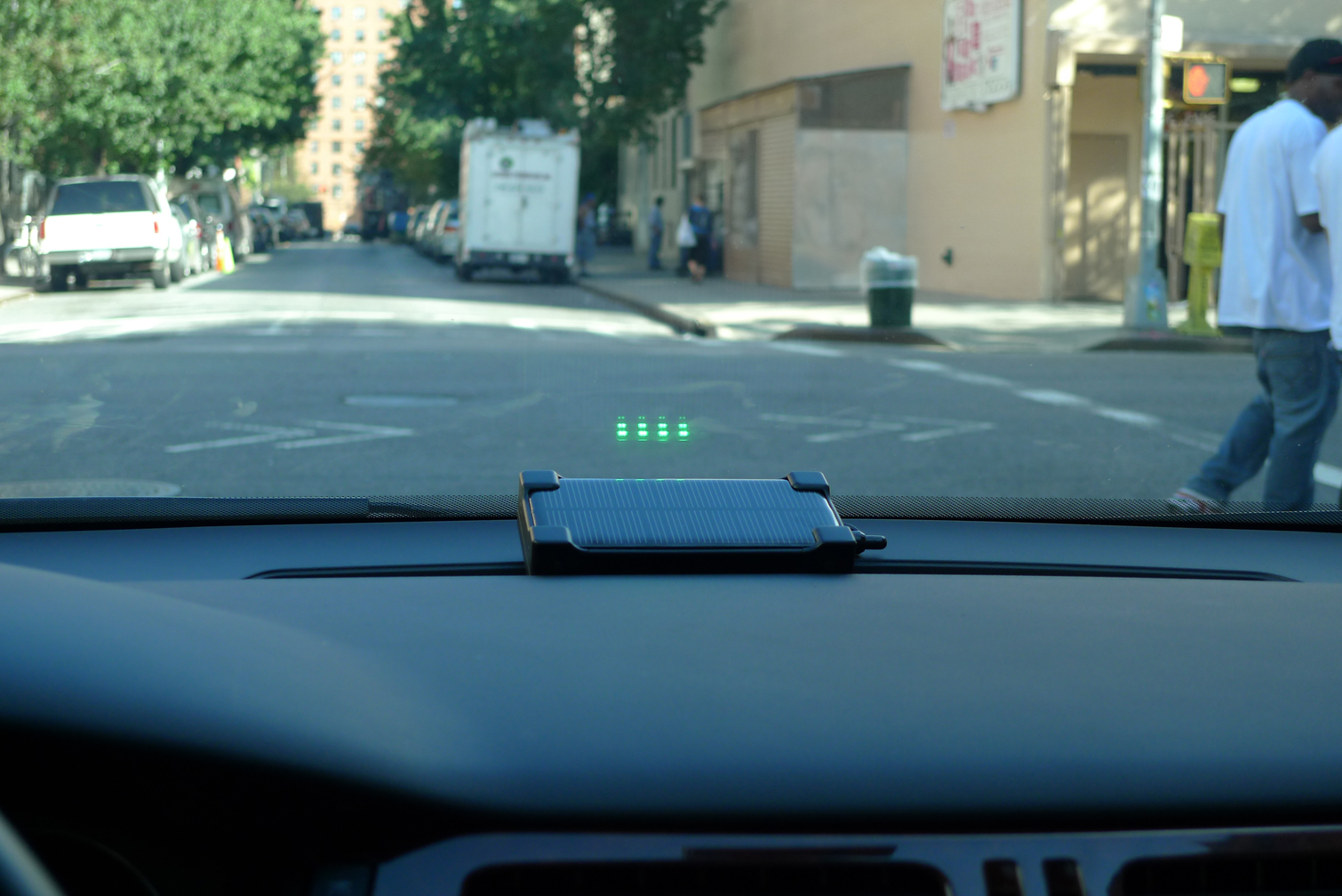
At Disrupt, Ford and Bug Labs demonstrated the OpenXC platform using a Ford Fiesta to showcase a prototype “Fuel Economy Challenge” app that uses Bug Labs’ hardware and software modules to provide a LED fuel efficiency display module in the vehicle’s cockpit. When up and running, the app illuminates the windshield with a display presenting the driver’s current fuel efficiency. Drivers then have access to realtime data on how others in the challenge are performing, and who is driving most efficiently.
It’s nice to see a once-troubled automaker finding new ways to remain relevant and provide its drivers with all the benefits of the mind-melting technology being developed by young American startups and tech companies. Developers and engineers, definitely look out for this one.
Demo with, is Venkatesh Prasad, can he come up?
I'm right here. Go ahead.
Oh, here.
I'd like to introduce Venkatesh Prasad from Ford Research, and Peter Semmelhack, the CEO of Bug Labs and they're gonna show you a demo of a brand new research project that basically lets you hack a car. Take it away Prasad.
Thank you Eric, appreciate it. Morning folks. Good Morning. I'm really excited here to be representing Ford and we have a few extremely exciting and engaging pieces of information for you, and it's something that we are going to share with you right here. We are going to give you a sneak peak of what we've been doing in terms of driving open innovation and really creating a disruption, a mash-up of IT and the automobile technologies, and technologies that enable all of us as developers, investors, as users to come together and really co-create with the manufacturers and producers.
Ford, as many of you may know is a 180 year old company, and so I'd say a few more years than all of the start-ups here put together. And so, it's really an exciting time for us to come together and really share with you what we know and how we could really be successful together. We've been, on the Ford side, been very successful not just in terms of making cars and trucks that we've been doing for a while as you know, but we've also been putting IT into our, into the car and making a lot of advances in terms of bringing connectivity technologies to automobiles.
and making that a real useful proposition to other consumers. We've got about 3 million cars today that have a technology called Sync that enables your cellphone and other devices to connect through the car's audio system. So Sync has been able to allow us to to embrace the creativity of developers.
But in a different kind of way, it's been a top down. We've sort of created a platform and it's been a top approach to adding value. And Sync has been been part of this whole effort. There was two days of Hackathon where Sync application...programming interface were used to create apps. And so there were several Hackathon apps that came out of Sync, that top down technology.
But what I'm here to talk about is really a different way to manage innovation and to create really the future for all of us going forward. What we want to be able to do is to embrace the power of the crowds. We want you to be able to modify hardware and software where Sync is primarily a software platform.
So we're really excited to be here to speak about a technology called open XC. X for essentially anything, and C for connectivity, but really, being able to work with open source hardware, open source software and related services off in the cloud. So, what they'll be presenting to you very shortly is the ability to take tool kits that let you modify the automobile, and really stage the experience for the future.
It's the sandbox open XC that we would like to speak more about, and we've been working to build this toolkit with our partner, Peter Semmelhack, who's the CEO of Bug Labs and with that, I'd like to introduce Peter.
Thank you very much. My name is Peter Semmelhack. Microphone. There it is. My name is Peter Semmelhack. I'm the founder and CEO of Bug Labs. And we're a start up based in New York City. And we're loosely a internet of things company. We help organizations like Ford innovate quickly and easily in hardware.
Right. We bring open source principles to hardware, and then we help those organizations get those devices onto networks. If you think about a Ford automobile, there's a lot of interest now in putting these things, these devices, on networks. So we're very happy to be working with Ford. We were introduced to Ford by a gentleman by the name of Eric Von Hippel.
He's a professor at MIT. Some of you may know him. He wrote a book a couple of years ago called, "Democratizing Innovation" and in this book he talks about his thirty or, twenty or thirty years of study where he's thinking about this idea of innovation not coming from big organizations like Ford, but coming from the community.
In one of my favorite examples that has to do with automobiles is the cup holder. And the cup holder, you know twenty years ago didn't really exist in cars, and as a result the community community built them themselves. So an aftermarket, the cup holders, you remember they sat on the windshield and all these sorts of things.
The vehicle manufactures recognized this was a good idea and so they pulled them into the car. So now Ford vehicles and others have cup holders. But that was a crowd source innovation, right. Now what happens if you take a car and you think about it electronically as a computer and what would, if you, if I could turn the car over to you and say what would you guys add to the car to make it your own, personalize it maybe for a certain lifestyle or for a certain geography.
What would you do? And that question was what, has driven this project now, which we've been working on, and so, we said, "Well. What would we do?" And we put a team together of three people and we work for the past six weeks on a couple of ideas. We have three applications. One, which I'll demonstrate today.
Two, you can go out to the display outside and see the other two. Really, what was an idea is how do we, how do we take open source principles, the idea of hardware and software to stand in this case of Ford Fiesta. Of the Ford Fiesta sitting over here is a small car. It has lot of features and functions, but it doesn't have a couple of things that we wanted.
So, I'm gonna hold this up, I don't know where the cameraman is. This is something we built using completely open source hardware principles. There's a 3D printer. It's off the shelf solar panel LED light, and the idea is this is a device that will pair up with a computer that's in the car. This is called a Bug Base, and so these are connected over BlueTooth.
What it is is it's a socially networked fuel efficiency meter. Okay, so if you see here that the green light, what that does it's a little LED and over blue tooth it connects to the base which talks to the car and the car basically, has operational data about miles per gallon, and it will create a heads up display on the windshield to show you how your doing.
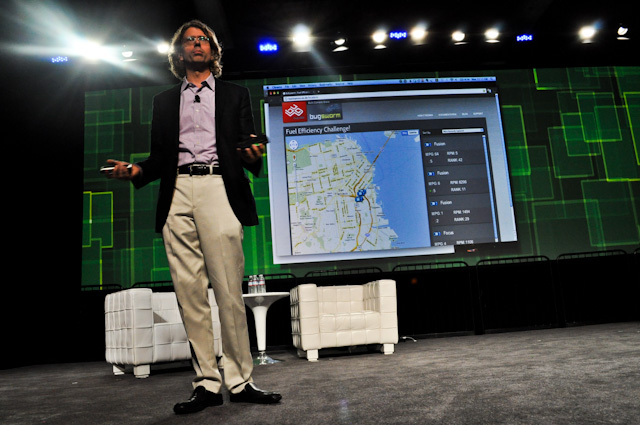
So as you're driving now with this device, you can actually see how you're driving, but more importantly, the Bug Base over a 3G network adds the information to a cloud based application we have called Bug Swarm, which we're just actually announcing today. And we'll show you this in a minute. But the idea is that you turn the device on and you can drive and see how you're doing but then you can also share that data with others.
So this is just one example of something that we built literally in six weeks, a team of three people. But why don't we go to the display on my laptop there. And what I'm gonna do is show you a demonstration of how this works. And it's a web application that we built using Bug Swarm.
With the laptop.
And you're gonna see a couple of cars driving around a map. And the idea is that these are my friends and part of swarm. They all have Ford vehicles that have this built in. And what's happening is the information is getting uploaded to the...to the server. And now you can actually see, you know, that car, what's the mileage or the performance they're having.
Excuse me.
And it's a contest. So if we can pop that up... we don't get it up, we could show you later. But if you think about the idea of hardware extensions There you go, it's right there.
There it is, okay. So, this is called the "fuel efficiency challenge". We built this as part of this application. And so this is obviously these are Fiestas and Fusions running on San Francisco, it 's not real data but the idea you can see. Now what I'm gonna do is I'm gonna get into my car, not literally, but figuratively and I'm gonna start my vehicle and so now what happens is, I start the car and what happens is the, the, the blue tooth now pairs up with my device.
You'll see now the LED read out is giving me information about the fuel efficiency that's screen card from the car. And then based on the latency of the network you'll see my cars show up. But you'll see what happens here is that everybody is ranked based on, here comes my car. Everybody is ranked based on the real time information coming from the automobile, right?
It's kind of a fun little thing where you can now challenge each other to who has the best performance. But we literally did this in six weeks. we went from an idea to little working prototypes, and nice looking working prototypes in six weeks, and this could be a market of four. It could be just my friends and I wanted this, and because now Ford is not looking, you know, askance at this sort of thing, they're actually embracing it, they're encouraging it.
They're gonna be giving out tool kits for everybody in this room. They're interested to build new things, build businesses around this idea. So, it's a fascinating idea, think Ford, as a leader in this market of plain technology, you know, first in front of the automobile is an important part. These types of applications and new widgets I think will be a really interesting area to explore; it's a project we're working on with them now, and we'll be continuing now for the next few months and we'll have an update in a few, terrific.
So, what are those types of things you could do with this technology? What are are other apps that you built or you think you could be built?
Ya. We've got. It was a very interesting story because we had about three folks who are really actively working on this project and they came up with three different ideas. We could have selected one where all three were great.
What were the other two?
There are two others. One was a first grade checking app allows you to take one of these little modules, plug it in and your car then automatically checks into Four Square when you get to your favorite spot, or if your friends are in the neighborhood it sort of alerts you to the fact that your friends in the neighborhood that's really impressive social.
Like a parking check in.
That's right and do more and the second one has to do with sort of an audio road trip so if you're passing by along the road and there's a point of interest, it's sort of point of interest that speaks to you. Obviously, there's many such apps around, but this is a really neat and a graded one that's on the phone and of course, the point of this is not the apps themselves.
But to really invite the developers in the world who wanna be able to hack the hardware and software to come to us, to work with us to really make yourself and also, collectively profitable beyond the Lakers systems as drive here.
Right.
And I can see businesses around, you know, maybe getting into the diagnostics of the car. I love to have my own dashboard on my car, you know, the things that are available only to, you know, to the service station. Now, it's just a type of thing that somebody could train service around there.
Ya.
I think the real disruption here is the fact the typically large establishments work with focus groups and market studies for solutions that serve millions. We do like, we do a great job of that. So we do, most of our business is right around that. But here's a huge opportunity where the market size is five or four or three or two or one.
We can still have something that's right there. So you might have a car that doesn't have the one feature you want, and it gives and opportunity for some of us to come together and make it happen. Right. And where can people find out more information about this?
For now you can go to the Bug Lab site, you can come to us, there's information that we have on our site through BugLabs.com?
BugLabs.net. And actual developer kits are going to become available towards the end of the year, we're working on them right now. Well probably have a sign up sheet, well not sheet, but a sign up system where anybody that's interested in participating in that can sign up. But you know the next couple of months there are going to be some interesting announcements around this whole process.
Ok, so it's not available yet, but you think by the end of the year people will get these devices and start hacking?
The tool kits.
Ya. And so the whole idea here is to have a sandbox where people can safely create applications that aren't going to impact the critical systems of the car.
Right, so obviously if you're very, very sensitive to not compromising the primary functionality of the vehicle, the safety aspects, everything is regulated. What we're saying is an opportunity here to go back to the future if you will, to go back to the days when you can actually modify cars. Here's an opportunity now to come together.
Embrace the power of electronics, the power of the cloud. Bring it all together to be able to modify hardware and software to create this new kind properly.
It 's like they're new after market parts, in a way.
Ya.
All right everyone, please give Ford and Bug Labs a round of applause.
Thank you.
Thank you. And thank you very much. And we have our next speaker on board.