Jason Kincaid currently works as a writer at TechCrunch.
He grew up in Danville, California and later relocated to UCLA in Los Angeles, California, where he studied biology with a minor in ‘Society and Genetics’.
You can reach him at jkincaidtc@gmail.com (he has other addresses too, so don’t worry if you have a different one). → Learn More
It’s no secret that fresh produce straight from the farm can often beat the potato skins off of its supermarket counterpart — and why farmer’s markets are becoming increasingly popular. But unless you set aside that chunk of time every weekend to pick up your veggies from local growers, you’re probably stopping by your supermarket anyway.
The solution to this has been the emergence of Community Supported Agriculture programs, where members of the community agree with farmers to purchase a certain amount of produce, and then pick that food up at local dropoff points at regular intervals. But, while they’ve been around for decades, these programs aren’t necessarily easy to find or use. If only we could use technology to make things a bit more efficient…
Today, a service called Farmigo is launching as part of the TechCrunch Disrupt Battlefield, and it’s looking to make these CSAs more accessible, more popular, and more efficient — disrupting the way you set about buying your produce.

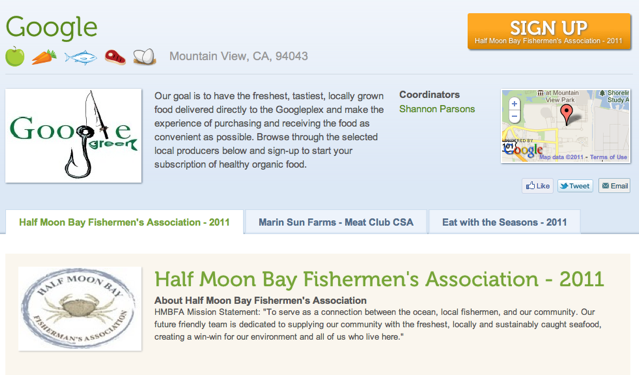
The site is essentially a platform for discovering, signing up for, and sharing CSAs. You can browse local dropoff points, viewing which foods each food producer is delivering. After choosing your producer and the items you want, you sign up for a regular subscription, which allows the producer to plan ahead. You can see an example dropoff listing here (it’s for Google’s office, which three producers use as drop-off points).
Farmigo is also using a ‘tipping point’ model (as popularized by Groupon), where you need a minimum number of participants before you’re able to create a new CSA in your area (if you don’t have enough people, it isn’t worth the farmers’ while). The company believes this fact will help the service spread virally — just like Groupon, users have an incentive to get their friends to sign up.
And, aside from getting fresh food and supporting local growers, the site also says that you’ll typically save 20% to 30% off supermarket prices. Farmigo makes money by charging a 2% transaction fee for each order/subscription.
As a special offer, Farmigo says that the first 100 TechCrunch readers to create a dropoff point (and get enough friends to join so that it passes the tipping point) will get their produce free for a year. To get in ont eh deal, sign up, then put ‘TechCrunch’ in the comments section. Note that you have to create a dropoff point, not just join one.
Presentation:
That's the tech crunch disrupt battlefield. Are we ready to move on? Are you guys? They seem ready. Alright, well in that case please, yeah, so I'm gonna try to be as much of a dick as I can on time because last year it got a bit messy and people got too long and too short. demos do overrun I will cut you off, but if they overrun a bit I'll cut your question and hopefully it'll be fair to everyone, so.
I appreciate the musical introduction. Yea, that was your intro, yea, so it's all you now. Please welcome to the stage, from Farm Ego, Benzie Ronan and Josie Pick Hi. Yesterday I went to the farmers market and I got this fresh basket of produce. It was locally grown. It Organic. I bought it straight from the farmer and it was harvested about 24 hours ago.
Now, but I had to go on a Sunday 9 and 12. Now this bag of produce I got just down the street from where I live at a supermarket, so very convenient. A bit cheaper. But it was sitting on the shelf for up to about 2 weeks. It was grown with chemical, pesticides and fertilizers. And some of the produce actually came from different countries.
Now, what if we could get this fresh organic, great produce at the affordability and convenience of the supermarket? That was the inspiration behind Farmigo. Now, already today we have farms that are going direct to the consumer in programs that are called CSAs or Community Supported Agriculture. But they don't scale and they're a bit fragmented.
Starting today Farmigo is launching a marketplace. Now what we're doing is we're taking the traditional supply chain and we're collapsing it. We're removing the warehouse and the supermarket. This basically creates a direct relationship between you the consumer, and the grower. The next thing we do, is we have convenient pick-up locations so that the food comes to you so that it's convenient.
And then using group buying mechanics and subscription pricing we're able to decrease the price so it's more affordable for you. Let's take a look. So, we're at farmigo.com the marketplace and for this scenario gonna assume that I live and work in Mountain View. So we're gonna look for those convenient pick up locations.
Now you'll see here there's 53 locations these are live locations today. There's over fifteen hundred available locations in the system already. I'm going to filter this by fruits, veggies, let's do meat and eggs. So I've narrowed down some of the pick up locations based on my preferences. And then let's take a look at the list.
You can see one of them is Stevenson School, that 's where my kids go, so that would be easy to pick up my produce from there. We've also got evolution trainers, which is a gym. So, I work out twice a week, that would be a convenient place. And in this case, I'm also an employee of google, so I'm going to select that one, since why not have it come to my work place environment.
Now what we are going to see here is basically a brochure of of the pick up location at Google. You'll see that there are three producers here that deliver to this pick up location. Let's take a look at the first one. Here we can kind of browse a catalog of the different food items that this producer delivers to this location.
Now you'll notice that these are subscriptions the basis. So you're basically committing to a longer term relationship with each producer. That enables some predictability and stability in the food chain Now let's go over, you'll see, to Half Moon Bay fishermen. So these are the fishermen in Half Moon Bay that are catching the fish and delivering to you a fillet.
Now What you'll see here on the activation goal, is we're using group buying mechanics, so the producers actually said that there's a minimum number of people that need to sign up before they start making the delivering here. Here we're using group buying mechanics so that all the members of this pick-up location have a shared interest to start reaching out to members in their community and get them to join.
basically removing the marketing effort and making it community based on that location instead of having it, the expenses of the supply chain. So We can also see that we are providing basically social networking tools to the community. So that they can reach out whether it's Twitter, Facebook or email.
Now already we have over 40,000 families that are delivering their produce weekly through the system. Farmigo receives a transaction fee on each payment in the system. Now so far we discussed the consumer side. In order for this alternative supply chain to come together it's really the supply side that needs to match the demand.
Right? The inventory needs to match Let's take a look at what provides each producer on the network. So now we are looking at the web based solution that we give each producer on the network. Let's take a look at the dashboard, you'll see. So the system tracks, this is a web-based system and you're now looking the producer perspective, it tracks everything from harvest, packing, delivery and all the transactions taking place.
Let's take a look at another module, let's take a look at the round module. So now we're looking again from that one producer, this is all the information they need to know where they need to deliver, how much they need to pack and at what times it needs to be distributed. So let's summarize so far.
One. That's So one, we talked about collapsing the food chain, right? We're basically removing the retailer and the warehouse and By doing that, what we're doing is creating this direct relationship between you the consumer and the producer of your food. That increases profitability for the producer and decreases the cost for you.
The second thing that we're doing is making sure it's convenient. So the produce needs to come to you. We make very convenient pick-up locations available for you. And the third is using subscription pricing and group buying to decrease the price. Now, we all live in an era where the biggest changes on the planet are around ordinary individuals.
You are the biggest contributor to change right now on the planet. Now giving you the tools, so that each one of can take an active role in creating an alternative food system in our regional communities. So join one of the existing 1500 pick up locations at Farmigo.com. If there's not one available that's convenient, start your own.
Become a local hero take-- an active role. We expect there to be tens of thousands of these pick-up locations that sprout up across the country. We'll make the first 100 Tech Crunch viewers that new pick-up location Farmigo will give them a years worth of free produce. Now, join us. Help us grow a more sustainable food system That's better for the planet and better for you, thank you.
Well I'm a for an animated cartoon apple. I don't know about you. Who wants to go, Tony let's start with you first this time.
I'll go first. So, I love the vision of this but the challenge I have These type of models are around how do you get the scale? The margin structures are unbelievably thin right in the grocery space. And people will drive, as you know, very far out their. way to save 25 cents on an item. So, how does this work in terms of your margin structure?
And secondly, what's the role of community organizers and people on the ground to actually, to make these, facilitate this hand-off and distribution of the goods? Cause that's a big pain point here.
Okay, so one is scale.
Yeah.
Right. And the other one is how we kind of self organize the community.
Sure.
Right.
Yeah.
So, we're already seeing that from a scale perspective in forty thousand people or families, which is more like a hundred thousand individuals, are receiving their produce today. We're a young start up, right. We have only been around for two years. So we're basically multiplying by four times each year the number of people that are coming on board.
Farmers today, they get 20 percent on what you buy through a super market. Through this model they're getting 80 cents on the dollar that you're paying. So for the farms it's much more profitable, right? Now the question is how we actually increase that demand. Now it has to be community based, right.
We're not.
Well, actually my question versus your margin structure. You have to be operating on razor-thin margins.
Farmigo's is kind of the open table of this model. We're enabling you, the consumer, to go in and we're aggregating all of the different farms. And on the other side, we're providing a management system for each producer. We're a high-tech company. Our margins are similar to high-tech companies. We're taking a transaction fee of what's coming through the system.
So, from Farmigo's perspective, I think we're doing pretty well.
Wendy? We should try and have a second question.
I love the vision. Support that. I was thinking open table as the metaphor, so that made me feel like I'm with you on this. It seems to me it's understanding the roll-out and the amount of investment you have to make to work with the suppliers versus get the consumers ready to consume. And I think that's going to be tricky, just in term of resource allocation.
So these sales to the producers themselves are all done over the phone. We're able to close a sale in one hour. And then we have a team, we have a team, you know, we've invested in user experience.
So you don't have to go out and work it?
Oh no, no. We're not going, we're not.
So it's inside?
All telesales going out into farms and then from a demand perspective, you know, we're absolutely gonna be focusing on marketing that's community based. So you see that there's a video clip on our site now that you can see, you know, that's going to go viral. Where gonna kinda use the meet up, that's the other metaphor I would use because each one of these are kind of like mini meet ups, right?
And you need Get Satisfaction. I had to say that. I'm sorry.
No we are using Get Satisfaction.
There is an interest there.
I know, sorry.
But good plug.
I stand corrected.
Brad?
I was very impressed with the website and the analytics to the growers etc. very cool. I am impressed with how many distribution sites you guys have already. I think the thing that would give me pause is, for so many people the habitual behavior is I go to the grocery store. It may not be as good, but it's pretty good, and there is an old saying that in order to change consumer behavior you have to have an order of magnitude improvement in the experience.
So I would say I come away from this thinking this is pretty cool. I'm not totally convinced that it's a 10x improvement in a consumer experience to get them to really change behavior. I hope you guys succeed.
I guess to that, two years ago we were all saying Airbnb, no one's going to want to stay at somebody's house, right.
Yeah.
We all are traditionalists, we go with hotels. And that's taken off like wild fire. We're seeing the same thing happen here. I mean the community is kind of rising to the occasion. They want to do the right thing. The timing, if you look what's happening around recipes, the number of recipe sites that are coming out.
The foodies, the environmentalists. Actually on that side we are seeing a lot of grassroots movements that we think are gonna fuel this.
Steven?
So I actually, you know, after the last music there, I should say, for the last year I've been trying to do this stuff. Wholeshare in New York came out, it does the exact same thing. And I've tried it. It's really hard. It's very complicated because you have to figure out what farmers are going to be where, when for what pick ups.
This isn't easy stuff. So you're essentially trying to assume that desire for a better lifestyle outweighs lazy, and I don't know if that's true. People like to pick what they're going to eat, they like to see it before they get it. When you do these CSAs they've got tons of problems. You've layered on complexity on complexity with the Groupon buying, and the, like if it's such a discount because you're going directly, shouldn't it just be cheap all the time?
Like it just feels like there's so much you've thrown in here. If I'm signing up for this I've got to figure out the location. I've got to figure out what I'm gonna get cause I don't have the pricing, I don't know what's gonna be where. I have to go find different locations to pick different types of food up.
It just seems a lot more complex.
So you as the user find one location, right? For that location we give you basically an online catalog. You're able to see exactly what the pricing is and what you are going to be getting. As far as adoption, we have existing pick up sites, right? So lets say Google. We saw the number of people that were joining a CSA there, and then we saw the number of people who actually joined this program.
It's orders of magnitude higher. We have three different producers that are delivering there and we now have hundreds of people at Google that are signing up for this and receiving their produce weekly. Meat, fish, vegetables, you name it, right? We have locations at Facebook, Twitter, You know different locations are now coming to us saying we want to start this as a benefit to our employees.
It's different from Oshow. Oshow is actually going through. Distributors and they are having the actual coordinator do a lot of organizing. We have a lot of that logistics happening at the producer. Actually we have stickers that get on each item. Comes to your location it's already packed for you.
Okay we're out of time, but give one more round of applause for Farmigo. Just got confused because the time was starting to go up, and I didn't really know what that meant. So lets ready for the next startup. Stephen, are those the same shoes you were wearing? disrupt New York. I remembering admiring your shoes, I think.
No, I just, I'm not going to hold them up for people. But, they are kinda cool, they got a
Tony Conrad: Margins in grocers is small, how do you get scale?
A: We’re seeing 40,000 families receiving produce today. Multiplying 4x each year. Farmers are getting much more money for their goods when they sell this way… We take a transaction fee of what’s coming through the system.
Wendy Lee: I agreed with the OpenTable analogy.
Brad Garlinghouse: Very impressed by the website. Thing that gives me pause, for so many people habitual behavior is that grocery store is not as good, but pretty good. I come away thinking this is pretty cool, not convinced it’s 10x improvement.
A: Airbnb, you could have said the same thing.
Stephen Messer: CSAs are complex. If I’m signing up have to find where it is, what’s going to be where.
A: You as the user find one location, for that location you can see exactly what the pricing is and what you’re going to be getting.
Backstage interview:
How did it feel being on stage?
It felt great. And the fact that we were able to reach out to the Tech Crunch community. We want people to join this service, right? So it's great way to get people enthusiastic. And for them to join a pick up location or to start a new one. So that was great to have the audience. Were there any questions that you weren't anticipating?
I don't think so. I think it's a tough logistics challenge. Right? We're trying to create a new alternative food system. That means we're removing the wholesaler and the retailer. So, all the questions were mainly around that aspect of the model.
And what would you consider the best part of your performance on stage? You know, I think it's normally you're seeing kind of technology-related start-ups? Here you got to see real produce, it's a real physical problem that we're using technology to solve I think that part was most powerful
Farmigo is providing an alternative food system by enabling group-buying of fresh food directly from local farms & producers, making it convenient and affordable to get local, seasonal food.
A grassroots food movement has been driving the popularity of Farmer’s Markets and CSA programs (Community Supported Agriculture). Purchasing produce directly from the grower is disrupting the traditional supermarket channel by providing fresher, healthier and tastier food. Farmigo’s Internet system enhances this direct grower-to-consumer channel by adding convenience, affordability and accessibility...