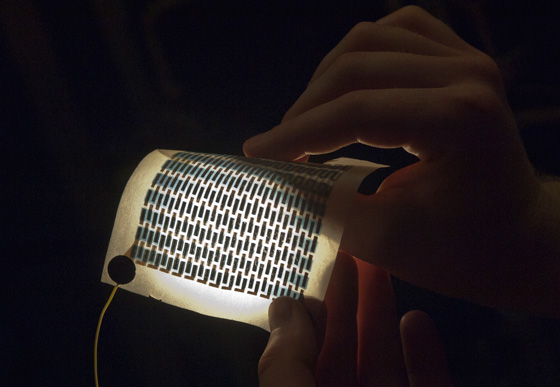
MIT professors Karen Gleason and Vladimir Bulovic, along with a team of students, have created a printed solar cell that can “print” solar cells onto paper or fabric, thereby allowing for foldable and rollable cells that do not lose their conductivity.
Building solar cells used to require high temperatures and precluded the use of paper and fabric. Now, however, sub-120 degree Celsius temperatures and vapor-based printing techniques mean that you could place the material on almost anything. Rather than having a substrate of glass or other material, this method allows for manufacturers to reduce materials costs and resource use. This also reduces installation costs as you could, feasibly, lay this on a flat surface like a roof and connect to the mains.
Sadly, these solar cells aren’t yet particularly efficient, topping out at about 1%. Plans are in the works to improve this technology considerably over the next few years.