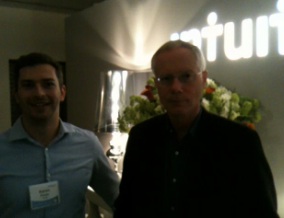
Last night I caught up with Intuit founder Scott Cook and Aaron Patzer, the founder of Mint who know runs Intuit’s personal finance group. I whipped out my iPhone and did an impromptu interview. Cook and Patzer talk about where growth is coming from at Intuit, how it tries to encourage entrepreneurism, and the “payment graph.”
Cook is really excited about SnapTax, the TurboTax iPhone app that lets people do their taxes by snapping a picture of their W-2 forms. The same OCR technology will soon be baked into the company’s upcoming GoPayment apps for accepting checks via photo. Patzer came into Intuit through the $170 million acquisition of Mint. Cook knows the value of injecting entrepreneurial DNA into the larger organization, and he tries to foster that spirit throughout Intuit.
Since Intuit bought Mint, it’s kept on growing from 1.7 million to 5.6 million users, and gradually it is being connected with hooks into Intuit’s more established products like TurboTax and Quicken. Off camera I asked why doesn’t QuickBooks offer a similar service to help businesses visualize and organize their expenses like Profitably does with QuickBook’s APIs, and Patzer agreed, “That is something that should be in QuickBooks.” (That is just his opinion, he doesn’t run QuickBooks).
In the video, Patzer imagines a Mint-like service which suggests deals on business services to QuickBooks users. Patzer goes beyond that and talks about the idea of a payment graph which tracks relationships between businesses and how much they are paying each other. Before the video, he told me: “People talk a lot about the social graph and interest graph. One third of the economy goes through QuickBooks in terms of businesses invoicing other businesses. Each invoice contains a connection between vendors, suppliers, and customers, and also the price of that connection. Representing the payment graph is huge opportunity and something no other company can do.” At it’s core that is a very interesting idea—to map out business relationships based on payments, with the strength of each tie determined by the flow of money either way. I wonder if it would look anything like social influence graphs that look at who retweets and @replies whom.
It is clear that Intuit is still extremely product focussed. I asked Cook what is more important to nail down first, the product or the business model. For Cook, product always comes first: “If you’ve got delighted customers, you can figure out downstream where the money is. If you don’t have delighted customers, stop. Don’t go there.”